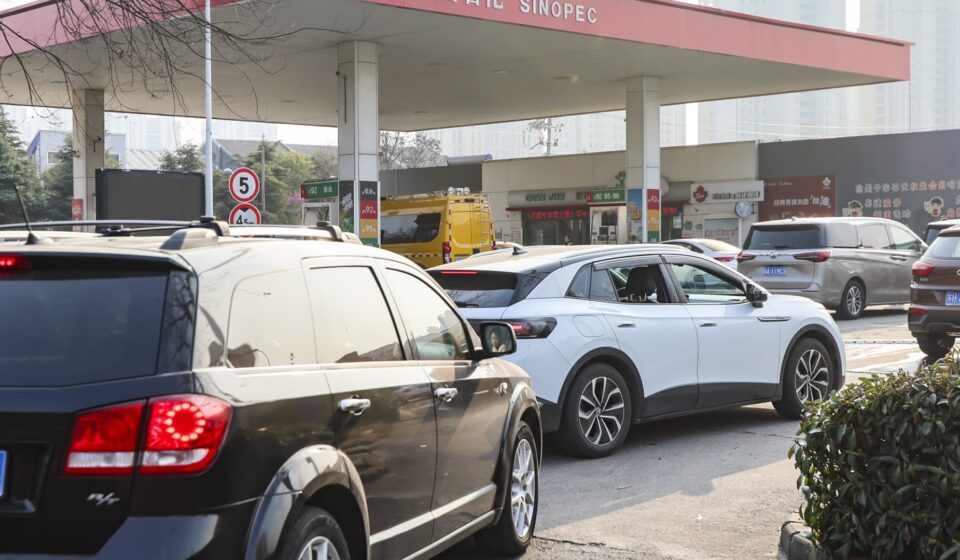

In Huaian, Jiangsu Province, vehicles lined up at petrol stations on March 9, 2026-a reflection of rising oil prices as geopolitical tensions shake global energy markets. For the first time in over three years, China’s factory-gate prices have seen an uptick, with the producer price index (PPI) increasing by 0.5% year-over-year. This marks the end of a prolonged deflationary period that began in 2022. However, despite this boost, the quarter’s PPI remains down 0.6% compared to the previous year.
Consumer inflation, on the other hand, is showing signs of moderation. March’s consumer prices rose by 1%, falling short of economist predictions of 1.2% growth and down from February’s 1.3% increase, according to the National Bureau of Statistics. The core consumer price index, which excludes food and energy costs, experienced a modest 1.1% rise in March compared to the previous year.
The ongoing conflict between the U.S. and Iran has severely impacted oil supply, especially following Tehran’s actions to restrict traffic through the vital Strait of Hormuz. As a result, global oil prices have surged-Brent crude now trading at $96.7 per barrel, reflecting a 33% increase since the conflict ignited on February 28. Meanwhile, U.S. WTI crude futures have risen to $98.5 per barrel, a staggering 47% rise from pre-war prices. As the world’s largest oil importer, China is bracing for potential inflationary pressures. However, its extensive strategic reserves and diverse energy portfolio offer some buffer against economic shocks.
Morgan Stanley’s chief China economist, Robin Xing, noted that “China fares better than its peers amid a sizable yet not extreme oil shock,” thanks to its energy flexibility and relatively low starting inflation. Xing forecasts a 1.2% rise in the PPI for 2026, with consumer inflation projected at 0.8%. Nonetheless, the bank has reduced its GDP growth outlook for China to 4.7% this year, assuming oil prices stabilize at around $110 per barrel. Should the Middle Eastern conflict escalate further, with oil surpassing $150 per barrel, real GDP growth could dwindle to 4.2%.
In response to soaring prices, China’s economic planning agency has approved significant increases in gasoline and diesel retail prices-420 yuan ($61.18) and 400 yuan per metric ton, respectively. These adjustments follow previous hikes last month and have resulted in gasoline prices soaring 11.1% from February, adding to an annual increase of 3.8%. As economists voice concerns about potential “bad inflation,” the rising costs could erode manufacturers’ profits, an already precarious situation.
While industrial profits surged earlier this year, driven by government initiatives to reduce overcapacity, the looming possibility of cost-push inflation poses a fresh challenge. The purchasing price index for raw materials and energy has outpaced the PPI, reflecting increasing concerns about manufacturing margins. Despite the uptick in CPI, it remains below the 2% level deemed acceptable by policymakers, leaving room for potential monetary easing.
The People’s Bank of China has indicated a cautious approach to monetary policy, reaffirming its stance for potential easing. Last month, it implemented only a modest 10-basis-point cut in its interest rate, indicating ongoing challenges in managing economic growth amid rising oil prices. Even with these pressures, yields on China’s 10-year government bonds held steady at 1.814%, signaling a tempered reaction to the oil market’s volatility.
As China’s economy navigates these turbulent waters, the interplay of domestic policies and external shocks will be critical in shaping its future trajectory.
Original Source: https://www.cnbc.com/2026/04/10/china-cpi-ppi-march-iran-oil-chock-consumer-inflation-manufacturing-.html
Category :
Tags:
Publish Date: 2026-04-10 08:39:00