Oil Prices Surge as Trump Vows to Hit Iran’s Power Plants: A Bold Move Towards Global Stability!

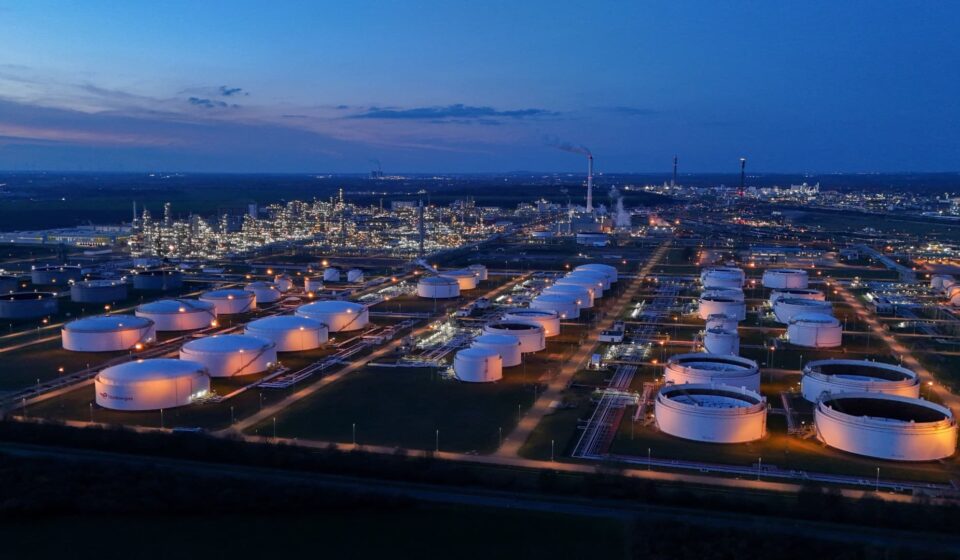
A recent aerial view of oil storage facilities at the TotalEnergies refinery in Leuna, Germany, captures a tense moment in global oil markets. As of March 17, 2026, oil prices are on the rise following U.S. President Donald Trump’s stark warning to Iran. He threatened to decisively attack the nation’s civil infrastructure if it fails to reopen the strategically vital Strait of Hormuz.
West Texas Intermediate (WTI) crude futures for May climbed over 2%, reaching $112.41 per barrel, while Brent crude for June delivery increased by approximately 1.3%, settling at $109.77 per barrel. Trump’s remarks reiterated a previous ultimatum: if Iran does not reopen the Strait of Hormuz by 8 p.m. ET tomorrow, the U.S. would target key Iranian assets, including power plants and bridges.
The ongoing closure of this critical maritime route has precipitated a supply shock that has driven up the prices of crude oil, jet fuel, diesel, and gasoline since the onset of conflict on February 28. “They have until tomorrow,” Trump emphasized, hinting that he perceives serious negotiations taking place between the U.S. and Iran. The president stated, “We’re getting the help of some incredible countries that want this to end, as it affects them too.”
According to Reuters, U.S. and Iranian officials are in talks to formulate a framework aimed at concluding their four-week conflict. Tehran has resisted Trump’s call for an immediate reopening of the Strait, instead proposing a 10-point plan that includes a complete cessation of hostilities in the region and lifting sanctions. However, analysts indicate that the likelihood of reaching a ceasefire agreement before the impending deadline appears slim. Trump acknowledged Iran’s proposal as “significant,” but asserted that it fell short of his expectations.
The uncertainty surrounding the negotiations keeps investors anxious, caught between anticipating a swift resolution or further military escalation. “There is no way to predict the outcome,” said Ed Yardeni, president of Yardeni Research. “We can’t rule out that Iran will cave in. Or, Trump may postpone the deadline again, claiming that negotiations are progressing. Or the war may escalate.”
Recent reports indicate a moderate uptick in shipping through the Strait of Hormuz, with eight tankers transiting on Monday, a notable increase from an average of fewer than two per day in March. Yet, this number pales in comparison to pre-war levels, which saw about 20 million barrels of crude and products moving through the strait daily in 2025. Michael Wan, a senior currency analyst at MUFG Research, noted that despite this marginal improvement in oil flows, the pathway to lasting peace seems “narrow and unlikely” due to the significant disparities among the involved parties’ expectations.
Experts assert that fully resuming shipping traffic through the Strait could require three to six months, given the challenges ahead. Energy markets are closely watching the developments, as any prolonged disruptions could lead to significant shortages in energy-dependent economies across Asia.
As the situation unfolds, investors remain vigilant, aware that the fog of war continues to cloud the horizon. The coming days may prove crucial in determining the trajectory of not only U.S.-Iran relations but also global oil prices.
Original Source: https://www.cnbc.com/2026/04/07/crude-oil-prices-today-iran-war-strait-hormuz-tuesday-deadline.html
Category :
Tags:
Publish Date: 2026-04-07 08:43:00