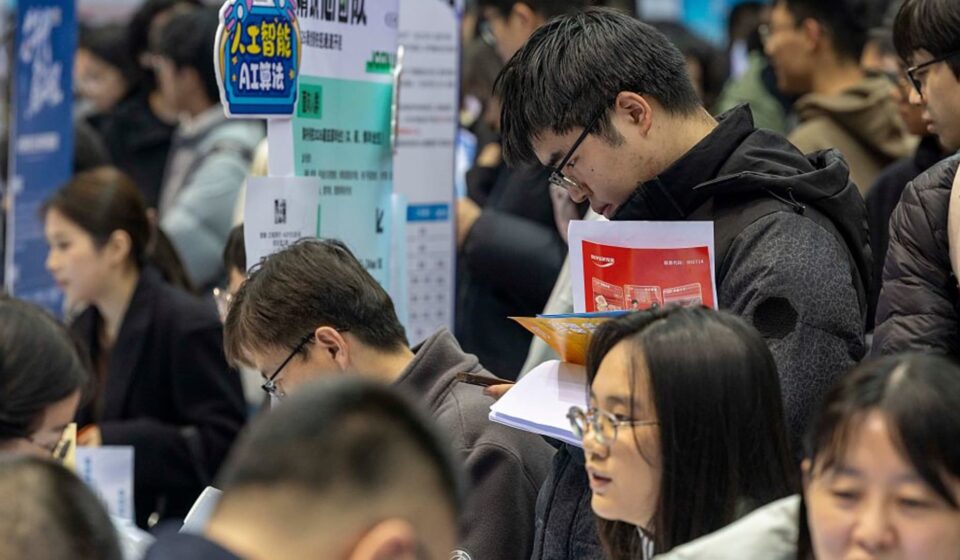

On March 24, 2026, college students in Harbin, China, flocked to the Large-scale Recruitment Fair for Science and Engineering Universities, eager to explore employment opportunities in a dynamic job market. This event highlighted the contrasting realities faced by job seekers amid significant changes in the technology sector.
As the U.S. tech industry, particularly Silicon Valley, braces for extensive layoffs, the situation in China appears more stable. Oracle’s recent layoffs underscore a broader trend, yet Alex Lu, founder of LSY Consulting, notes that China’s job landscape is protected from similar upheaval by government mandates, which aim to maintain an urban jobless rate of around 5.5%. Moreover, the comparatively lower labor costs in China result in fewer layoffs among local firms. According to Zhilian, a popular online job platform, the average salary for in-demand algorithm engineers in China stands at 20,035 yuan (approximately $2,900). While this is considered a decent beginning salary in China, it pales in comparison to the nearly $300,000 base salary offered to equivalent roles in the U.S., which often come with higher taxes and living expenses.
A human resources manager from Silicon Valley, who chose to remain anonymous, explained that the two markets are heavily competing for the same pool of talent. She pointed out that for many Chinese nationals working in the U.S., recent layoffs put their immigration status at risk, pushing them to consider returning to China. However, this transition can be challenging, as returning professionals may find China’s demanding work culture and long hours a stark contrast to their previous experiences.
While many U.S. companies embraced flexible work-from-home policies following the pandemic, Chinese businesses continue to emphasize in-office attendance. There’s a deep-rooted cultural preference among Chinese leaders for overseeing in-person teams. An engineer working in China is often expected to take on a broader array of tasks compared to their U.S. counterparts, thereby complicating the potential for AI to fully automate these roles, as noted by Tina Zhou, founder of the marketing startup Boomfluence.ai. Additionally, Chinese companies typically employ more staff in marketing and customer operations alongside engineering, further diversifying their workforce.
Despite these apparent advantages, AI-related layoffs have begun affecting Chinese firms as well. Alibaba, for instance, reported a headcount decrease of over 30% as part of a strategic pivot to prioritize AI advancements. Conversely, Tencent revealed a modest increase in its workforce in the past year, while Huawei confirmed a rise in its R&D personnel from 113,000 to 114,000.
The current business structures in China also help mitigate the immediate impact of AI. Lu emphasizes that Chinese companies are less digitalized than their U.S. counterparts. For example, OpenClaw, a popular productivity tool in China, is designed for individual rather than enterprise use, limiting its application within larger organizations.
The growing significance of AI remains a hot topic among parents in China who seek to prepare their children for future career success. Influencers like Zhang Xuefeng have been vocal about encouraging young learners, advising that children should become proficient in AI-related subjects as early as sixth grade. Meanwhile, policymakers are tasked with balancing support for technological innovation with the pressing issue of youth unemployment, which has hovered in the double digits despite an overall urban jobless rate around 5%.
As the landscape continues to evolve, industry leaders highlight the importance of ensuring AI innovations prioritize human needs. The implications for both local and international markets remain significant, as China seeks to carve out its role amid global technological advancements.
This evolving narrative reflects a complex interplay of employment opportunities, cultural expectations, and technological advancements that define the current job market in both America and China.
Original Source: https://www.cnbc.com/2026/04/07/ai-jobs-layoffs-us-china-engineers-hiring.html
Category :
Tags:
Publish Date: 2026-04-07 04:32:00