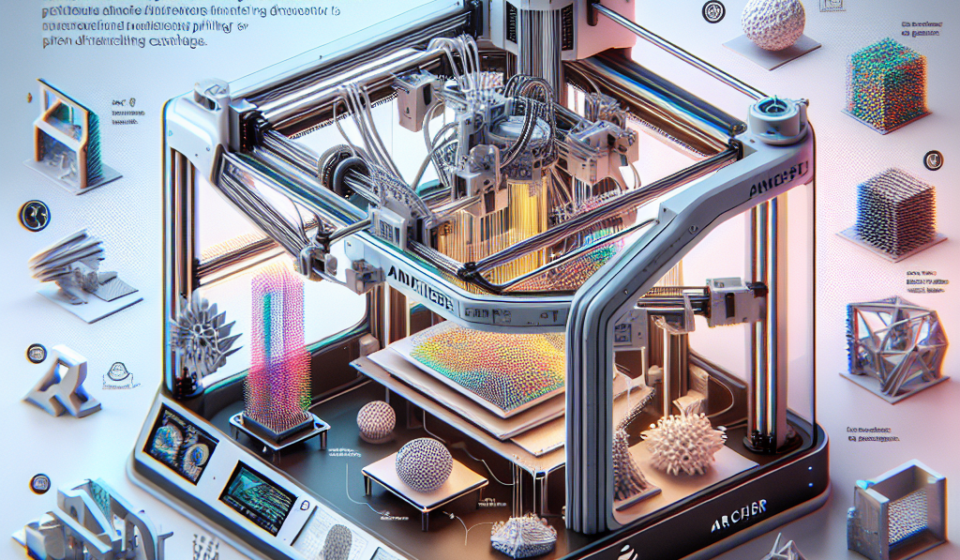

The Contrarian: We celebrate incremental improvements in 3D printing-faster motion systems, finer nozzles, cheaper materials-but we rarely interrogate the software and systems-level changes that turn clever prototypes into dependable manufacturing tools. A recent non‑planar, five‑axis printing project highlights why the future of additive manufacturing will be decided as much by slicers and workflow engineering as by hardware novelties.
The Signal
I recently came across a project-an Archer five‑axis printer-that combines a CoreXY motion system, automatic four‑hotend toolchanging, and a print bed mounted on three independently adjustable ball‑joint rails to enable non‑planar printing. Its creator is also developing a dedicated slicer (MaxiSlicer) and firmware strategies (purge optimization) to keep multi‑tool multi‑material waste to a minimum-an 830‑tool‑change, three‑colour double helix reportedly used as little as six grams of purge waste.
Why this matters for enterprise architecture and product strategy
This is a textbook example of a systems problem: advancing capability at the hardware layer exposes gaps at the software, process, and operational layers. Non‑planar and multi‑tool printing are not incremental hardware upgrades; they change the rules for slicing, thermal management, toolpath planning, and QA. In enterprise settings-whether an industrial R&D lab, a small manufacturer, or a government prototyping hub-these are the trade surfaces where project success or failure is decided.
Key trade-offs and implications:
– Capability vs. Complexity: Non‑planar kinematics expand the design space (better surface finish, fewer support structures, true multi‑material gradients), but they also multiply failure modes. Every additional axis and hotend increases the need for deterministic firmware, robust calibration, and real‑time diagnostics.
– Build vs. Buy (or Build and Partner): The hardware is impressive, but its commercial value depends on reliable software. Off‑the‑shelf slicers are not yet optimized for true five‑axis, multi‑tool workflows; teams must either invest in bespoke slicers or partner with specialist vendors. That decision shapes both time‑to‑market and technical debt.
– Throughput vs. Waste: The project’s purge optimization highlights a recurring systems challenge-thermal accumulation and stringing when hotends idle. You can brute‑force purge more material (simple but costly), or invest in smarter firmware and tool docking strategies (engineering up‑front, lower recurring costs). The latter aligns with long‑term TCO discipline.
Actionable advice for CTOs, Founders and Heads of Innovation
– Treat software as the product. Early-stage hardware research should budget at least 30–40% of effort to slicing, firmware, and tooling integration. Without it, the hardware becomes an academic demo, not a producible product.
– Modularize diagnostics. Add sensors and health endpoints (temperature, motor current, endstop states) to make field calibration and remote troubleshooting feasible-this reduces maintenance cost and accelerates enterprise adoption.
– Pilot with real production use‑cases. Run a 3–6 month pilot where non‑planar printing replaces or augments a current manufacturing step (e.g., surface finishing, assembly consolidation, small‑batch customization). Measure not just print fidelity but cycle time, scrap rate, and operator skill requirements.
– Consider standards and interoperability. Push for open slicer APIs and standardized tool‑change protocols; these are the primitives that let ecosystems form rather than locking customers into proprietary islands.
A pragmatic Bharat connection
For India’s MSMEs and regional innovation hubs-including Fab labs in the Northeast-this technology is more than novelty. Non‑planar printing can reduce assembly steps and material usage for specialised parts (medical aids, customized jigs, small run fixtures). But the adoption pathway must be pragmatic: shared facilities and service bureaus are the right model for de‑risking investment while building local capability. Training in slicer configuration and firmware calibration will be as important as CNC practice.
Takeaways
– Hardware advances require commensurate investment in software, diagnostics, and operational processes.
– Early focus on purge/thermal strategies and tool docking pays recurring dividends in waste reduction and quality.
– Pilot, measure, and modularize before committing to wide deployment-especially for small manufacturers.
– For regional ecosystems, shared infrastructure and skills development will enable equitable access to advanced additive capabilities.
Closing thought
True industrial adoption happens not when an innovation looks impressive on video, but when it’s predictable, maintainable, and economical at scale. The next wave of additive manufacturing winners will be those who master the invisible layers-the slicers, the firmware, and the operational playbooks-not just the mechanical novelty.
About the Author
Sanjeev Sarma is the Founder Director of Webx Technologies Private Limited, a leading Technology Consulting firm with over two decades of experience. A seasoned technology strategist and Chief Software Architect, he specializes in Enterprise Software Architecture, Cloud-Native Applications, AI-Driven Platforms, and Mobile-First Solutions. Recognized as a “Technology Hero” by Microsoft for his pioneering work in e-Governance, Sanjeev actively advises state and central technology committees, including the Advisory Board for Software Technology Parks of India (STPI) across multiple Northeast Indian states. He is also the Managing Editor for Mahabahu.com, an international journal. Passionate about fostering innovation, he actively mentors aspiring entrepreneurs and leads transformative digital solutions for enterprises and government sectors from his base in Northeast India.