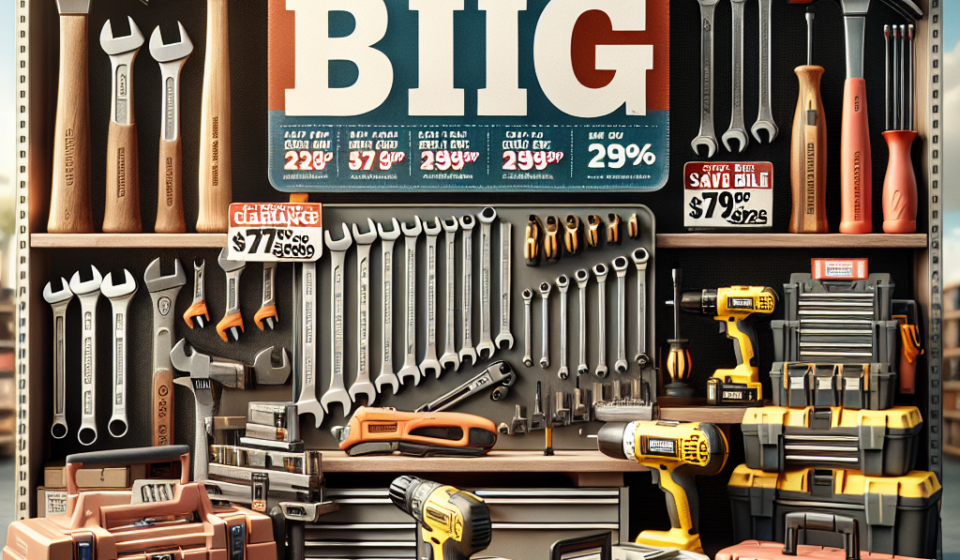

We celebrate a good sale because it feels like a smart win – but behind every “50% off” is a set of strategic choices that reveal how modern retail, trust, and access to tools are reshaping ecosystems. A Harbor Freight promotion (Inside Track Club, $29.99/year, with hundreds of discounted items through April 2, 2026) is more than a consumer opportunity; it’s a compact case study in commoditization, membership economics, and the democratization of capability.
The signal in the noise: a major U.S. tool retailer is using a low-cost membership model to drive lifetime value, clear inventory, and surface mid-range hardware (service carts, floor jacks, workbenches, protective cases) that trades off brand prestige for accessibility and volume. Product ratings, inexpensive shipping, and modular offerings (from screwdrivers to rolling workbenches) complete the value proposition.
What this means for technology and enterprise leaders
– Commoditization of infrastructure is not limited to software. Physical tools and hardware are following the same pattern software did a decade ago: rising parity, falling cost, and a decisive role for platform/marketplace mechanics (membership, reviews, financing). For architects and procurement leads, that should trigger the same questions we ask of software: where do we standardize, where do we differentiate, and when does buying scale better than building?
– Membership-as-lock-in. A small annual fee ($29.99) that unlocks repeated discounts changes buyer behaviour more than a one-time coupon. For enterprises, subscription models from vendors (support bundles, preferred-customer pricing, platform credits) create soft switching costs. Factor this into vendor selection – not only price today but the friction of moving later.
– Trust signals matter more than ever. With many low-cost options, buyer reviews, ratings, and demonstrated reliability become the effective “API” for trust. Enterprise procurement should codify these signals: minimum review counts, failure-rate thresholds, and warranty/return SLAs before approving a SKU for repeat purchase.
– Total cost over sticker price. A $20 screwdriver set may be an excellent buy for a household, but for a workshop or an MSME the calculus must include durability, warranty, safety certification, and downtime cost when a tool fails. Treat physical tool purchases like platform buys: assess TCO, replacement cadence, and serviceability.
Actionable guidance – what CTOs, Founders and Facility Heads should do now
1. Turn procurement into architecture: create approved supplier lists with measurable KPIs (defect rates, warranty turnaround, average unit life) rather than buying ad-hoc on price alone.
2. Use membership/deal cycles strategically: centralize bulk buys around promotional periods to reduce per-unit CAPEX and capture favourable SLAs.
3. Standardize and share: for campuses, factories, or co-working spaces, invest in communal tool libraries (a “makerspace” or shared tooling pool) to increase utilization and reduce per-user cost.
4. Measure downstream effects: track incidents, maintenance windows, and replacement spend so discount-driven procurement doesn’t create hidden operational debt.
5. Insist on safety & compliance: for tools used in regulated environments, require certifications and third-party testing as non-negotiable procurement gates.
A note for India – especially Northeast innovators
Affordable, reliable tools are the hardware counterpart of cheap cloud compute for software startups. In regions like the Northeast, where maker spaces, vocational training centres, and MSMEs are expanding, access to cost-effective, quality tools accelerates skill formation and the repair economy. Subsidized or shared procurement strategies – driven by cooperatives, municipal labs, or industry bodies – can multiply the impact of seasonal deals and reduce entry barriers for young entrepreneurs.
Closing thought
Discounts make headlines; design and discipline create durable advantage. Whether the asset is code or a rolling workbench, our job as architects and leaders is to see past the sticker to the lifecycle, the network effects, and the operational cost that follow every purchase.
About the Author
Sanjeev Sarma is the Founder Director of Webx Technologies Private Limited, a leading Technology Consulting firm with over two decades of experience. A seasoned technology strategist and Chief Software Architect, he specializes in Enterprise Software Architecture, Cloud-Native Applications, AI-Driven Platforms, and Mobile-First Solutions. Recognized as a “Technology Hero” by Microsoft for his pioneering work in e-Governance, Sanjeev actively advises state and central technology committees, including the Advisory Board for Software Technology Parks of India (STPI) across multiple Northeast Indian states. He is also the Managing Editor for Mahabahu.com, an international journal. Passionate about fostering innovation, he actively mentors aspiring entrepreneurs and leads transformative digital solutions for enterprises and government sectors from his base in Northeast India.