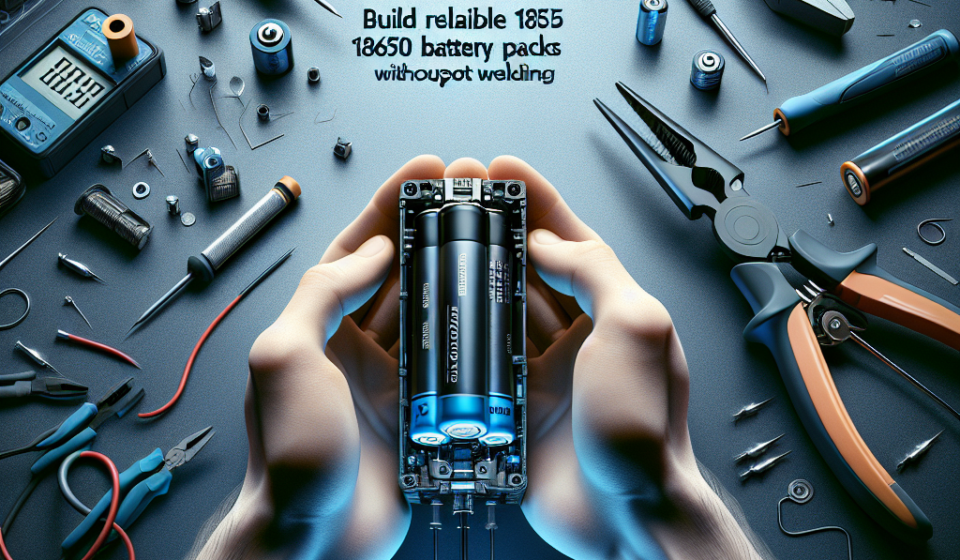

We often fetishize elegant manufacturing-laser-welded seams, glinting stamped tabs, immaculate assembly lines-while overlooking the friction that keeps small teams and local innovators out of hardware work. A design that trades spot welders and nickel strip for screwdriver-driven cams is precisely the kind of friction-reduction that can democratize battery assembly, but it also forces a set of hard engineering and regulatory questions that every product leader must take seriously.
Context
I recently came across a modular 18650 battery assembly concept (Cell‑Lock) that replaces spot-welding with interlocking end caps and cam-style electrical contacts. The idea is compelling: rapid, tool-light mechanical assembly and reconfiguration, demonstrated up to e‑bike packs – but with open concerns about contact reliability, current capacity, and thermal behavior.
Analysis – what this means for product and platform leaders
At first glance this is an exercise in elegant constraints: remove heat, simplify tooling, and enable field serviceability. Those are valid strategic goals for founders, CTOs, and civic innovators. But from a chief‑architect perspective the transition from prototype to deployed product uncovers several engineering trade‑offs:
– Electrical contact vs. weld: A weld or brazed joint gives a predictable low-resistance, high-current path. Mechanical cams depend on contact area, surface finish, and consistent torque. Contact resistance can vary with vibration, corrosion, and temperature, which means power loss and localized heating – precisely what you do not want in a battery pack.
– Thermal and safety envelope: Batteries fail thermally along non-linear paths. Even a small high‑resistance contact can create a hotspot that leads to thermal runaway. Any modular system must be designed with redundant safety: per‑cell sensing, robust cell-level fusing, and clear thermal pathways to avoid insulated hotspots.
– Manufacturing repeatability and verification: The benefit of the modular approach is quick iteration and repairability, but at scale you must prove repeatability. That requires test fixtures, torque-controlled assembly, environmental cycling, and accelerated life testing to map failure modes.
– Build vs. buy and scaling path: For early-stage products and local repair networks, modular assemblies make sense – they reduce CAPEX and enable field swapping. For high-current consumer EVs or fleet vehicles, there’s still a strong case to migrate to welded or bonded submodules where contact integrity is necessary for long-term reliability.
Actionable recommendations for CTOs and founders
– Treat the mechanical contact as a first-class electrical component: specify contact material, surface plating, mating force, and test for milliohm stability over vibration and humidity cycles.
– Design for instrumentation from day one: include thermistors and cell‑level voltage sensing accessible to your BMS. Use them during prototype runs to collect failure data.
– Layer safety: mechanical retention, cell-level fuses, thermal cutouts, and a BMS with fast disconnect capability. Don’t assume the mechanical lock will prevent electrical faults.
– Plan a staged manufacturing roadmap: prototype with modular cams for R&D and local assembly; validate at scale and be prepared to re‑engineer to welded submodules if analytics show unacceptable contact loss or heating.
– Engage certification early: safety and compliance testing (shock, vibration, thermal) will shape design choices more than aesthetic arguments.
The India/Northeast relevance – practical frugal innovation
This “no-spot-welder” approach has genuine value in markets where capital for specialized tooling is limited and repairability is a competitive advantage. For last-mile electrification and informal e‑vehicle repair ecosystems across India – including the Northeast – a modular pack that enables safe, local cell replacement and pack reconfiguration could lower barriers to service and extend assets’ lifetimes. But the same opportunity demands adherence to national safety and certification regimes; local assembly must be matched with training, testing rigs, and clear instructions to avoid creating safety liabilities.
Takeaways
– Modularity reduces entry barriers but increases the importance of instrumentation and safety architecture.
– Expect to trade field serviceability for electrical performance unless you validate contacts with rigorous testing.
– Use modular designs as an iteration vehicle, not necessarily the final high-volume solution.
– For India, modular packs can enable distributed assembly and repair – provided they are coupled with certification, training, and lifecycle management.
Closing thought
Modularity in hardware can replicate the rapid iteration benefits we enjoy in software – but only if we couple the lowered assembly friction with disciplined measurement, safety engineering, and a clear pathway to industrial-grade reliability.
About the Author Sanjeev Sarma is the Founder Director of Webx Technologies Private Limited, a leading Technology Consulting firm with over two decades of experience. A seasoned technology strategist and Chief Software Architect, he specializes in Enterprise Software Architecture, Cloud-Native Applications, AI-Driven Platforms, and Mobile-First Solutions. Recognized as a “Technology Hero” by Microsoft for his pioneering work in e-Governance, Sanjeev actively advises state and central technology committees, including the Advisory Board for Software Technology Parks of India (STPI) across multiple Northeast Indian states. He is also the Managing Editor for Mahabahu.com, an international journal. Passionate about fostering innovation, he actively mentors aspiring entrepreneurs and leads transformative digital solutions for enterprises and government sectors from his base in Northeast India.