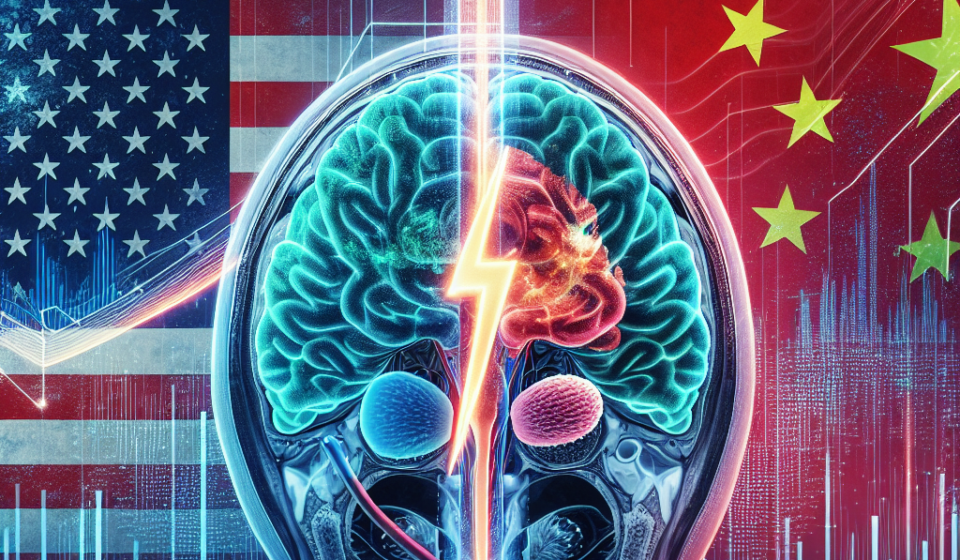

We tend to treat brain–computer interfaces as a binary choice: invasive implants or sci‑fi headsets. The real strategic shift happening now is neither purely surgical nor purely speculative – it’s about tradeoffs between access, safety, and scale. Non‑invasive ultrasound BCIs are quietly reframing those tradeoffs, and that matters to technologists, healthcare leaders, and policy makers alike.
Context
A recent report highlighted a fast‑moving Chinese startup that has raised significant early funding to develop non‑invasive, phased‑array ultrasound BCIs while a separate local team focuses on implantable systems. The story is notable not only for capital but for an explicit strategy: leverage manufacturing scale and hospital partnerships to accelerate R&D and build large clinical datasets for AI.
Analysis – what this means for architecture, strategy and governance
1) Technology tradeoffs: Ultrasound BCI promises whole‑brain reach and stimulation without craniotomy, shifting the calculus from “can we reach neural tissue?” to “how reliably and safely can we modulate it at scale?” For enterprise architects and CTOs, that means designing systems where hardware, firmware, cloud analytics and clinical workflows are co‑designed rather than bolted together. Speed without rigorous validation invites long‑term liability and clinical risk.
2) Data becomes the competitive moat – and a regulatory headache: The plan to create an “Ultrasound Brain Bank” is strategically sensible from an AI point of view: large, labeled neural datasets accelerate decoding models. But neural data is uniquely sensitive. Any organisation building such repositories must treat them as critical national assets, with privacy, consent, provenance and bias assessment baked into the ingestion pipeline. From an engineering perspective, expect requirements for federated learning, differential privacy, and auditable model lineage to become default design constraints.
3) Manufacturing and supply‑chain advantage: Leveraging integrated manufacturing to iterate hardware quickly shortens time‑to‑prototype, but also concentrates risk – a faulty batch or compromised firmware can cause harm at scale. For product leaders this raises the familiar “speed vs stability” trade: compress development cycles only where you have end‑to‑end traceability, signed firmware, secure boot, and reproducible quality assurance.
4) Security is not optional: BCIs will sit at the intersection of medical devices and critical systems. Threat models must include device tampering, model theft, data exfiltration and adversarial manipulation of stimulation signals. A Zero Trust posture, hardware root of trust, secure OTA processes, and rigorous third‑party component audits are governance essentials.
5) Build vs Buy – a clearer framing: For hospitals and large enterprises, the decision isn’t simply to buy a device. It’s whether to join an ecosystem: contribute clinical data, integrate with EMRs, and accept vendor‑managed models. Smaller healthcare providers should prioritize modular integration, open APIs, and contractual rights to audit models and datasets before committing.
Bharat connection – where India fits in
This is a genuine opening for India. We have deep clinical patient pools, growing medical device manufacturing, and an active research community. India can attract responsible neurotech R&D by insisting on strong ethical frameworks, locally governed datasets, and “make in India” manufacturing standards for medical hardware. State and central technology committees should begin drafting regulatory guardrails specific to neurodevices – covering clinical trial standards, cross‑border data flows, and consent models – so innovation does not outpace patient safety.
Practical takeaways for CTOs and founders
– Treat neural datasets as the product: design for consent, provenance, and federated analytics from day one.
– Invest in secure hardware roots of trust, signed firmware and auditable supply chains.
– Engage regulators early; clinical validation pathways will define commercial viability.
– Consider partnership models with large hospitals for low‑cost, high‑quality trials rather than trying to run everything in‑house.
– Prepare for ethical audits and independent safety reviews as a market differentiator.
Closing thought
We are at the point where neurological reach is moving from the lab into real healthcare decisions. Speed matters – but without a deliberate architecture for safety, privacy and trust, rapid progress will be brittle. Thoughtful engineering, rigorous governance, and international collaboration will determine whether these technologies heal at scale or create new systemic risks.
About the Author Sanjeev Sarma is the Founder Director of Webx Technologies Private Limited, a leading Technology Consulting firm with over two decades of experience. A seasoned technology strategist and Chief Software Architect, he specializes in Enterprise Software Architecture, Cloud-Native Applications, AI-Driven Platforms, and Mobile-First Solutions. Recognized as a “Technology Hero” by Microsoft for his pioneering work in e-Governance, Sanjeev actively advises state and central technology committees, including the Advisory Board for Software Technology Parks of India (STPI) across multiple Northeast Indian states. He is also the Managing Editor for Mahabahu.com, an international journal. Passionate about fostering innovation, he actively mentors aspiring entrepreneurs and leads transformative digital solutions for enterprises and government sectors from his base in Northeast India.