Breaking News: UAE Celebrates Safety as ‘Missile Threat’ Alert Lifted; Qatar Issues Urgent Advisory for Citizens

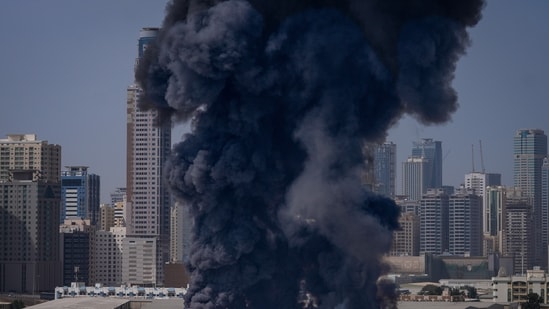
A black plume of smoke has been spotted rising from a warehouse in Sharjah City after Iranian strikes targeted various locations in the United Arab Emirates (UAE). In response to these escalating attacks, the UAE has lifted its previous safety alert and stated that the situation is currently safe, while Qatar has urged its citizens to adhere to government instructions. On Saturday, Dubai’s main airport, one of the world’s busiest for international traffic, temporarily shut down after authorities intercepted an unidentified object nearby.
Recent Iranian assaults have hit significant sites, including Abu Dhabi Airport, the luxurious Palm Jumeirah, and the iconic Burj Al Arab hotel. On Tuesday, debris from a drone strike ignited a fire at the U.S. consulate in Dubai. UAE President Mohammed bin Zayed issued a stern warning to the nation’s adversaries: “Do not mistake our prosperity for weakness,” he said during a visit to a hospital treating victims injured by an Iranian projectile, asserting that the UAE is “no easy prey.”
On Saturday, Qatar’s defense ministry reported that Iran fired around a dozen missiles, six of which were intercepted. Some missiles fell into territorial waters, while others landed in uninhabited areas. Saudi Arabia confirmed it had thwarted a drone attack targeting the diplomatic quarter in Riyadh, and Kuwait’s military reported responding to several hostile drone incursions. Meanwhile, Iranian President Masoud Pezeshkian publicly apologized to neighboring countries, stating they would be spared attacks unless strikes originated from their territories.
The conflict escalated over the weekend, affecting not just the UAE but also Saudi Arabia, Qatar, and Kuwait, where precautionary oil production cuts have been announced. Iranian missiles and drones continue to pose threats across the Gulf region, marking a dangerous escalation of hostilities. The U.S. embassy in Kuwait and the U.S. consulate in Dubai were both potentially hit, along with other vital infrastructure.
As tensions rise, the Gulf Cooperation Council condemned Iran’s actions, labeling them as “dangerous acts of aggression” that compromise regional security. The Council’s Secretary General emphasized that targeting civilian infrastructure represents a violation of international norms.
In related developments, an Iranian drone attack on a desalination plant in Bahrain resulted in material damage, marking a significant escalation in targeting essential infrastructure. This incident underscores the reliance of Gulf nations on such facilities for drinking water.
As the situation progresses, the region sees increased military readiness, with air defense systems in both the UAE and Kuwait actively intercepting incoming threats. Amid this turmoil, various airline operations are affected, including limited flights from Qatar Airways and cancellations by Oman Air, emphasizing the airspace’s precarious status.
Furthermore, the UAE has confirmed four fatalities and numerous injuries linked to the Iranian strike, including the death of a Pakistani national due to falling debris in Dubai. As residents received missile threat alerts, authorities advised caution, emphasizing the need to remain safe.
In this volatile environment, the intricate web of military and diplomatic responses continues to unfold, impacting civilians, infrastructure, and regional stability. As developments emerge, the Gulf remains on high alert in anticipation of further aggression and retaliatory measures.
The escalating crisis poses a crucial challenge for regional diplomacy, highlighting the urgent need for a comprehensive dialogue to prevent further violence and instability in the Gulf region.
Original Source: https://www.hindustantimes.com/world-news/dubai-news-live-updates-abu-dhabi-uae-qatar-kuwait-middle-east-us-israel-iran-war-flights-airports-strikes-latest-news-101772934213577.html
Category :
Tags:
Publish Date: 2026-03-08 15:07:00