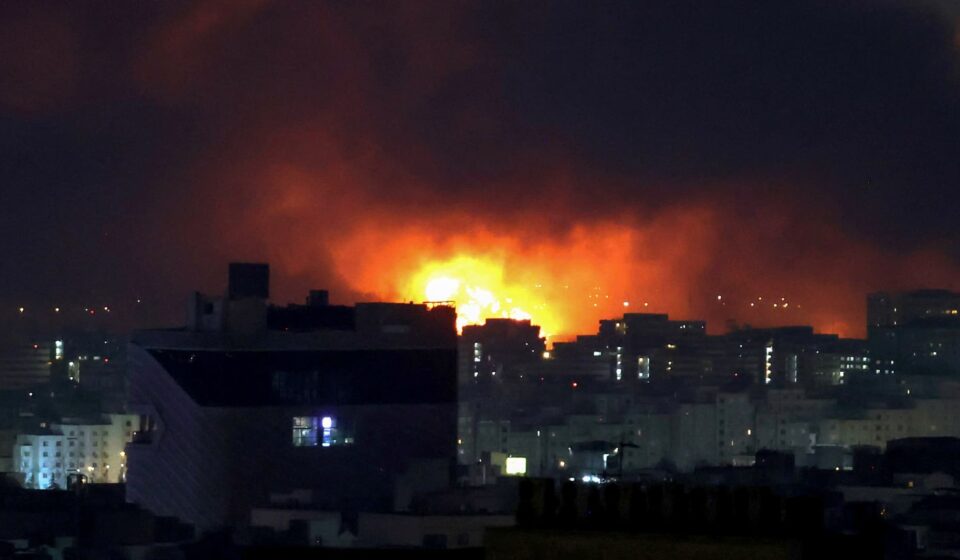

Smoke and fire billow from Mehrabad International Airport in Tehran following a series of airstrikes on March 7, 2026, as tensions escalate in the region. Iran’s president has publicly reassured neighboring Gulf states that the country does not intend to initiate further conflict, even as the U.S. and Israel have increased military operations targeting Tehran’s nuclear and missile capabilities. In a statement relayed through Iran’s national news agency on Telegram, Masoud Pezeshkian expressed remorse to the Gulf neighbors, emphasizing, “We do not intend to invade other countries. Let us defend our soil to bring Iran out of this crisis with dignity.”
The military actions by the U.S. and Israel have intensified, following the launch of “Operation Epic Fury.” This joint campaign aims to dismantle Iran’s military infrastructure and has reportedly seen U.S. forces strike over 3,000 targets within its first week. Concerns mount as President Donald Trump calls for Iran’s “unconditional surrender,” inciting fears of prolonged conflict that could destabilize global oil markets. Traffic in the crucial Strait of Hormuz, a vital artery for energy supplies, has already reached near standstill.
As Iranian missiles and drones continue to be intercepted, local Gulf states are ramping up defensive measures. Saudi Arabia’s Ministry of Defense announced the successful interception of a drone near Riyadh. The United Arab Emirates also reported activating their air defenses in response to threats from Iran, assuring residents that unusual sounds were due to the interception of incoming missiles and drones. In light of these developments, Dubai issued alerts for residents to seek secure shelter as airline Emirates temporarily suspended flights to the city.
The escalating conflict is having significant ramifications on global oil prices, with U.S. crude experiencing its largest weekly increase since futures trading began in 1983, soaring up by 35.63%. Brent crude also spiked approximately 28% in its biggest weekly surge since April 2020, signaling potential supply disruptions amidst ongoing hostilities.
The Israel Defense Forces confirmed the completion of a new wave of airstrikes on Tehran, involving around 80 fighter jets. Targets included key military sites such as the Central Military University of the Islamic Revolutionary Guard Corps and missile storage facilities. The IDF stated, “These strikes degrade the Iranian regime’s ability to fire at Israeli civilians.”
Amid the rising threat, countries in the region remain on high alert, deploying air defenses to mitigate Iranian attacks. While President Pezeshkian seeks to ease regional tensions, the rhetoric from both Iranian and American leaders suggests that the path toward de-escalation may be fraught with challenges.
The situation remains fluid as military operations continue, leaving the Gulf states and the global community watching closely for further developments that could significantly alter the geopolitical landscape in the Middle East. As hostilities persist, the region grapples with the potential fallout that could extend beyond its borders, affecting international relations, security, and the global economy.
Original Source: https://www.cnbc.com/2026/03/07/not-slowing-down-one-week-on-us-israeli-strikes-on-iran-continue.html
Category :
Tags:
Publish Date: 2026-03-07 14:44:00