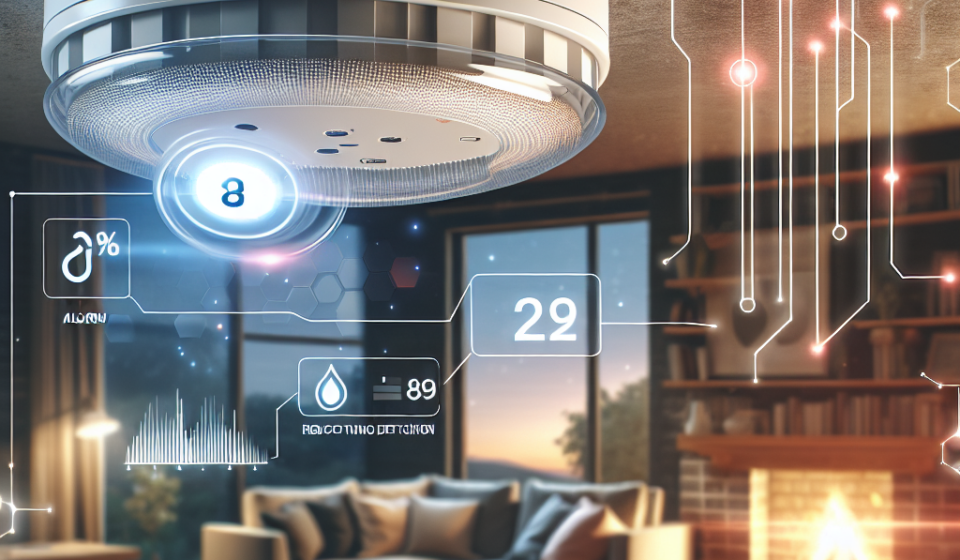

We celebrate the “smart” in our homes – voice control, presence sensing, energy dashboards – yet we still rely on basic, stove-side logic to keep our families safe. That disconnect is not just an inconvenience: it’s an architectural failure of the smart-home stack.
Context
A recent product review surfaced a simple but telling problem: there are plenty of smart smoke detectors, but far fewer practical smart heat alarms and very little real-world support for mixed systems that combine smoke, heat and CO detection while providing reliable, interoperable alerts. Where systems exist, software quality, lifecycle support and cross-vendor integration are often weak.
Why this matters (the strategic lens)
Safety devices are different from convenience devices. They are latency-sensitive, require deterministic behaviour, and must work when connectivity or cloud services fail. Treating them like another IoT toy – cloud-first, siloed, and closed – creates operational risk and long-term technical debt.
Three architectural themes follow.
1) Interoperability over feature novelty
Fragmented ecosystems force consumers to choose vendor lock-in or compromise on safety coverage. The industry needs composable approaches: standard protocols for local signalling (radio mesh, secure BLE/Thread), a common data model for event types (smoke, heat, rate-of-rise, CO), and a migration path for legacy wired systems. Matter and other efforts are a start, but product teams must design for graceful degradation and cross-vendor integration from day one. For CTOs and founders, that means making “played well with others” a product requirement, not an afterthought.
2) Fail-safe, offline-first design
A smoke alarm that only notifies you via the cloud is not a smoke alarm – it’s a notification appliance. Safety systems must have robust local logic: alarms that interlink locally so a sensor’s activation triggers housewide sirens even with no internet; local logging for post-event forensics; and secure OTA only where it improves resilience. Architectures should therefore be hybrid: local deterministic controllers + optional cloud for analytics, alerts and long-term telemetry. From a security standpoint, that also narrows the attack surface – keep the life-safety loop isolated from the broader smart-home network and enforce strong device identity and secure boot.
3) Software quality and lifecycle economics
Hardware often lasts a decade while apps and cloud services evolve much faster. The result is devices orphaned by poor apps, buggy cloud integrations, or deprecated backends. Product leaders must budget for a 7–10 year maintenance window for life-safety products: guaranteed firmware updates, replaceability policies, and data portability for users switching platforms. For enterprise buyers and smart-home integrators, insist on SLAs around security patches and an explicit end-of-life policy.
A practical Bharat/Northeast perspective
The same problems are magnified in geographies with intermittent connectivity or fragmented supply chains. In many parts of India (including the Northeast), an offline-first safety design isn’t just a nice-to-have; it’s mandatory. Local manufacturing and open standards can reduce costs and improve repairability – a pathway worth exploring for Indian startups aiming at both domestic and export markets.
Actionable takeaways
– Treat life-safety as a system: require local interlinking, deterministic alarms, and cloud as an adjunct.
– Make interoperability a first-class product requirement: support open protocols and expose clean APIs.
– Plan for long-term maintenance: 7–10 year firmware and security support must be part of the product economics.
– Segment the network: isolate life-safety traffic and enforce device identity and secure boot.
– Consider localization: design for low-connectivity environments and repairability if you plan to serve diverse markets.
Closing thought
We should applaud the smart-home revolution – but not at the cost of replacing proven safety practice with brittle convenience. The smarter path is to design systems where intelligence amplifies safety, not replaces it.
About the Author Sanjeev Sarma is the Founder Director of Webx Technologies Private Limited, a leading Technology Consulting firm with over two decades of experience. A seasoned technology strategist and Chief Software Architect, he specializes in Enterprise Software Architecture, Cloud-Native Applications, AI-Driven Platforms, and Mobile-First Solutions. Recognized as a “Technology Hero” by Microsoft for his pioneering work in e-Governance, Sanjeev actively advises state and central technology committees, including the Advisory Board for Software Technology Parks of India (STPI) across multiple Northeast Indian states. He is also the Managing Editor for Mahabahu.com, an international journal. Passionate about fostering innovation, he actively mentors aspiring entrepreneurs and leads transformative digital solutions for enterprises and government sectors from his base in Northeast India.