
We obsess about clouds, containers and generative AI – and then wonder why our core banking change projects stall for years. The missing perspective is simple: modernization is less about replacing every legacy box tomorrow and more about making legacy systems speak in events that modern platforms can consume, react to, and learn from.
Context
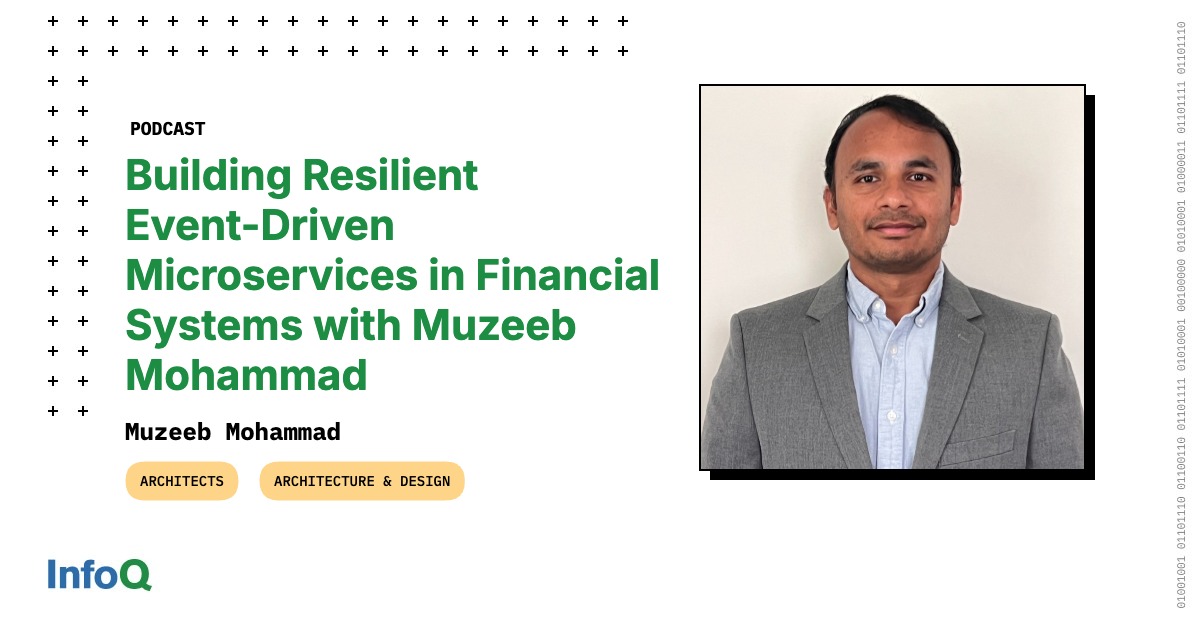
I recently listened to an InfoQ podcast conversation with Muzeeb Mohammad that highlighted a practical path: use event streaming (Kafka), lightweight adapters (MQ/CDC), and observability to incrementally migrate mainframe-driven financial workflows. The result: decoupled teams, faster time-to-market, and new capabilities such as replayable event histories and AI-assisted anomaly detection.
What this really means for enterprise architects
1) Event-streaming is a migration pattern, not a silver bullet.
– Treat events as the contract that defines business intent (“checking account created”) rather than implementation detail (“a COBOL routine wrote a record”). This lets you apply the strangler-fig pattern safely: expose a system-of-reference while preserving the mainframe as the system-of-record until you’re ready to flip the switch.
2) Hybrid adapters are pragmatic: MQ + CDC + Kafka
– Many successful programs don’t rip out mainframes; they publish changes from the legacy store (CDC) or emit messages from the transaction layer (MQ), then translate those into Kafka topics consumed by new microservices. This preserves transactional guarantees where needed and gives downstream systems an event-driven surface.
3) Observability and identity are non-negotiable
– A TraceID that follows a transaction from UI to COBOL to cloud is as important as any schema. Without distributed tracing, reconciliation and incident response become expensive. Invest early in tracing, structured logs, spans and a reconciliation pipeline that surfaces inconsistencies between system-of-record and system-of-reference.
4) Platform teams must own non-functional cross-cutting concerns
– Security-as-code (environment-as-code via Terraform), API governance (OAuth/service-to-service auth), CI/CD pipelines, and policy enforcement should be platform-provided features, not every team’s side project. That reduces drift and speeds safe deployments.
5) Expect eventual consistency and design for it
– Asynchronous designs trade immediate consistency for resilience and parallelism. Model compensating actions, user-facing progress states, and idempotent consumers. Reconciliation jobs using CDC are essential to building confidence before promoting a distributed system to be the system-of-record.
AI and risk-aware adoption
– Use AI initially for low-risk value: observability-driven anomaly detection and event correlation for SRE are high ROI and controlled entry points. For business-critical AI (fraud, credit decisions) plan for explainability, human-in-the-loop, bias testing and regulatory compliance; treat these as product programs, not experiments.
A practical Bharat lens
– From my work advising state and central technology bodies, the same patterns apply in Indian contexts: public sector and older private banks often run COBOL cores and benefit from event-first modernization. In regions with intermittent connectivity – common in parts of Northeast India – event-driven and idempotent designs actually help build resilient user flows and offline-capable services that synchronize reliably when connectivity resumes.
Actionable checklist for CTOs and Founders
– Start with a high-value, bounded domain (e.g., new-account onboarding) and prove eventing end-to-end.
– Implement CDC + reconciliation to build trust before cutting over.
– Invest in distributed tracing, a central observability platform and a TraceID practice.
– Build a platform team to provide environment-as-code, security policies and CI/CD primitives.
– Pilot AI for SRE/anomaly detection first; expand to business use cases with governance guardrails.
Closing thought
Modernization is not a single migration window; it’s a series of trust-building steps where events become the lingua franca between old and new. Design your migration so the business can see progress daily – not just on a distant cutover checklist.
About the Author
Sanjeev Sarma is the Founder Director of Webx Technologies Private Limited, a leading Technology Consulting firm with over two decades of experience. A seasoned technology strategist and Chief Software Architect, he specializes in Enterprise Software Architecture, Cloud-Native Applications, AI-Driven Platforms, and Mobile-First Solutions. Recognized as a “Technology Hero” by Microsoft for his pioneering work in e-Governance, Sanjeev actively advises state and central technology committees, including the Advisory Board for Software Technology Parks of India (STPI) across multiple Northeast Indian states. He is also the Managing Editor for Mahabahu.com, an international journal. Passionate about fostering innovation, he actively mentors aspiring entrepreneurs and leads transformative digital solutions for enterprises and government sectors from his base in Northeast India.