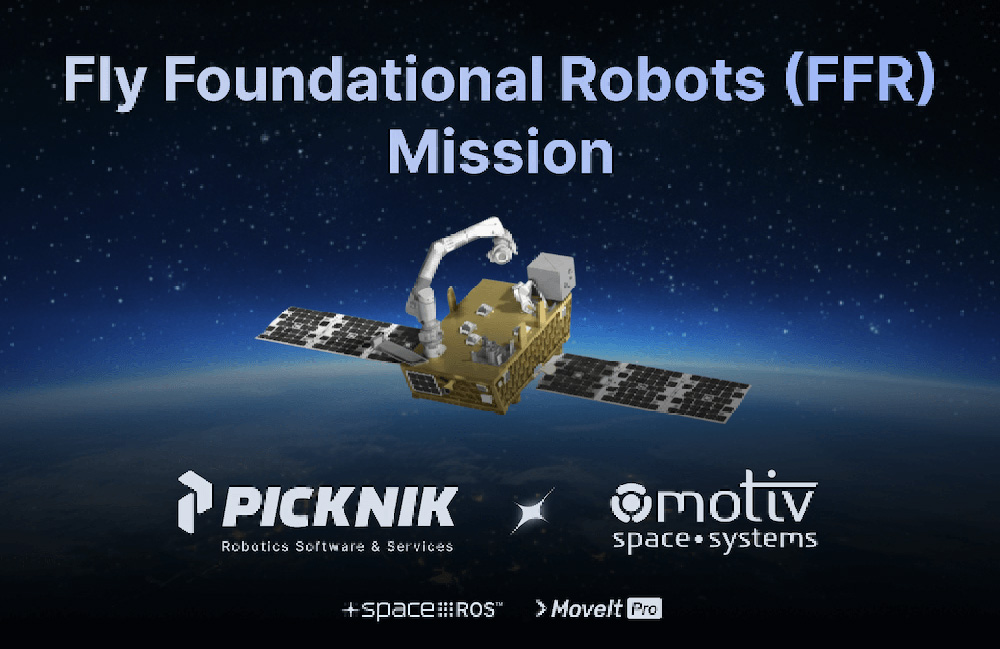

We often celebrate rockets and hardware in space programs, but the unsung battleground today is software: the orchestration, verification and resilient execution of robotic behaviour where human intervention is delayed, expensive, or impossible. The recent collaboration between Motiv Space Systems and PickNik Robotics on NASA’s Fly Foundational Robotics (FFR) mission is a timely reminder that the next frontier is not only mechanical – it’s architectural.
Context
I recently came across a project in which Motiv Space Systems contracted PickNik to provide motion-control and operational tooling for NASA’s FFR mission, using Space ROS and MoveIt Pro to build a flight‑ready stack for on‑orbit manipulation, digital twin simulation, and long‑duration operations with intermittent communications.
Why this matters (the strategic zoom-out)
Space robotics compresses many of the architectural tensions enterprise architects face today: extreme constraints (compute, power, thermal), intermittent connectivity, the need for verifiable autonomy, and long maintenance cycles. The FFR work highlights three shifts that have wide implications for how we design critical systems on Earth as well as in orbit.
1) Open-source ecosystems move from optional to mission-critical.
Space ROS and MoveIt Pro show that mature open-source projects can form the backbone of safety‑critical systems. For enterprises, this means rethinking vendor lock‑in and blanket “build-everything” instincts. High-quality OSS reduces duplicate effort and lets teams focus on mission differentiation – but it also requires disciplined governance: version control, provenance, safety audits and a plan for long‑term maintenance.
2) Simulation and digital twins are now non‑negotiable.
The collaboration emphasises planning through simulation and digital twins to validate behaviour before risky execution. In enterprise terms, this is the architectural equivalent of “shift-left” for system validation: invest earlier in faithful simulation environments to reduce operational surprises and technical debt during production rollouts.
3) Design for harsh constraints forces better engineering discipline.
Flight compute environments are resource‑constrained and have strict real‑time requirements. Designing for that envelope yields systems that are inherently more robust: smaller attack surface, clearer failure modes, and predictable behaviour. The trade‑off is deliberate: moving from feature bloat to capability minimalism.
Practical implications – the Chief Architect’s checklist
– Build vs Buy: Prefer modular, battle‑tested components (e.g., motion planners, behaviour sequencers) for non‑differentiating capabilities. Buy/OSS + integrate; build only the mission‑specific layers.
– Verification: Allocate >30% of the project schedule to simulation, validation, and hardware‑in‑the‑loop testing. There are no shortcuts for high‑assurance systems.
– Resilience by design: Plan for intermittent connectivity with graceful degradation, local autonomy, and secure remote supervision. Operational tooling (ground terminals, telemetry) matters as much as on‑device logic.
– Governance for OSS: Establish SLAs, security scanning, and an upgrade path for third‑party libraries used in production-critical systems.
– Cost of change: Minimising runtime dependencies and avoiding opaque middleware reduces long‑term maintenance costs – critical for systems with multi‑decadal lifetimes.
A brief Bharat connection (why this is relevant to India)
India’s space ecosystem – from ISRO to the growing private sector – is poised to benefit from these software-first lessons. Adopting open standards like Space ROS, investing in digital twin facilities, and building local expertise in motion planning and verification will accelerate capabilities without repeating global R&D costs. For technology teams across government and industry in India (including in the Northeast, where STPI and local incubators are active), this is an opportunity to specialise in software for constrained, safety‑critical systems – a niche with global demand.
Key takeaways
– Treat mature open-source robotics frameworks as strategic assets, not experiments.
– Prioritise simulation and hardware‑in‑the‑loop early; it pays off in reliability and lower operational risk.
– Design for constraints to reduce complexity and long‑term technical debt.
– For leaders: align procurement, security, and engineering roadmaps around repeatable, verifiable integration patterns.
Closing thought
As robotic systems migrate from labs to long‑duration operational environments – whether in orbit or at the edge on Earth – the differentiator will be the architecture of trust: software that is verifiable, maintainable, and resilient. That’s where the real mission value lies.
About the Author Sanjeev Sarma is the Founder Director of Webx Technologies Private Limited, a leading Technology Consulting firm with over two decades of experience. A seasoned technology strategist and Chief Software Architect, he specializes in Enterprise Software Architecture, Cloud-Native Applications, AI-Driven Platforms, and Mobile-First Solutions. Recognized as a “Technology Hero” by Microsoft for his pioneering work in e-Governance, Sanjeev actively advises state and central technology committees, including the Advisory Board for Software Technology Parks of India (STPI) across multiple Northeast Indian states. He is also the Managing Editor for Mahabahu.com, an international journal. Passionate about fostering innovation, he actively mentors aspiring entrepreneurs and leads transformative digital solutions for enterprises and government sectors from his base in Northeast India.