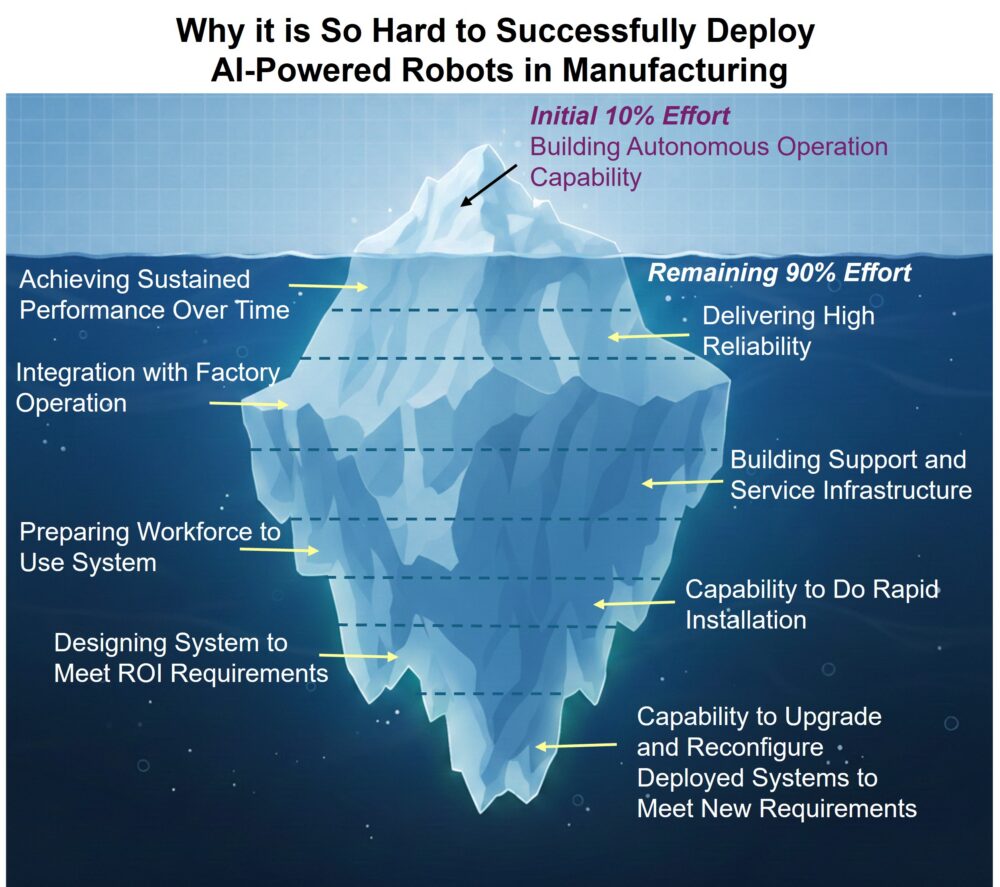

We worship robotics demos – the clever proof-of-concept that picks a handful of parts, tunes the sensors in a quiet lab, and posts a flawless run. But if you care about production, demos are the beginning of a conversation, not the end. The hard work is in turning that polished demo into a reliable, serviceable, and profitable fleet across real factory floors.
Context
I recently read a thoughtful analysis that lists why many robotics demonstrations struggle to scale in high‑mix manufacturing. The piece identifies data scarcity, limited part diversity in tests, overlooked human-system integration, poor service infrastructure, and a missing software/PHM strategy among the core causes. These are not isolated engineering bugs – they are systemic gaps that turn promising pilots into shelved projects.
Analysis – what this means for architecture and strategy
Four architectural principles flow from these observations and should guide any CTO or founder thinking about automating high‑mix work.
1) Design for scale from day one – not as an afterthought.
A single cell in a lab will never produce the diversity of sensor and failure data you need for robust AI, PHM, and maintainability. Plan to run multi-cell pilots or partner with an OEM/service provider to aggregate operational data. Architect systems with modular, standardized interfaces (mechanical, electrical, software) so field variation doesn’t cascade into bespoke fixes.
2) Treat perception and planning as products that need a data pipeline.
Perception models trained on a dozen parts and pristine lighting fail quickly on a shop floor. Combine real-world collection with domain‑randomized synthetic data, and build continuous data‑ops: automated labeling, validation, and versioned model deployment. That requires investment in edge/cloud pipelines and a release discipline – the same lifecycle thinking we apply to enterprise software must apply to robot intelligence.
3) Make humans and operations first-class citizens.
Automating 90–95% of work is often optimal, but human integration must be baked into cell design: predictable handoffs, operator utilization models, local workpacks, and simple, role-based UIs. Invest in training and create workflows where an operator can supervise multiple cells or complete meaningful offline tasks while the robot works. This is essential for ROI and shop‑floor acceptance.
4) Build the service and PHM layer before you need it.
Low availability from rare but hard failures kills economics. An AI‑driven PHM needs data from many cells; equally important is the service network to act on PHM alerts. Consider shared service pools, remote-first diagnostics, spare-part strategies, and contractual SLAs. Architect for safe-fail modes and automated recovery to reduce mean-time-to-repair.
Practical tactical checklist (what I recommend)
– Start pilots as clusters (5–20 cells) to create useful data and service economics.
– Define OEE and availability targets before building the demo. If you can’t meet them in simulation, redesign.
– Invest early in data infrastructure: sync edge logs, imaging, and failure tags to a central store.
– Use modular mechanical/tooling standards so new parts don’t force redesign.
– Build simple, local UIs and operator training playbooks; measure human utilization.
– Plan OTA software and security (zero trust for remote connections).
– Consider partnerships for field service and spare‑parts distribution.
– Calculate ROI including consumable savings, quality improvement, and reduced rework – not only labor replacement.
A note for India and the Northeast
For India’s MSME-heavy manufacturing base, the implications are material. Individual shops rarely can justify an in‑house service team or large pilot fleet. Cluster-based deployment models – shared automation cells, common service providers, and data cooperatives supported by state/STPI programs – can create the economies of scale needed. I’ve seen this approach work in other domains: when local industry clusters pool demand, both deployment risk and cost fall.
Closing thought
If we want robots to move from theater to the shop floor, we must stop treating demos as products. Treat them as hypotheses to be validated with data, service models, workforce design, and production economics – and then engineer the entire system, not just the robot.
About the Author Sanjeev Sarma is the Founder Director of Webx Technologies Private Limited, a leading Technology Consulting firm with over two decades of experience. A seasoned technology strategist and Chief Software Architect, he specializes in Enterprise Software Architecture, Cloud-Native Applications, AI-Driven Platforms, and Mobile-First Solutions. Recognized as a “Technology Hero” by Microsoft for his pioneering work in e-Governance, Sanjeev actively advises state and central technology committees, including the Advisory Board for Software Technology Parks of India (STPI) across multiple Northeast Indian states. He is also the Managing Editor for Mahabahu.com, an international journal. Passionate about fostering innovation, he actively mentors aspiring entrepreneurs and leads transformative digital solutions for enterprises and government sectors from his base in Northeast India.