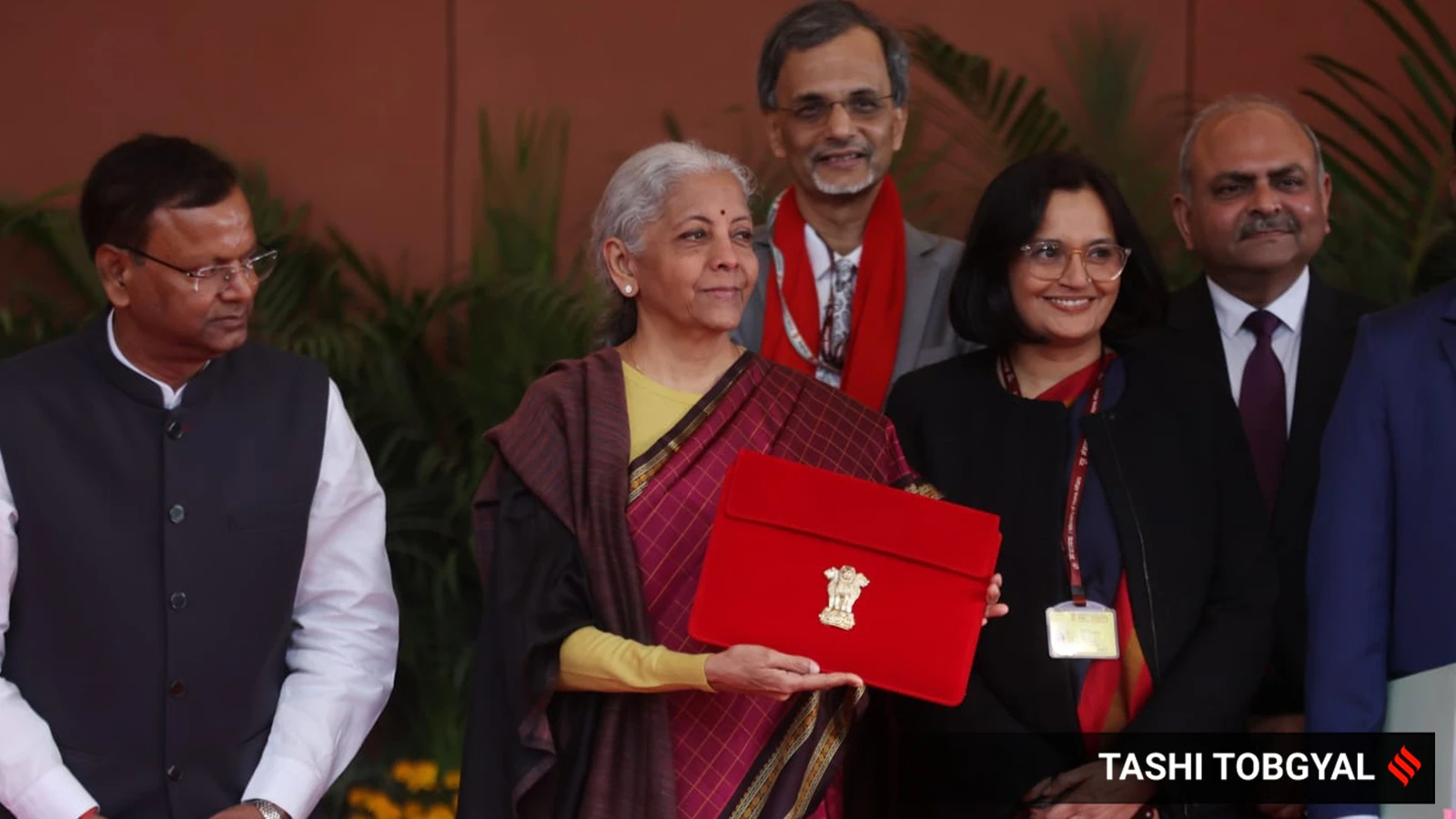

Chandigarh has received an allocation of ₹6,545.52 crore in the Union Budget for 2026-27, which is ₹437.66 crore less than the ₹6,983.18 crore budget estimates for the previous fiscal year. However, the Union Territory Administration has described this as a 4.63% increase in real terms, after considering the impact of the electricity department’s privatization. The UT Administration had initially projected a budget requirement of ₹8,379.81 crore for 2026-27, seeking an additional ₹1,396.63 crore to support health, education, transport, and urban infrastructure projects. The budget presented by Finance Minister Nirmala Sitharaman in the Lok Sabha on Sunday allocated ₹6,545.52 crore-of which ₹5,939.52 crore is earmarked for revenue expenses and ₹606 crore for capital expenditures.
The budget for 2025-26 was initially ₹6,983.18 crore, comprising ₹6,185.18 crore for revenue and ₹798 crore for capital works. Revenue expenditures primarily cover salaries and recurring costs, while capital expenditures focus on development initiatives and asset creation. Although the current allocation is lower by ₹437.66 crore, officials attribute most of the reduction to a structural adjustment following the privatization of the UT Electricity Department.
The Finance Ministry has cut the energy sector’s core allocation from ₹877.39 crore in the previous year to ₹156.95 crore in the 2026-27 budget, resulting in a substantial adjustment of ₹720.44 crore. The UT Administration claims that when excluding this one-off adjustment, the budget actually indicates an increase of ₹282.28 crore, or 4.63% compared to the last fiscal year.
Chandigarh MP Manish Tewari has voiced his criticism regarding the budget cut, pointing to poor fund utilization by the UT Administration. In a post on X, he noted that while the allocation for Chandigarh in the 2025-26 budget was ₹6,187 crore, only ₹5,556 crore was actually spent, leading to an underspend of over ₹630 crore. This underutilization has contributed to a lower allocation of ₹5,720 crore for 2026-27.
Tewari emphasized that the reduced budget would negatively affect urban infrastructure, healthcare, and public services in the city. He argued that this should not be labeled as fiscal prudence but should be viewed as a “lack of focus” in governance.
Despite the overall reduction in budget allocation, the energy sector has been given ₹189.67 crore for renewable energy initiatives and residual components post-restructuring. This funding will support the promotion of new and renewable energy sources and the implementation of a model solar city program.
The budget prioritizes core public services, with six primary sectors accounting for ₹4,998.45 crore, or 76.37% of the total allocation. Education has received the highest allocation of ₹1,295.38 crore, which represents 19.79% of the overall budget. This funding will be directed towards modernizing educational facilities, purchasing equipment, developing infrastructure for the National Cadet Corps, and expanding graduate courses, among other initiatives.
The housing and urban development sector is allocated ₹1,127.95 crore, covering land acquisition, infrastructure enhancements, urban roads, and storm-water drainage, among others. The police department is allotted ₹970.53 crore, while health services will receive ₹955.41 crore to upgrade community health centers and strengthen healthcare facilities.
For transportation, ₹459.51 crore is allocated for new buses and modernizing transport facilities. Other sectors collectively account for ₹1,547.07 crore, focusing on areas like social security, forestry, and miscellaneous expenditures.
Criticism has arisen from both the Aam Aadmi Party (AAP) and Congress regarding the budget reduction, highlighting concerns about its impact on civic services and infrastructure. The AAP pointed out that the UT Budget for 2026-27 is set at ₹5,720 crore, a significant drop from the revised expenditure of ₹6,187 crore in 2025-26. Senior AAP leader Vikrant A Tanwar warned that the reduced allocation and high administrative costs would limit funds for development.
Tanwar also noted the absence of a clearly defined allocation for the Municipal Corporation, signaling potential issues for essential services like sanitation and drainage. Congress has echoed these worries, labeling the reduction of over ₹1,200 crore as “unfair and unprecedented” and suggesting it reflects a lack of concern for the city’s needs.
Rajiv Sharma, a spokesperson for Congress, stated that the Corporation received only ₹625 crore last year, with nearly ₹500 crore remaining unspent and likely to lapse. He highlighted that the civic body, responsible for daily operational tasks, received a mere 9% of the total budget allocation, all while facing severe resource constraints.
Both parties have called for assured and transparent funding for the Municipal Corporation to maintain essential civic services.
Original Source: https://indianexpress.com/article/cities/chandigarh/aap-congress-slam-cut-in-budget-flag-strain-on-civic-services-chandigarh-gets-rs-6545-52-crore-rs-437-66-crore-less-than-last-year-10508062/
Category: Chandigarh,Cities
Tags:
Publish Date: 2026-02-02 01:19:00