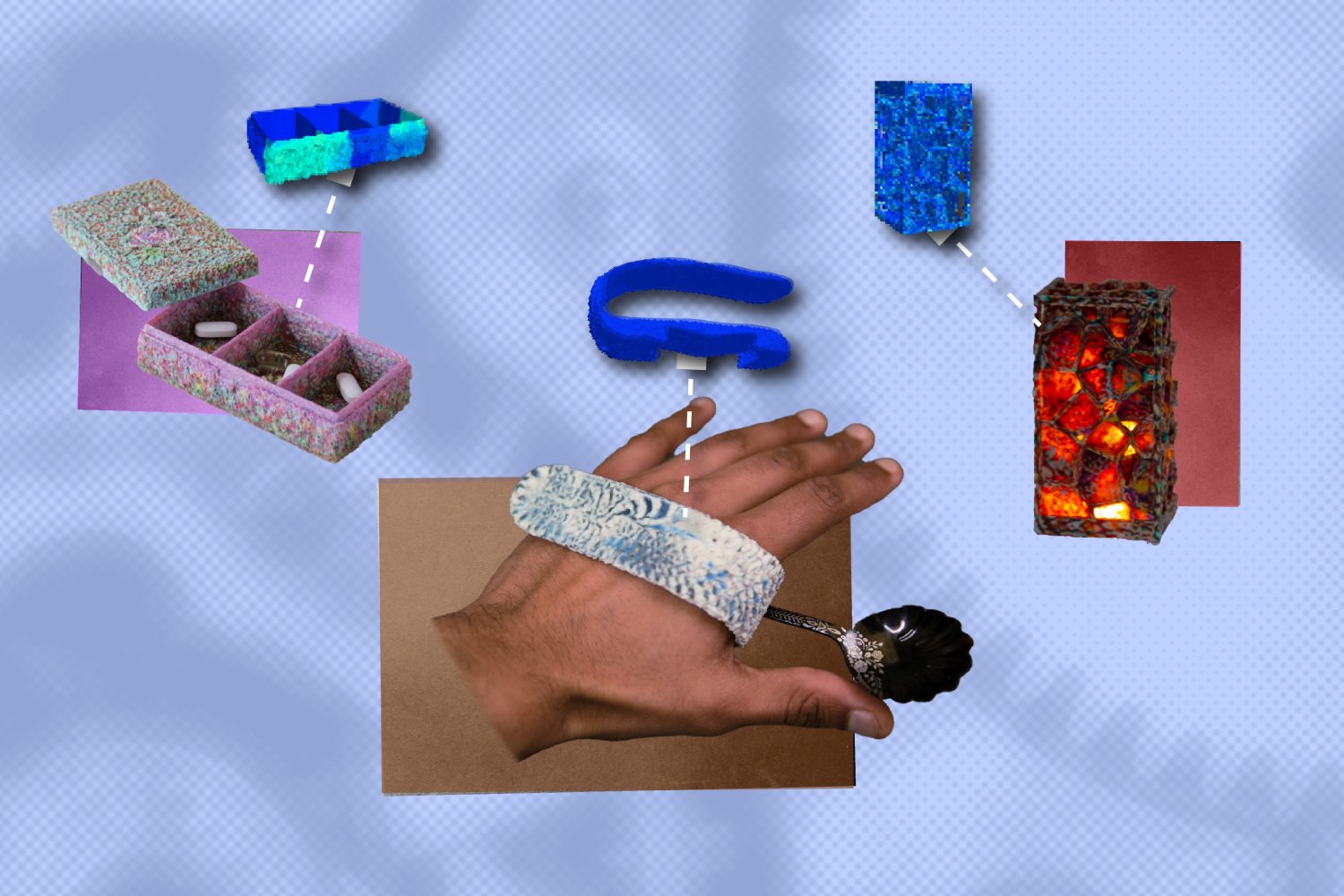

Generative artificial intelligence (AI) is significantly transforming digital content creation, making it challenging to remember the internet’s pre-AI landscape. Although AI tools excel in artistic projects like videos and photos, their capabilities in creating tangible, personalized objects such as phone cases and home decor items remain largely unrealized. Researchers from the MIT Computer Science and Artificial Intelligence Laboratory (CSAIL) have identified a critical issue: the mechanical integrity of 3D models generated by AI.
While AI can produce custom 3D models, these systems often overlook the material properties essential for physical objects. Faraz Faruqi, a PhD student at MIT’s Department of Electrical Engineering and Computer Science, has been investigating this limitation. He has developed generative AI systems that not only focus on aesthetics but also ensure functionality and the tactile qualities users desire.
In collaboration with researchers from Google, Stability AI, and Northeastern University, Faruqi has introduced an AI-powered system named MechStyle, designed to create durable real-world objects that reflect users’ visual and tactile preferences. Users can either upload their own 3D models or choose from preset designs, such as vases or hooks, and provide prompts in the form of images or text. The generative AI modifies the 3D geometry, while MechStyle simulates the impact of these changes on different sections to ensure critical areas remain structurally sound. Once satisfied with the design, users can 3D print their unique creations.
For instance, a user could opt for a wall hook and select a suitable printing material like polylactic acid. They could then instruct the system to create a cactus-shaped hook. The AI works alongside a simulation module to generate a model that resembles a cactus yet maintains the durability of a hook, suitable for hanging items like mugs or coats. This process includes a stylization phase where the system adjusts a model’s geometry based on the text input while utilizing feedback from the simulation.
Previously, CSAIL’s research indicated that 3D stylization often led to issues, with only about 26 percent of modified models retaining structural integrity due to the AI’s inadequate understanding of physics. Faruqi states, “We want to use AI to create models that you can actually fabricate and use in the real world. So MechStyle simulates how generative AI changes affect structure, allowing personalization while ensuring everyday usability.”
MechStyle could eventually empower users to design custom belongings, such as glasses adorned with fish-scale patterns or pillboxes with unique textures. The system holds the potential for tailored home decor and even assistive technology, catering to individual specifications like finger splints for those with dexterity challenges.
Looking ahead, MechStyle could streamline prototype creation for various products sold in retail environments. The CSAIL team aims for both professional and novice designers to dedicate more time to ideation and testing, rather than manual assembly.
To enhance the reliability of MechStyle’s outputs for daily use, the team integrated a finite element analysis (FEA) for simulating physics. This approach allows users to visualize a 3D model as a heat map, highlighting viable structural regions and identifying weaknesses. Faruqi explains that while running these simulations after every change can slow the AI process, MechStyle is optimized for when to conduct detailed structural analyses. If changes threaten any area, the system re-evaluates the physics of the design, ensuring its stability remains intact.
By employing FEA with adaptive scheduling, MechStyle has successfully generated objects with up to 100 percent structural viability. The research team tested various models styled like bricks, stones, and plants, finding that dynamically identifying and addressing weak points was the most effective strategy for creating viable objects.
MechStyle offers two modes: a freestyle feature for quick visualizations and a structured mode that meticulously analyzes the impacts of modifications. This allows users to experiment with designs and understand how creative additions might affect durability.
Currently, while MechStyle ensures that models remain structurally sound before 3D printing, it does not yet enhance models that initially lack viability. Users attempting to upload these flawed designs receive error messages, although Faruqi and his collaborators aim to enhance the durability of these faulty models in future iterations.
Furthermore, the team envisions a future where generative AI creates 3D models directly for users, moving beyond stylization of uploaded designs. This feature would simplify the process for those unfamiliar with 3D modeling by allowing them to generate custom creations from scratch, such as a unique bowl design.
“While style-transfer for 2D images works incredibly well, the transition to 3D remains a challenge,” notes Google Research Scientist Fabian Manhardt, who was not involved in the study. “3D modeling is complex due to the scarcity of training data and the risks to structural integrity that arise from altering geometry. MechStyle addresses this issue by enabling 3D stylization without compromising strength, empowering users to express their individuality through tailored products.”
Faruqi co-authored the study with senior author Stefanie Mueller, MIT associate professor and CSAIL principal investigator, alongside researchers Leandra Tejedor and Jiaji Li. Additional co-authors include Amira Abdel-Rahman, now an assistant professor at Cornell University, Martin Nisser, Google researcher Vrushank Phadnis, Stability AI Vice President Varun Jampani, MIT Professor Neil Gershenfeld, and Northeastern University Assistant Professor Megan Hofmann. This research was supported by the MIT-Google Program for Computing Innovation and was presented at the Association for Computing Machinery’s Symposium on Computational Fabrication in November.
Original Source: https://news.mit.edu/2026/genai-tool-helps-3d-print-personal-items-sustain-daily-use-0114
Category:
Tags:
Publish Date: 2026-01-15 02:30:00