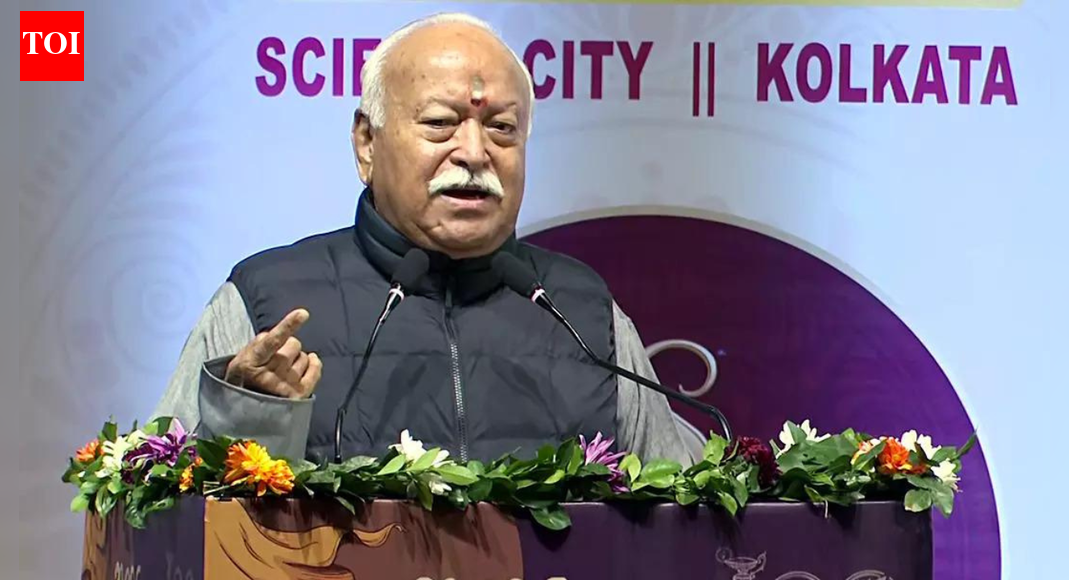

Kolkata: In a significant address on Sunday, Rashtriya Swayamsevak Sangh (RSS) chief Mohan Bhagwat emphasized that viewing the RSS solely through the lens of the Bharatiya Janata Party (BJP) is a fundamental misunderstanding. Speaking at the Kolkata Vyakhyanmala, a session marking the centenary of the RSS, Bhagwat expressed that while the organization aims to unite Hindu society, it does not seek to oppose others.
Bhagwat stated, “Many people tend to interpret the Sangh through the prism of the BJP. That is a big mistake.” His remarks aimed to clarify the distinct identities of the two organizations. During his over-hour-long speech, he elaborated on the diverse roles of RSS members, noting that while some are involved in politics and governance, others contribute to various fields.
The RSS chief addressed misconceptions surrounding the Sangh’s activities, arguing for an objective interpretation rather than relying on secondary sources. “The primary goal of the Sangh is the organization of the entire Hindu society, not opposition to any other group,” he remarked. Bhagwat encouraged listeners to reassess negative perceptions, asserting, “If you view the Sangh as anti-Muslim, that is your opinion. However, I urge you to reconsider if you do not find evidence to support it.”
Highlighting the need for political awakening in West Bengal, Bhagwat traced the history of political movements in India, recalling the role of the Congress party in the struggle for independence. He acknowledged that while political awareness propelled the nation’s freedom, there were parallel efforts emphasizing social reform, notably those initiated by Raja Ram Mohan Roy.
Bhagwat spoke about the rich diversity inherent in Hindu society, asserting, “Hindu is not merely a label but an attribute that defines our nature as individuals who honor their motherland, regardless of our languages, rituals, or customs.” He also addressed the Muslim community, asserting that despite differences in worship, they share a common identity within the broader cultural and social fabric of the nation.
On the contentious issue of the Babri Masjid, Bhagwat described it as a “political conspiracy” that serves neither Hindus nor Muslims, suggesting it was primarily motivated by electoral considerations. Additionally, he criticized the use of public funds for constructing religious structures, recalling that the Somnath temple was built through societal contributions rather than government financing. “The government should refrain from funding temple constructions; such endeavors must derive from public support,” he emphasized.
Through these statements, Bhagwat articulated a vision of unity rooted in cultural identity, urging society to organize collectively without fragmenting into isolated entities. His reflections on governance, social reform, and the essence of Hindu identity serve not only as a clarion call for the RSS but also as an invitation for broader discourse on communal harmony in India’s diverse landscape.
As this dialogue continues to unfold, the implications of Bhagwat’s address resonate beyond the immediate context, inviting a deeper examination of identity, unity, and socio-political engagement within Indian society.
Original Source: https://timesofindia.indiatimes.com/india/looking-at-rss-through-bjp-lens-a-big-mistake-mohan-bhagwat/articleshow/126109644.cms
Category :
Tags:
Publish Date: 2025-12-22 01:18:00