
“Don’t blame the pilots yet. Look at the plane.” This blunt message comes from Ed Pierson, a Boeing whistleblower who has challenged the narrative of pilot error following the tragic Air India 787 crash in Ahmedabad, which claimed the lives of over 260 people, including 242 aboard the flight. Pierson described the Dreamliner as an “electrical monster” and stated that investigators are overlooking deep-seated manufacturing and systemic failures.
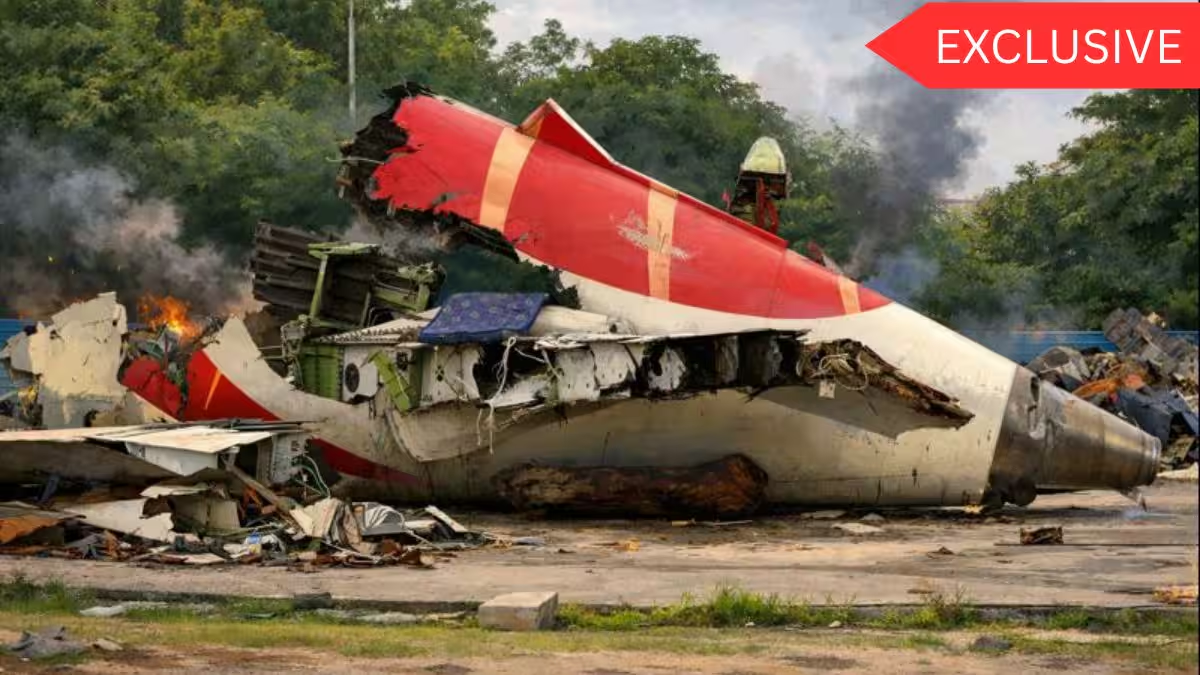
What began as a routine take-off turned disastrous as the aircraft crashed shortly after departure, erupting into flames and impacting both the flight’s passengers and the medical college hostel it struck. Pierson emphasizes that focusing on pilot error distracts from significant and long-standing flaws in the Boeing 787 itself.
The fatal incident occurred at 13:39 on June 12, when the Air India Boeing 787-8 departed from Sardar Vallabhbhai Patel Airport in Ahmedabad, bound for London’s Gatwick Airport. Mere minutes later, it crashed into a nearby area, sending thick black smoke into the sky as the flight transformed into a fireball. The aircraft was carrying 230 passengers and 12 crew members, with only one survivor, Vishwash Kumar Ramesh, emerging from the wreckage. The tail section of the aircraft crashed into BJ Medical College’s Atulyam hostels, leading to more deaths among students, raising the overall toll to 260.
Since the Aircraft Accident Investigation Bureau (AAIB) released its preliminary report, speculation around mechanical failures and fuel contamination has faded, with increasing scrutiny on pilot error.
Former Boeing senior manager-turned-whistleblower Pierson criticized the preliminary report as “horrible” and expressed concerns about the investigatory direction, citing Boeing’s quality control failures and weak regulatory oversight. In an exclusive interview, he revealed long-standing concerns about the quality control environment in Boeing’s factories, noting the immense pressure on manufacturing and supply chain teams.
“The pressure to complete work was extraordinary,” Pierson remarked, pointing to a culture of long hours that led to repeated mistakes. He indicated that quality control inspections over multiple systems, including flight controls and electrical systems, frequently flagged issues.
Despite automation’s role in manufacturing, Pierson stressed that human labor remains crucial. He recounted a high-stress environment on the factory floor, where he observed instances of errors and poor communication. “We witnessed mistakes and arguments. This should not happen when building planes,” he said.
Pierson also noted the occurrence of dangerous failures during system-wide tests meant to verify operational functionality, stating, “We saw multiple test failures, which indicated a troubling history of quality lapses in manufacturing.”
He labeled the 787 as an “electrical monster,” explaining that failures within critical systems could send erroneous signals throughout the aircraft. With its complex structure composed of multiple power panels and circuits, the 787 poses significant challenges.
Pierson rebuffed the idea of pilot error, stressing that investigators must first evaluate potential system faults. Reacting to a Wall Street Journal report that hinted at pilot shortcomings while investigations were ongoing, he termed the piece “disgusting.” He expressed bewilderment at the publication’s failure to uphold credibility.
“There’s a recurring pattern: after an accident occurs, condolences are issued, but pilot blame follows without investigation. It’s a reflex to shield parties involved in the investigation,” he said.
Pierson criticized the AAIB’s preliminary report for omitting vital information related to sensors, stabilizers, and cockpit recordings, arguing that this lack of transparency misrepresents the incident. He also highlighted the absence of data from crucial systems like the Aircraft Communications Addressing and Reporting System.
He questioned the lack of pilots on the initial investigative team, arguing for the inclusion of Aviation Maintenance Technicians, who possess firsthand experience with the systems in question. Pierson welcomed the Indian Supreme Court’s intervention, which recognized that public sentiment does not fault the pilots.
As the AAIB and National Transportation Safety Board (NTSB) prepare for their upcoming meeting, Pierson expressed skepticism, citing what he views as the NTSB’s “horrible deterioration” since previous incidents, particularly the 737 Max crashes.
Calling for more accountability, Pierson criticized both Boeing and the NTSB for ignoring known electrical failures leading up to crashes, claiming that necessary information was withheld from investigators. He characterized current accidents investigation processes as outdated, advocating for modernized approaches that match aircraft sophistication.
As survivors and victims’ families await further details surrounding the Ahmedabad crash, issues surrounding aircraft safety and regulatory oversight continue to gain relevance in discussions about the future of aviation.
Original Source: https://www.firstpost.com/world/dont-blame-the-pilots-boeing-whistleblower-calls-787-an-electrical-monster-after-air-india-crash-13961391.html
Category: India
Tags:
Publish Date: 2025-12-20 09:42:00