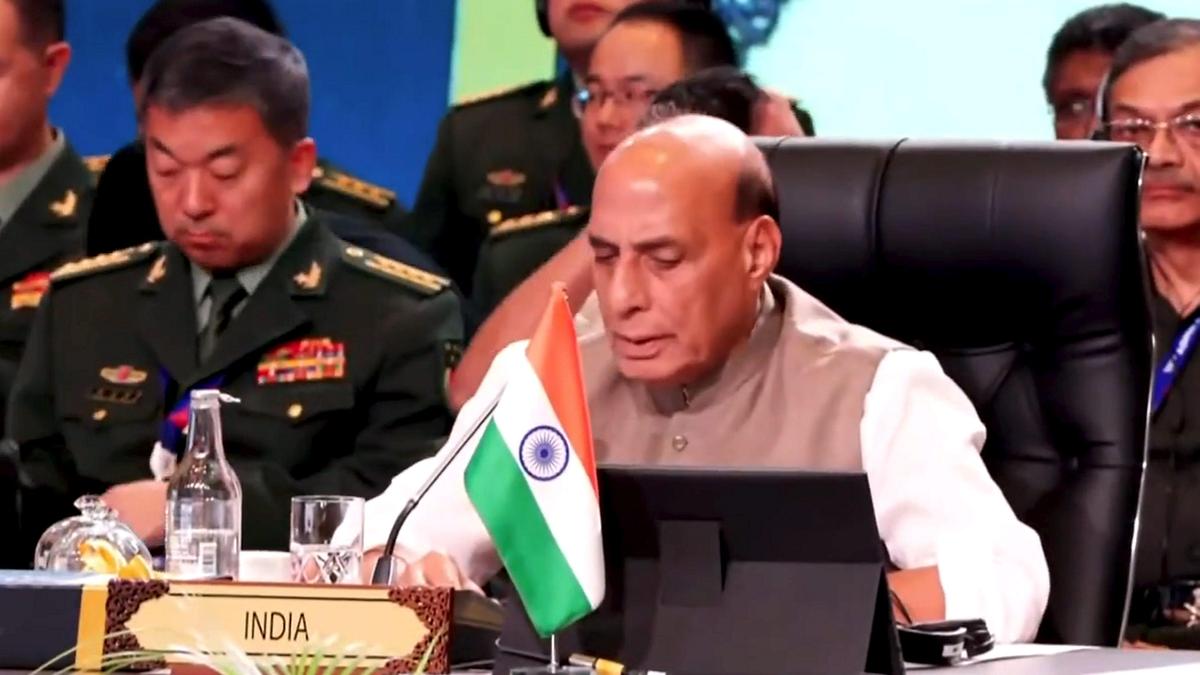

India’s Defence Minister, Rajnath Singh, emphasized the country’s commitment to the rule of law and freedom of navigation in the Indo-Pacific, stating these principles aim to protect the interests of all stakeholders rather than target any specific nation. His remarks were made on Saturday, November 1, 2025, during a gathering of Defence Ministers from ASEAN countries and their dialogue partners in Kuala Lumpur. Singh asserted India’s belief that the Indo-Pacific should be open, inclusive, and free from coercion.
He advocated for a collective security approach to safeguard the sovereignty of all nations in the region. “India’s focus on the rule of law, especially under the United Nations Convention on the Law of the Sea (UNCLOS), and its support for freedom of navigation are intended to protect the collective interests of regional stakeholders,” he said. This statement comes amid increasing calls from various ASEAN countries and democratic nations for adherence to UNCLOS, particularly in light of China’s expanding military presence in the disputed South China Sea.
Addressing the ASEAN Defence Ministers’ Meeting Plus (ADMM-Plus), Singh emphasized that India’s engagement with ASEAN is long-term and principle-based, reflecting a collective commitment to ensuring the region remains open and free from coercion. He noted that future security will depend less on military capabilities and more on managing shared resources, securing digital and physical infrastructure, and effectively responding to humanitarian crises.
Singh posited that ADMM-Plus could bridge strategic dialogue with practical outcomes, fostering peace and shared prosperity in the region. This platform consists of the 11-member ASEAN and its eight dialogue partners, including India, China, Australia, Japan, New Zealand, South Korea, Russia, and the United States. He called for a reaffirmation of commitment to a robust, ASEAN-led security architecture that supports the collective regional interest.
India stands ready to enhance cooperation on various fronts, promote dialogue, and maintain stability through effective regional frameworks. “The last 15 years have shown us that inclusive cooperation is essential; regional ownership provides legitimacy, and collective security strengthens individual sovereignty,” he noted. Singh projected this approach will continue guiding India’s relations with ASEAN in the future.
He expressed India’s readiness to contribute constructively to these efforts in line with its MAHASAGAR vision-Mutual and Holistic Advancement for Security and Growth across Regions. Singh highlighted that ADMM-Plus’s evolution reflects the changing security landscape, now encompassing new domains such as cyber threats and critical infrastructure protection. He emphasized that such non-traditional security cooperation can build trust among nations.
The Defence Minister also explained that ADMM-Plus is central to India’s ‘Act East Policy’ and its broader Indo-Pacific strategy. Since becoming ASEAN’s dialogue partner in 1992, India has participated in this vital framework, which officially convened its inaugural ADMM-Plus in Hanoi in 2010.
Singh reiterated India’s commitment to integrating climate resilience into defence cooperation, contending that the relationship between environmental stress and resource scarcity underscores this issue as vital for regional security. India’s Indo-Pacific security vision intertwines defence collaboration with economic progress, technology sharing, and human resource development.
He remarked that the focus on “inclusivity and sustainability” during Malaysia’s ASEAN chairmanship is both timely and essential. In terms of security, inclusivity means that every country, regardless of size, should be an equal partner in shaping the regional order. Sustainability implies developing security frameworks that can withstand shocks and adapt to new challenges, built on long-term cooperation rather than short-term alignments.
During the conclave, Singh conducted separate bilateral meetings with his counterparts from Singapore, New Zealand, Vietnam, and South Korea to strengthen these ties and enhance mutual cooperation.
Original Source: https://www.thehindu.com/news/national/indo-pacific-should-remain-free-from-any-form-of-coercion-rajnath/article70228569.ece
Category:
Tags:
Publish Date: 2025-11-02 00:14:00