
The race for lunar supremacy is intensifying as the geopolitical rivalry between the United States and China extends into space exploration. With tensions around trade simmering, both nations are ramping up efforts to assert their dominance in the cosmos, specifically targeting lunar missions that aim to advance their respective agendas.
Since landing humans on the Moon in 1969, the U.S. has maintained its position as a leader in lunar exploration, with the Soviet Union once serving as its primary rival. Although Russia, hampered by sanctions, is collaborating with China on plans for the International Lunar Research Station by 2035, China’s ambitions have surged in recent years. The nation successfully conducted its first crewed space mission in 2003 and has made significant advancements toward landing astronauts on the Moon by the end of this decade.
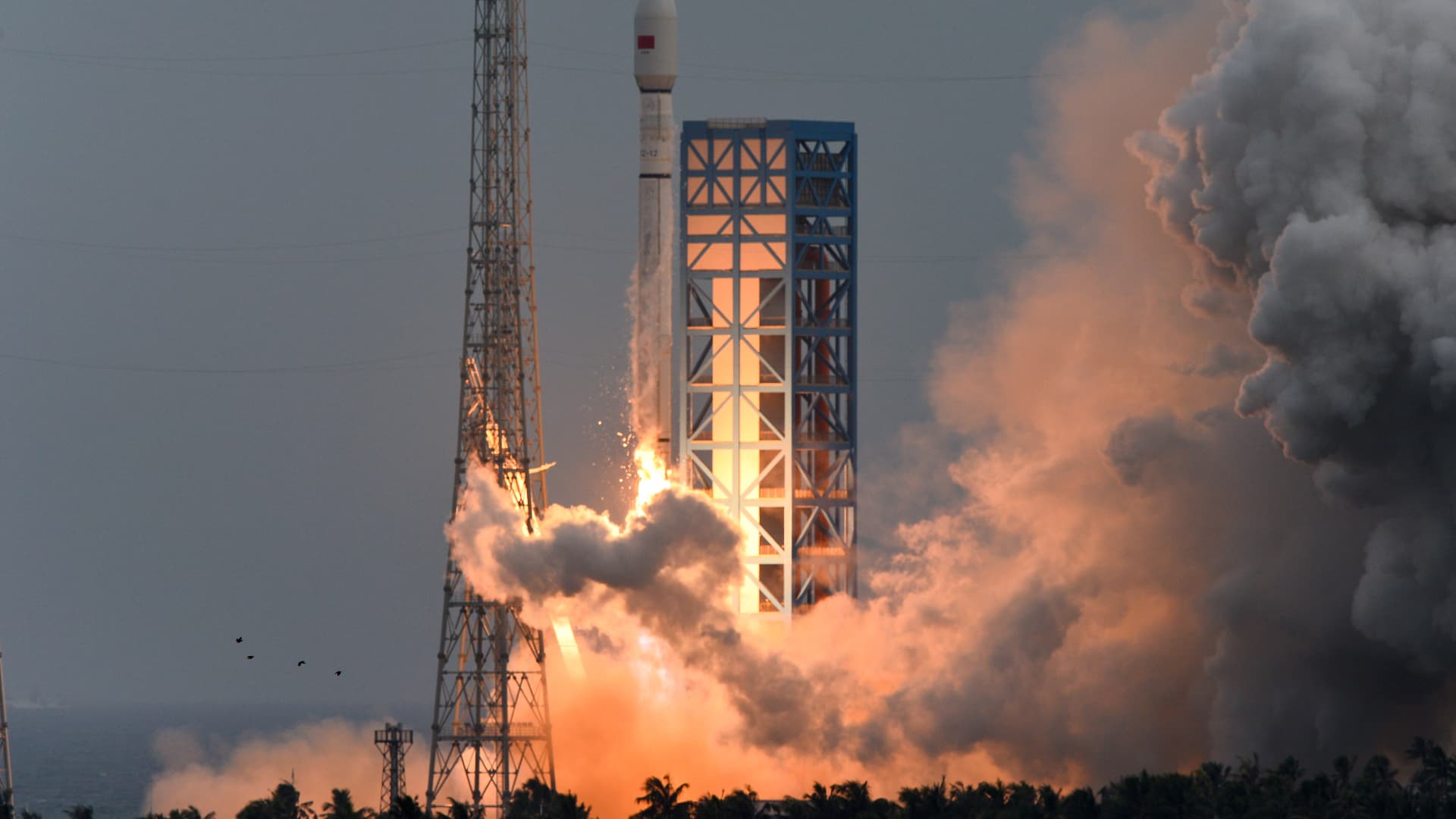
This month marked a pivotal moment for China’s space program, as the China Manned Space Agency announced the successful test of its Lanyue lunar lander in Hebei province. The simulated lunar gravity and terrain conditions signify China’s commitment to lunar exploration, further echoed by the recent static fire test of the Long March-10 rocket, which is designed for future crewed and cargo transport missions to China’s Tiangong space station.
China’s summer of activity has included successful trials of the Mengzhou spacecraft, crucial for its lunar plans, and the launch of the ninth Tianzhou cargo spacecraft to Tiangong. Beijing has reaffirmed its goal to land its astronauts on the Moon before 2030, directly challenging NASA’s Artemis program, which aims to return Americans to the lunar surface around 2027. While the U.S. has a significant historical advantage thanks to the Apollo missions, uncertainty surrounds NASA’s lunar lander choices. SpaceX’s Starship, facing a tumultuous year, is set for another test launch on August 24, while Blue Origin’s Mark 1 lander remains under development.
In the backdrop of burgeoning space ambitions, China’s state-owned China Aerospace Science and Technology Corporation remains paramount, though commercial companies like Galactic Energy and LandSpace are also emerging players. Professor Quentin Parker from the University of Hong Kong remarked, “I believe China could beat NASA back to the Moon,” citing delays and budgetary issues within NASA that could allow China to take the lead.
National prestige isn’t the only consideration; concerns in the U.S. about the militarization of space accompany these ambitions. General Chance Saltzman, the chief of space operations at the U.S. Space Force, articulated these worries, stating that the People’s Republic of China is developing a “kill web” of satellites designed for real-time targeting and surveillance.
While space has evolved into a new frontier for competition, recent reports indicate that hackers supporting the Kremlin have even utilized orbiting satellites to influence events on Earth. Kazakhstan’s Baikonur spaceport is also undergoing upgrades to attract more commercial ventures, while the U.K. Space Agency merges with another government body to streamline operations amid financial constraints.
Looking ahead, precision remains crucial for both nations in navigating this complex landscape of political and technological rivalry. As the U.S. and China prepare for their next lunar missions, the world watches closely, anticipating a new chapter in the story of space exploration that intertwines national interests with global aspirations. The outcomes here will not only signify technological advancements but will also influence broader geopolitical dynamics, making space exploration a battlefield of not just rockets but of strategic influence on Earth’s stage.
Original Source: https://www.cnbc.com/2025/08/22/investing-in-space-the-us-china-space-race-is-getting-tighter.html
Category :
Tags:
Publish Date: 2025-08-22 10:40:00