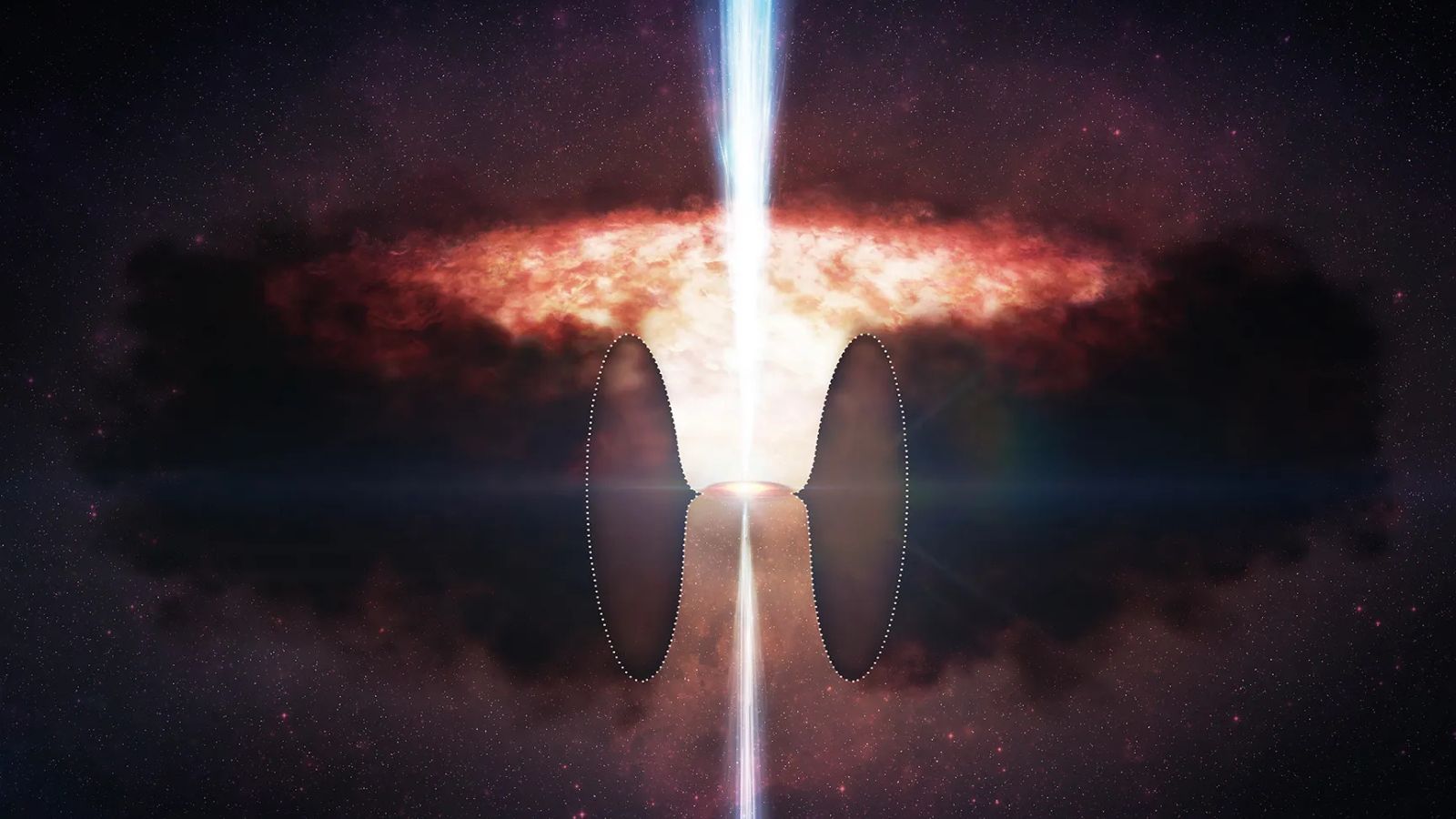

Astronomers have made a groundbreaking discovery, potentially marking the first recorded instance of a massive star exploding while interacting with a black hole. The star, designated SN 2023zkd, was initially detected in July 2023 by the Zwicky Transient Facility in California. Located around 730 million light-years away, within a galaxy characterized by minimal star formation activity, SN 2023zkd was identified using advanced artificial intelligence (AI) tools that swiftly pinpoint unusual cosmic occurrences. This early detection allowed astronomers worldwide to focus their telescopes on the event, capturing vital observations as it unfolded.
Ashley Villar, an associate professor of astronomy at Harvard University and a co-author of the study, noted, “2023zkd shows some of the clearest signs we’ve seen of a massive star interacting with a companion before explosion. We think this might be part of a whole class of hidden explosions that AI will help us discover.”
Initially exhibiting the behavior typical of a supernova-a bright flash tapering off over time-the star exhibited an unexpected resurgence of brightness months later. Historical data revealed a gradual increase in brightness that persisted for nearly four years, or 1,500 days, prior to the explosion. Such a protracted pre-explosion phase is rare and suggests the star was under intense gravitational strain.
Experts propose that the star may have been in orbit around a black hole. Analysis of light curves and spectra indicates that the star underwent two noteworthy eruptions in the years leading up to its demise, expelling substantial amounts of gas. The initial peak in brightness resulted from the blast wave, while a secondary, slower peak was produced by a collision with a dense, disc-shaped cloud.
As the black hole exerted its gravitational influence, the star likely succumbed to collapse. The research team also speculates that the black hole may have consumed the star before it could complete its natural explosion cycle, implicating that the observed supernova light stemmed from debris colliding with surrounding gas. In either scenario, the outcome would lead to an even more massive black hole.
“This is the strongest evidence to date that such close interactions can detonate a star,” stated Alexander Gagliano, lead author and researcher at the Institute for Artificial Intelligence and Fundamental Interactions. “We’ve known for some time that most massive stars are in binaries, but capturing one in the act of mass exchange just before the explosion is incredibly rare,” he added.
The findings emphasize the crucial role of AI in identifying rare cosmic events, timelier than ever before. The researchers highlighted the promise of future facilities like the Vera C. Rubin Observatory. This observatory, poised to survey the entire southern sky every few nights from its base in the Chilean Andes, could significantly enhance the ability to detect and study such extraordinary phenomena.
“We’re now entering an era where we can automatically detect these rare events as they occur, not just afterwards,” Gagliano asserted. “That means we can finally start linking the way stars live with how they die, and that’s incredibly exciting.”
These findings were published in the Astrophysical Journal on August 13.
Original Source: https://indianexpress.com/article/technology/science/ai-and-astronomy-how-ai-is-changing-the-way-we-discover-cosmic-events-10188929/
Category :
Tags:
Publish Date: 2025-08-14 17:08:00