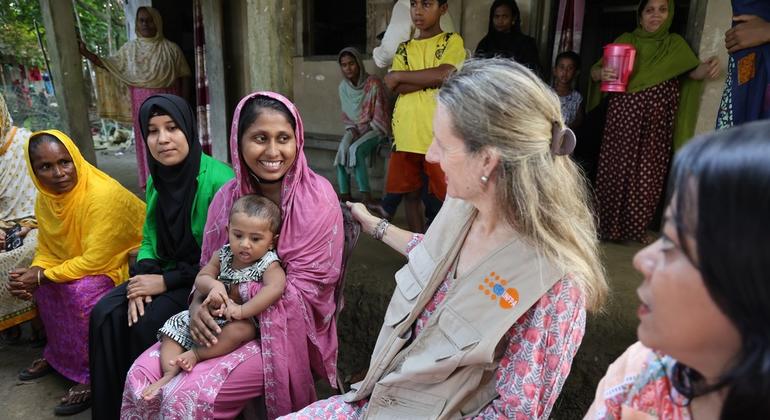

Sunamganj, a district in northeastern Bangladesh, is experiencing the harsh realities of climate change through increasingly frequent and severe floods. These sudden deluges displace families, disrupt daily life, and cut off essential services, posing significant challenges for the over 670,000 women of reproductive age in the region who rely on consistent access to reproductive healthcare. To combat this worsening crisis, the United Nations Population Fund (UNFPA) is actively training women to prepare for the flood’s impacts and protect their families.
Among those benefiting from this training is Shakila Akhter, a 24-year-old mother of two, who found herself eight months pregnant during the last flood. “Thanks to the training I received, I knew what to carry, how to prepare, and how to protect my family,” she said. Shakila has since embraced family planning tools she was unaware of before, stating, “I want to choose when I’m ready for another child.” She emphasized the undeniable link between climate change and escalating floods, noting that the flood season has lengthened, sudden floods have become more common, and overall weather patterns have shifted dramatically over the last two decades. “We all should be prepared to manage it to survive,” she added.
This proactive approach is supported by local volunteers trained to facilitate community resilience against climate-related challenges. Shakila Begum, a 26-year-old volunteer, began her journey with just two days of training. She is now integral to the Climate Resilience Health System and Community initiative, funded by UNFPA and the Swedish International Development Cooperation Agency. Through her efforts, she assists 75 families with maternal healthcare and family planning. “One woman had dangerously high blood pressure just before giving birth. I advised her family to go to the local hospital, where she safely delivered-completely free of cost,” she recounted.
Additionally, the initiative provides community spaces where women can learn about sexual and reproductive health. In Kurban Nagar, volunteers have taken to staging “street dramas” to address critical issues such as maternal health and disaster preparedness. Local student Taskira Hauque Tazin, a core member of the theatre group, expressed her pride in advocating for women’s empowerment. “Through these plays, we raise awareness so that women don’t fall behind,” she stated. “Whether it’s in the sun, rain, or storm-we’ll keep doing this work for the people.”
Anima Akhter, a 24-year-old mother from Kurban Nagar, shared how the dramas create a safe space for discussing personal issues. With the support of local volunteers, she delivered her youngest child at a hospital, illustrating the community’s growth in addressing healthcare challenges. Her husband, Nurul, has also become an advocate for women’s and girls’ health, actively discussing these topics with fellow community members.
Nevertheless, challenges persist. In flood-prone areas, over half of deliveries still occur at home, and conversations on menstruation remain shrouded in shame. Cultural norms often hinder women from pursuing their own income opportunities, leaving them particularly vulnerable during climatic disasters. This situation was highlighted at the recent Global Symposium on Climate Justice and Impacted Populations in Brasília, co-hosted by UNFPA and the Brazilian government. Leaders at this gathering reiterated the need for gender-inclusive climate negotiations and emphasized the disproportionate impacts of climate change on women and girls.
Diene Keita, Acting Executive Director of UNFPA, noted the alarming rise in maternal mortality rates and gender-based violence as direct consequences of climate disruptions. “Our collective efforts must strengthen the resilience of women, girls, and health systems to withstand and adapt to climate shocks,” she urged. Preparing for challenges, responding effectively, and striving for better outcomes must remain central to climate resilience initiatives moving forward.
This vital work in Sunamganj not only protects individuals but also sets an example for other vulnerable communities across the globe.
Original Source: https://news.un.org/feed/view/en/story/2025/08/1165615
Category :
Tags:
Publish Date: 2025-08-09 17:30:00