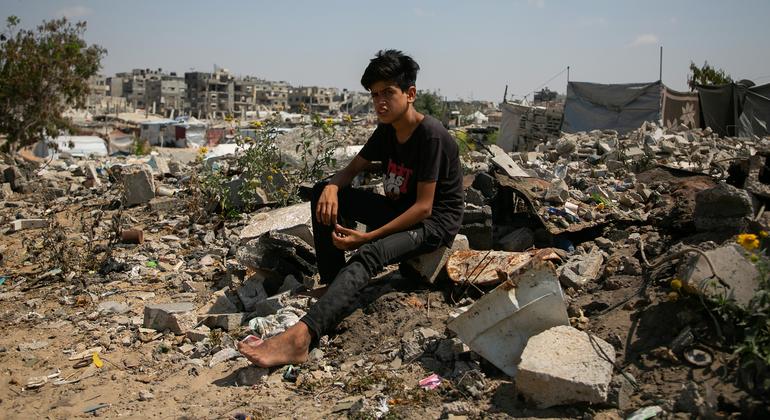
Unbearable Struggles: Tens of Thousands Face Heartbreaking Displacement in Gaza’s New Evacuation Crisis

Those affected by recent relocation orders are being directed to Al Mawasi, a coastal area near Khan Younis already burdened with overcrowding, according to the UN Office for the Coordination of Humanitarian Affairs (OCHA). The UN agency reported that Al Mawasi, lacking essential resources for survival, has seen nearly two dozen airstrikes impacting displaced Gazans who are seeking shelter in makeshift tents between March 18 and April 11. As the conflict enters its 21st month, the most vulnerable populations in Gaza continue to face dire living conditions.
Among those struggling is 70-year-old Musbah Zaqqout, one of 230 patients relying on critical dialysis at Al-Shifa Hospital in Gaza City. Recently, ongoing supply shortages have forced treatments to be cut down from three sessions to just two per week, as the World Health Organization (WHO) highlighted. Zaqqout’s wife, Saadia, shared their ordeal: “He suffered greatly when dialysis was not available. He was suffocating and often hospitalized, even falling into a coma.” However, with assistance from partner organization KS Relief, WHO managed to deliver vital dialysis supplies and fuel, enabling Al-Shifa to resume urgent treatment. “Thank God, after restarting dialysis, his condition improved,” Mrs. Zaqqout added, while the WHO reiterated the need for a continuous flow of food, fuel, and medical supplies into Gaza. The organization warned that critical shortages persist and without urgent replenishment, healthcare services could come to a standstill.
In a related development, the United Nations Relief and Works Agency for Palestine Refugees in the Near East (UNRWA) expressed grave concerns regarding child malnutrition in Gaza. Currently, one in ten children visiting UNRWA clinics exhibits signs of malnutrition, a condition virtually unheard of in the region before the conflict began. Between March and June, this issue has more than doubled among children under five, exacerbated by the ongoing Israeli blockade. Louise Wateridge from UNRWA remarked, “It’s becoming increasingly difficult for us to provide services,” adding that over half of UNRWA’s installations are situated within combat zones or under displacement orders. As of the latest update, only six health centers and 22 medical points operate, alongside 22 mobile medical units. Alarmingly, nearly 60 percent of necessary medical supplies are currently unavailable, leading the agency to stress, “Children are dying before our eyes, because we lack the medical supplies and sustained food to treat them.”
Due to the Israeli blockade that commenced on March 2, UNRWA revealed it has run out of critical medications, including those for high blood pressure, antiparasitic and antifungal treatments, as well as antibiotics for adults. The provision of clean water also remains a significant challenge, with only two main water wells still operational out of ten that functioned prior to the war. The blockade has forced UNRWA to halt water and sanitation services for approximately 25,000 displaced individuals in shelters in northern Gaza due to recent displacement orders. “The restrictions on fuel entry jeopardize life-saving services,” the UN agency cautioned, warning that essential water services could shut down without sustained fuel supplies.
As the humanitarian crisis in Gaza deepens, the need for immediate and robust international support is critical to ameliorate the suffering of its residents.
Original Source: https://news.un.org/feed/view/en/story/2025/07/1165404
Category :
Tags:
Publish Date: 2025-07-16 17:30:00