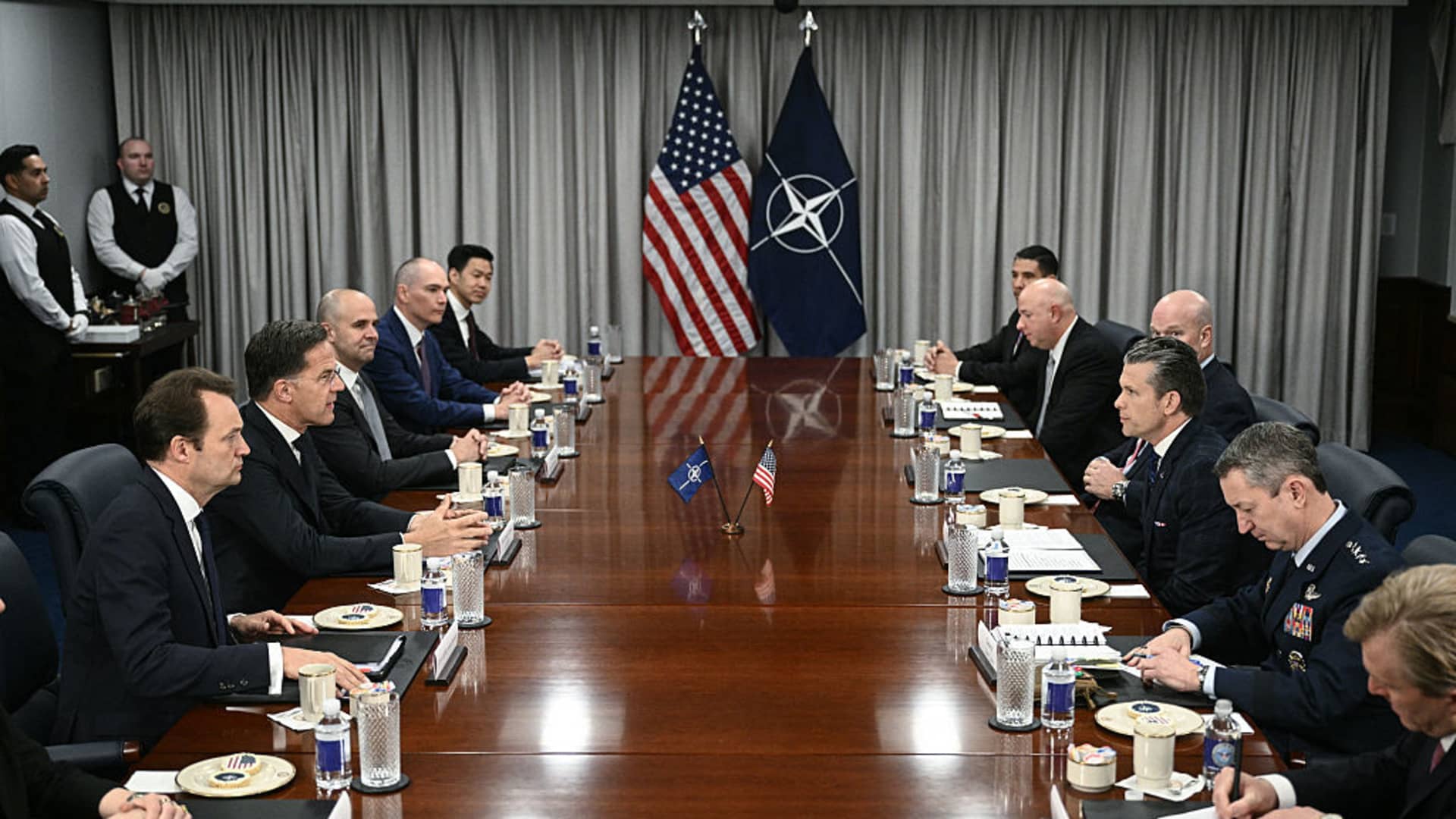

U.S. Secretary of Defense Pete Hegseth met with NATO Secretary General Mark Rutte at the Pentagon on April 24, 2025, as tensions rise ahead of NATO’s annual summit. The United States is urging its allies to significantly ramp up defense spending to a target of 5% of their gross domestic product (GDP). This ambitious figure comprises 3.5% earmarked for direct defense needs and an additional 1.5% aimed at enhancing security infrastructure, such as cyber capabilities and intelligence.
While some member states express readiness to approach this target, others struggle to meet the previously established 2% guideline, set over a decade ago. The real concern remains whether nations will follow through on their pledges. “Talk is cheap, and timelines can be vague,” cautioned Kurt Volker, a former U.S. ambassador to NATO. He emphasized that the U.S., especially under President Donald Trump, seeks genuine commitment from allies, urging them to present concrete plans for achieving this spending goal.
The stakes are high as NATO allies convene in The Hague on June 24-25, with geopolitical unrest in Ukraine and the Middle East further highlighting the urgency of increased defense budgets. Analysts predict that this summit could prove pivotal for NATO, as the U.S. has made clear its expectations ahead of the meeting. Hegseth asserted earlier this month that the 5% target “will happen,” a sentiment echoed by Rutte as he rallied further support from member states.
Historically, the context of NATO spending has evolved. At a time when only six nations, including the U.S., met the 2% benchmark, the landscape has shifted. By 2024, 23 NATO members were compliant with this threshold. However, major economies such as Canada, Spain, and Italy still lag in contributions. Notably, no country has yet approached the 5% goal, with doubts about whether they will meet this ambitious standard.
The U.K., Poland, and Germany have pledged to boost their defense spending, but their timelines remain uncertain. Reports indicate that the U.K. may attempt to delay reaching the target by three years. Spain and Italy are perceived as significant holdouts, with commitments only extending to the 2% target by 2025. Meanwhile, Canada’s defense budget fell short at 1.3% of GDP as of 2024, less than several of its NATO counterparts.
Experts emphasize the complexity of tripling defense expenditures to 5%. Jason Israel from the Defense Technology Initiative remarked that nations are grappling with how to balance these commitments against rising domestic tensions around spending. He pointed out that significant shifts in military capability take time and cannot be achieved merely through pledges.
European defense stakeholders are keenly observing NATO’s discussions, as they navigate the gap between commitments and actionable procurement. Micael Johansson, CEO of the Swedish defense firm Saab, highlighted the need for Europe to unite its defense spending to enhance production capabilities. Similarly, Roberto Cingolani of Italian defense company Leonardo stressed the necessity of prioritizing defense production over fragmented country-specific efforts.
As NATO progresses, the pressure mounts for member states to translate verbal commitments into tangible actions. The road ahead demands not only financial investments but a genuine reevaluation of defense priorities for mutual security. The upcoming summit could define NATO’s future trajectory amid a rapidly changing global landscape.
Original Source: https://www.cnbc.com/2025/06/23/nato-summit-allies-to-agree-to-spending-hike-but-will-they-deliver.html
Category :
Tags:
Publish Date: 2025-06-23 10:43:00