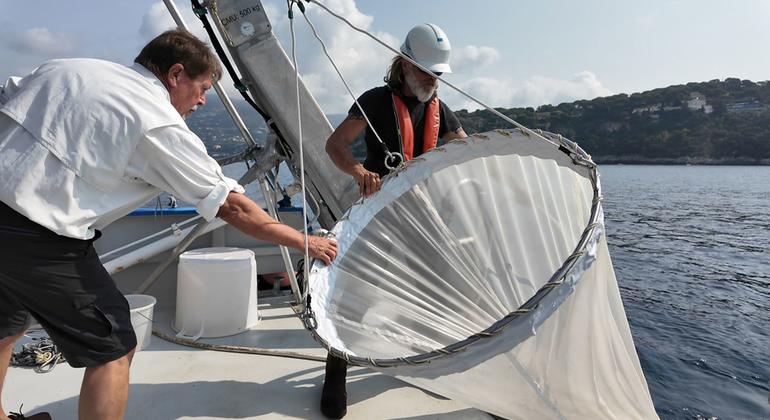

On a sunlit morning off the coast of Villefranche-sur-Mer, the 40-foot scientific vessel Sagitta III navigates the azure waters of the Mediterranean, passing serene marinas and lush, pine-fringed terraces of France’s Côte d’Azur. A buoy bobbing on the horizon marks a vital sampling site that local scientists have monitored for decades. Here, in the heart of the ocean, the romance of the coastal scenery fades as Lionel Guidi, a researcher from the Villefranche Oceanography Lab (LOV), focuses intently on the sea. His mission? To collect plankton, the microscopic organisms that form the ocean’s vital ecosystems.
“There’s life!” exclaims marine technician Anthéa Bourhis as the team prepares to haul in their catch. Under the watchful eye of Captain Jean-Yves Carval-a seasoned navigator with five decades of maritime experience-the crew operates with precision. “Plankton is fragile,” Carval reminds them. “If you go too fast, you make compote.” As the vessel approaches the buoy, the excitement builds. Below deck, Chief Mechanic Christophe Kieger readies a robust winch, deploying a fine-meshed net that descends to 250 feet. Moments later, the net surfaces, heavy with a gelatinous mass.
Inside the catch lies more than just seawater and goo; it’s a glimpse into the planet’s past and possibly its future. Guidi, 44, has dedicated his career to studying these creatures, pointing out their significance: plankton are the heartbeat of ocean ecosystems. They absorb carbon dioxide, release oxygen, and support the entire marine food web. However, these organisms-some smaller than a speck of dust-are now showing troubling signs.
At the LOV, scientists have maintained one of the world’s longest continuous records of plankton, and the data reveals an alarming trend. “At our observation site, surface temperatures have risen by approximately 1.5 degrees Celsius over the last 50 years,” Guidi notes. This increase correlates with a decline in phytoplankton production, which could trigger cascading effects throughout marine life, threatening fish stocks and global biodiversity.
Back at the lab, as the Sagitta III returns to port, Guidi scans the day’s samples, which are now fixed in formaldehyde to preserve them for analysis. “Everything starts with plankton,” he emphasizes, while the youthful Bourhis collects data for an AI-operated database designed to categorize zooplankton by various classifications. “You look through the microscope, and there’s a whole world,” she exclaims as graceful copepods appear on the screen.
Plankton’s pivotal role in ecological balance and climate regulation cannot be understated, and their decline poses a significant threat to both marine and terrestrial life. As Jean-Olivier Irisson, another plankton expert at LOV, explains, “If there’s no more plankton, there’s no more life in the ocean. And if there’s no more life in the ocean, life on land won’t last much longer.”
The urgency of protecting ocean ecosystems takes center stage next week in Nice during the UN Ocean Conference, where delegates will discuss crucial initiatives like the ’30 by 30′ pledge to safeguard 30% of the ocean by 2030. Guidi underscores the importance of integrating scientific findings into policy decisions. “We convey scientific results; these are facts, not opinions,” he asserts.
As Guidi, Bourhis, and Captain Carval continue their vital work-hauling life from the ocean, capturing its essence in pixels, and sharing findings with the global community-they illuminate the intricate, often-overlooked connections that sustain our planet. Their research is not just about the fragility of plankton but a testament to the interconnectedness of all life on Earth.
Original Source: https://news.un.org/feed/view/en/story/2025/06/1164141
Category :
Tags:
Publish Date: 2025-06-08 17:30:00