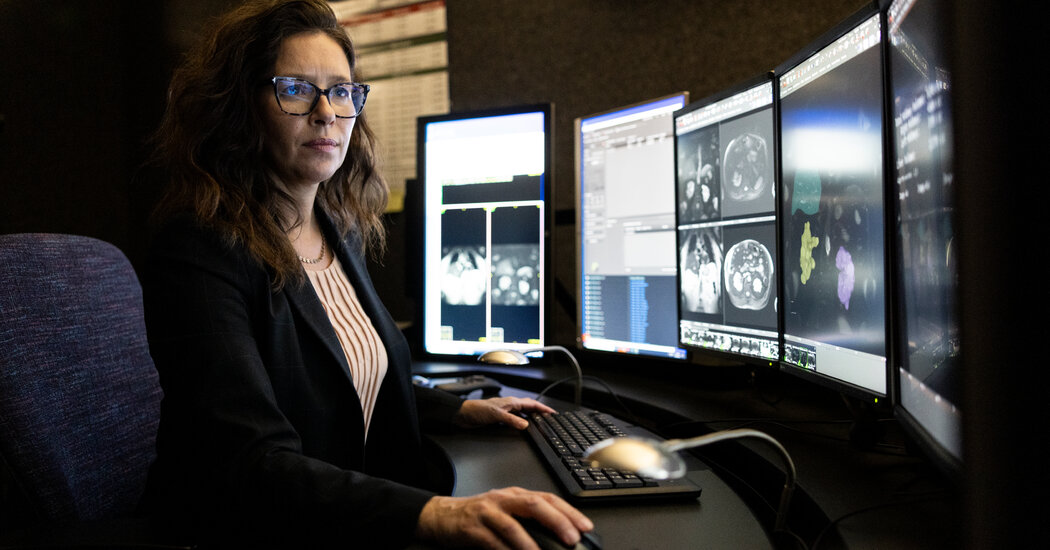

Nine years ago, artificial intelligence pioneer Geoffrey Hinton sparked a pivotal discussion in the medical field by declaring that training radiologists should cease, predicting that AI would surpass human performance in imaging within five years. Contrary to this forecast, radiologists remain in high demand, with a recent study from the American College of Radiology projecting a growing workforce through 2055. Hinton, who earned a Nobel Prize in Physics the previous year for his A.I. innovations, was accurate in asserting the technology’s impact, but he underestimated its role as a collaborative tool rather than a job eliminator.
At the Mayo Clinic, a leader in healthcare innovation, radiologists are increasingly integrating A.I. into their workflows to enhance image clarity, automate mundane tasks, detect abnormalities, and even predict diseases. “Would it replace radiologists? We didn’t think so,” noted Dr. Matthew Callstrom, chair of radiology at Mayo Clinic. “We understood the complexity of their role.”
The conversation around A.I.’s potential to disrupt the workforce continues, with experts divided over whether the technology will augment human capabilities or displace jobs. Rapid advancements in AI—especially in applications like chatbots—have intensified this debate. Leaders from tech firms such as OpenAI anticipate A.I. fulfilling most cognitive tasks in the near future, while many researchers advocate for a more tempered view, akin to past innovations like electricity and the internet.
The case of radiologists illustrates this dynamic well. Currently, about 75% of the 1,000 A.I. applications approved by the Food and Drug Administration for medical use focus on radiology, showcasing A.I.’s strength in pinpointing specific abnormalities like lung lesions. “While there’s incredible progress, A.I. primarily targets singular issues,” remarked Dr. Charles E. Kahn Jr., a radiology professor at the University of Pennsylvania.
The scope of a radiologist’s work extends far beyond image analysis. They collaborate with other medical professionals, communicate with patients, write reports, and interpret findings based on extensive knowledge and experience. David Autor, a labor economist at MIT, contends that predictions of job loss frequently overlook the intricacies of human roles in complex fields like radiology.
At Mayo Clinic, A.I. is not merely a threat but a tool for enhancing efficiency and accuracy. Since Hinton’s alarming prediction, the radiology team has expanded by 55%, now employing over 400 radiologists. Addressing potential A.I. impacts in 2016, Mayo’s leadership prioritized using technology to improve their practices. The department now boasts a dedicated A.I. team of 40 professionals focused on creating tailored A.I. solutions, from tissue analyzers to disease predictors.
For example, Dr. Theodora Potretzke has worked with A.I. to measure kidney volume more efficiently. Previously reliant on manual methods, she now accesses precise measurements instantly, saving significant time while ensuring accuracy. “I’m comfortable using A.I. for efficiency, but I maintain my role in interpretive conclusions,” she explained.
Dr. Francis Baffour described A.I.’s presence in radiology as ubiquitous, with algorithms enhancing image capture, cleaning, and interpretation. Mayo Clinic employs over 250 A.I. models across various departments, leading to new insights that human professionals may miss. One A.I. project analyzes pancreas shapes to predict cancer years earlier than standard methods.
Dr. John Halamka, overseeing Mayo’s digital health initiatives, expressed optimism about A.I.’s future in medicine. He believes it will become essential, predicting that “in five years, it will be malpractice not to use A.I.” Hinton, reflecting on his previous statement, conceded that he underestimated A.I.’s partnership potential with human radiologists rather than merely replacing them.
In summary, the evolution of A.I. in radiology serves as an instructive case, illustrating a collaborative future where technology amplifies human expertise rather than renders it obsolete. This collaborative model is bound to redefine the healthcare landscape, reinforcing the message that A.I. will augment rather than replace medical professionals.
Original Source: https://www.nytimes.com/2025/05/14/technology/ai-jobs-radiologists-mayo-clinic.html
Category : Artificial Intelligence,Hospitals,Innovation,Research,Doctors,Mobile Applications,Computers and the Internet,Medicine and Health,Mayo Clinic,Hinton, Geoffrey E
Tags:
Publish Date: 2025-05-14 14:30:00