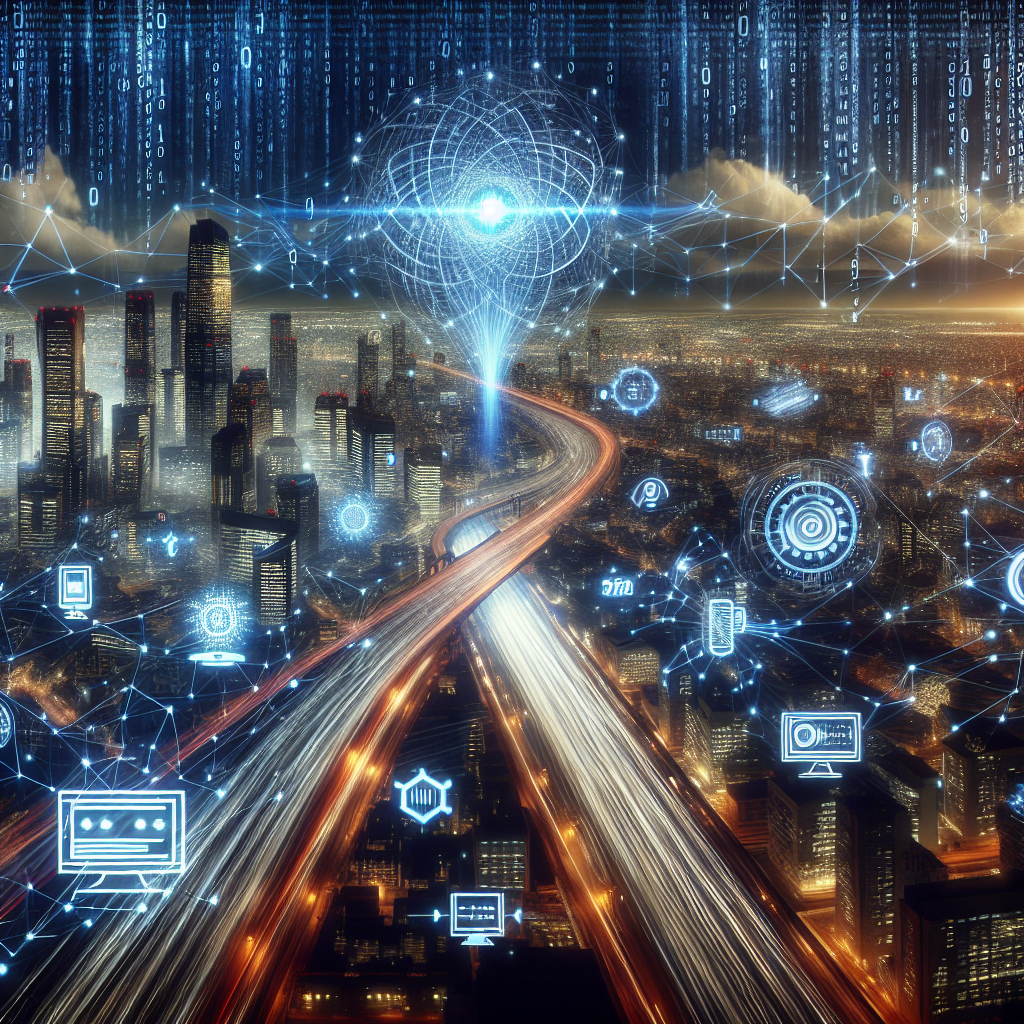
Revolutionize Your Data Processing: Unleashing the Power of Edge Computing in 2025

Imagine you’re watching your favorite sports game, and the action is unparalleled. But then, you see a split-second delay in the streaming video. Frustrating, right? It’s a bit like sitting in a movie theater with a friend who keeps checking his phone, missing the best parts. In our hyper-connected world, where speed is king and data flows like a river, that lag is simply not acceptable. Enter edge computing—the unsung hero that’s ready to transform how we process real-time data by 2025.
Edge computing, at its core, is about bringing computation and data storage closer to the sources where data is generated. Instead of sending everything to a central cloud for processing (which can feel like sending a kid to a big city for a field trip), edge computing allows us to handle a lot right at the “edges” of the network—closer to where the action is happening. Think of it as a local café where you can grab coffee while your tech buddies brew up fresh code, rather than waiting for the barista at a crowded chain.
Let’s take a stroll down memory lane to 2020, when I was helping implement AI-driven systems for smart agriculture at Webx Technologies. One of our clients was a farm in the Sylhet region using drones to monitor crops. When the drone detected a potential pest outbreak, it could send an alert—which could either trigger an immediate response or get lost in the cloud data surge. By integrating edge computing, we enabled real-time processing of this data on the drone itself, ensuring farmers could act faster. Suddenly, waiting for cloud processing became yesterday’s news, and our farmers were empowered to protect their crops like never before.
Now, let’s talk about what this means for 2025. With advancements in 5G and IoT technologies, edge computing is set to proliferate. Imagine standalone devices—your car, your thermostat, even public traffic lights—all functioning on their own intelligence. With latency reduced to mere milliseconds, the transition from data generation to actionable insights will be almost instantaneous. This isn’t fluff; it’s the future knocking on our doors.
This flourish of data processing at the edge brings a few takeaways worth considering. First, think about privacy and security; processing data closer to the source means we minimize the exposure of sensitive information in transit. If a device can analyze your data locally rather than sending it to a central server, it can enhance security and retain your privacy in ways traditional computing can’t.
Second, operational efficiency will get a serious upgrade. For businesses that rely on real-time data for decision-making, edge computing can reduce bandwidth use and cloud costs, keeping your budget in check while allowing for more agile operations. Imagine having the capability to analyze customer behaviors on-site without ever needing to send data back and forth—it’s like having the wisdom of a sage constantly by your side.
Lastly, consider the implications for innovation. Startups with edge computing solutions can disrupt industries by offering tailored experiences in a way that centralized models simply can’t. The game is changing, and those who embrace the edge will be writing the playbook.
So, whether we’re talking about autonomous vehicles navigating through traffic or advanced healthcare systems monitoring patients in real-time, the ripples of edge computing will redefine how we interact with technology. Now is the time to start rethinking not just how we use data, but the very architecture of our tech ecosystems.
In this race for speed and efficiency, embracing edge computing isn’t just an option. It’s a necessity. As we look toward 2025 and beyond, let’s gear up: the edge is where innovation breeds like wildfire, fostering a landscape of possibilities that are as limitless as our imagination.
Author Profile
Sanjeev Sarma is Director of Software Services and Chief Software Architect at Webx Technologies Private Limited. With a fervent passion for technology, he explores the intersections of AI, cybersecurity, and everyday life, aiming to inspire readers to embrace innovation while maintaining a grounded perspective.