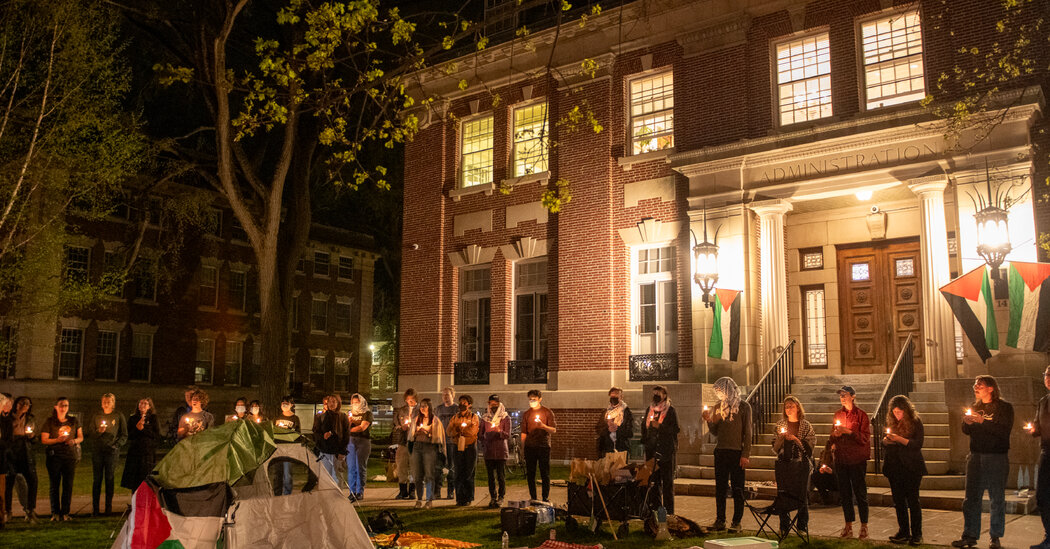

In a growing controversy over higher education’s political landscape, approximately 600 college leaders have publicly opposed the Trump administration’s interference in academia. Notably absent from this group is Sian Beilock, Dartmouth College’s president, who instead opted to convey her thoughts through a personal message to her institution. Beilock emphasized the need for higher education institutions to elevate their role as “a trusted beacon for knowledge and truth,” asserting that “reflection does not mean capitulation.” This stance, according to both her supporters and critics, has so far kept Dartmouth out of the administration’s direct line of fire.
While six of the eight Ivy League schools are grappling with substantial funding threats amounting to billions, largely due to concerns about antisemitism and related issues, Dartmouth has yet to face the same scrutiny. Harvard University alone could lose over $2 billion. Every Ivy except Dartmouth is currently under investigation for allegedly allowing antisemitism on campus. However, if federal policies shift, Dartmouth could still feel the repercussions through higher endowment taxes and visa regulations impacting its international student community.
Supporters characterize Beilock as a proponent of free expression and diverse viewpoints, noting her commitment to these ideals well before the Trump administration intensified campus debates. Malcolm Mahoney, leader of the Dartmouth Political Union, described her dedication as genuine and devoid of political motives. Conversely, critics argue that Beilock is attempting to appease conservative factions to shield Dartmouth from potential backlash, highlighting instances of heavy police presence during pro-Palestinian protests last year.
Dartmouth’s relative immunity to federal pressure may stem from its smaller size and conservative reputation compared to its Ivy League counterparts. Beilock has strategically aligned the college with conservative viewpoints, appointing a former Republican official as a top lawyer and prioritizing free expression in her public communications. Recent comments from White House officials indicate positive relations, with Harmeet Dhillon, head of the Justice Department’s civil rights division, praising Dartmouth for its approach.
While acknowledging the importance of free speech, Beilock maintains that it should not infringe upon others’ expressions. She asserts that her consultations span the political spectrum to uphold academic freedom and viewpoint diversity while fostering independence as an institution. At 49, Beilock is the youngest Ivy League president and has faced backlash in the wake of her peers resigning in response to handling student protests.
In a pivotal move that attracted mixed reactions, she authorized armed police to dismantle a peaceful protest encampment on campus, harking back to earlier moments of student demonstrations that the college tolerated. This incident notably contrasts with Dartmouth’s historical protests against apartheid.
Her appointment of Matthew Raymer, who previously championed Trump’s policies, as the college’s chief legal counsel has stirred discontent among student activists, raising concerns about the treatment of international students. More than 2,500 alumni have signed a petition urging Beilock to join those resisting governmental pressures, while others hail her as a leader championing free speech, with petitions in her support gathering significant signatures.
Despite the polarized opinions her approach has incited, Beilock insists on maintaining her course. Drawing from her tenure at the University of Chicago, where institutional neutrality became a cornerstone, she believes that institutions can assert their unique voice while navigating the complex political landscape. Amid ongoing discussions about fostering open dialogue, Beilock remains steadfast in her vision for Dartmouth, stating, “We can stand with our peers and also speak in our own voice; those are not mutually exclusive.”
Original Source: https://www.nytimes.com/2025/05/11/us/politics/dartmouth-college-trump.html
Category : Dartmouth College,United States Politics and Government,Colleges and Universities,Pro-Palestinian Campus Protests (2023- ),Beilock, Sian,Dhillon, Harmeet,Hanover (NH),Federal Aid (US),Ivy League,University of Chicago,New Hampshire,Academic Freedom,Conservatism (US Politics)
Tags:
Publish Date: 2025-05-12 19:12:00