
In the waters off New England, one of Earth’s rarest mammals, the North Atlantic right whale, swims slowly with its mouth agape, filtering tiny reddish zooplankton known as Calanus finmarchicus from the sea. These zooplankton, about the size of grains of rice, are essential for the whale’s survival, with only around 370 of these majestic creatures left.
For decades, researchers tracked these small plankton by sending vessels into the ocean, towing nets and counting samples manually. However, scientists are now turning to a new method that involves satellite data. By utilizing data from NASA’s satellites, researchers have developed a way to detect swarms of Calanus at the ocean surface in the Gulf of Maine, leveraging the natural red pigment of these animals. This innovative approach, detailed in a recent study, could enhance researchers’ ability to pinpoint where copepods congregate and where the whales might follow.
Monitoring zooplankton from space may greatly benefit both the whales and maritime industries. By predicting where these mammals are likely to feed, marine resource managers aim to reduce the risk of vessel strikes and entanglements, which are significant threats to the species. Understanding their feeding patterns could also improve operational efficiency for the shipping and fishing industries.
“NASA invests in this kind of research because it connects space-based observation with real-world challenges,” stated Cynthia Hall, a support scientist at NASA’s headquarters in Washington. Hall is part of the Early Career Research Program, which partially funded the project. “It’s yet another way to put NASA satellite data to work for science, communities, and ecosystems.”
This new methodology employs data from the Moderate Resolution Imaging Spectroradiometer (MODIS) onboard NASA’s Aqua satellite. Rather than directly spotting the copepods, the MODIS instrument analyzes how sunlight reflected off the ocean surface is altered by the substances in the water.
When large numbers of zooplankton rise to the surface, their reddish pigment—astaxanthin, which also gives salmon their pink hue—affects how photons, or light particles from the sun, are absorbed or scattered. The behavior of these photons in the ocean varies based on the mix of living organisms and inorganic materials in seawater, causing slight color shifts detectable by MODIS.
“We didn’t know to look for Calanus this way before,” noted Catherine Mitchell, a satellite oceanographer at Bigelow Laboratory for Ocean Sciences in East Boothbay, Maine. “Remote sensing has usually focused on smaller entities like phytoplankton. Recent findings suggest that larger zooplankton can influence ocean color as well.”
Previously, researchers tested this satellite method to detect copepods in Norwegian waters. Now, some of those scientists, alongside Mitchell’s team, have refined the technique for application in the Gulf of Maine, a critical feeding area for right whales during their migration. By integrating satellite data, models, and field measurements, they created enhanced images revealing Calanus swarms at the surface and estimated their populations.
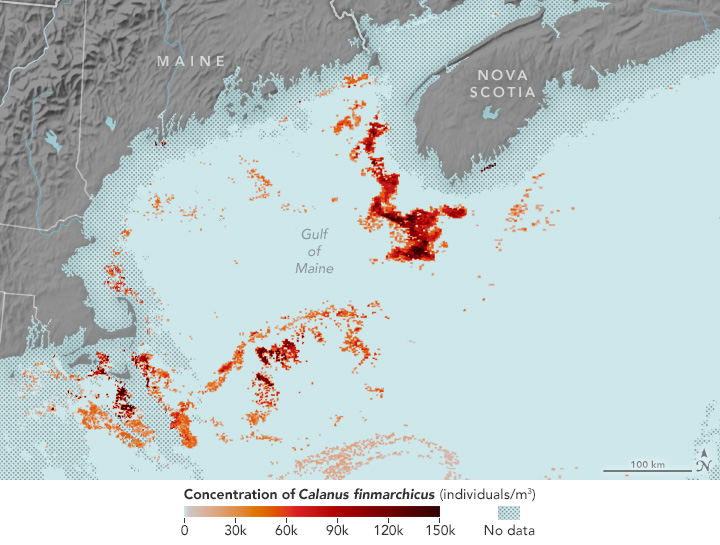
The accompanying map illustrates Calanus patches in Gulf of Maine surface waters from June 17, 2009, identified during their new approach tests. On that day, estimated concentrations of the copepods reached as high as 150,000 individuals per cubic meter. For comparison, a separate image shows the same area in natural color as perceived by the human eye. The map reveals patterns almost invisible to the naked eye in natural color images alone, such as dense patches southwest of Nova Scotia and sparser clusters toward the gulf’s center.
“We know that right whales inhabit areas we don’t fully comprehend,” remarked Rebekah Shunmugapandi, a satellite oceanographer at Bigelow and the study’s lead author. “This satellite-based information on Calanus could help pinpoint unknown feeding grounds or better predict whale migration patterns.”
Original Source: https://earthobservatory.nasa.gov/images/154283/mapping-the-tiny-plankton-that-feed-giant-right-whales
Category:
Tags:
Publish Date: 2025-05-12 03:33:00