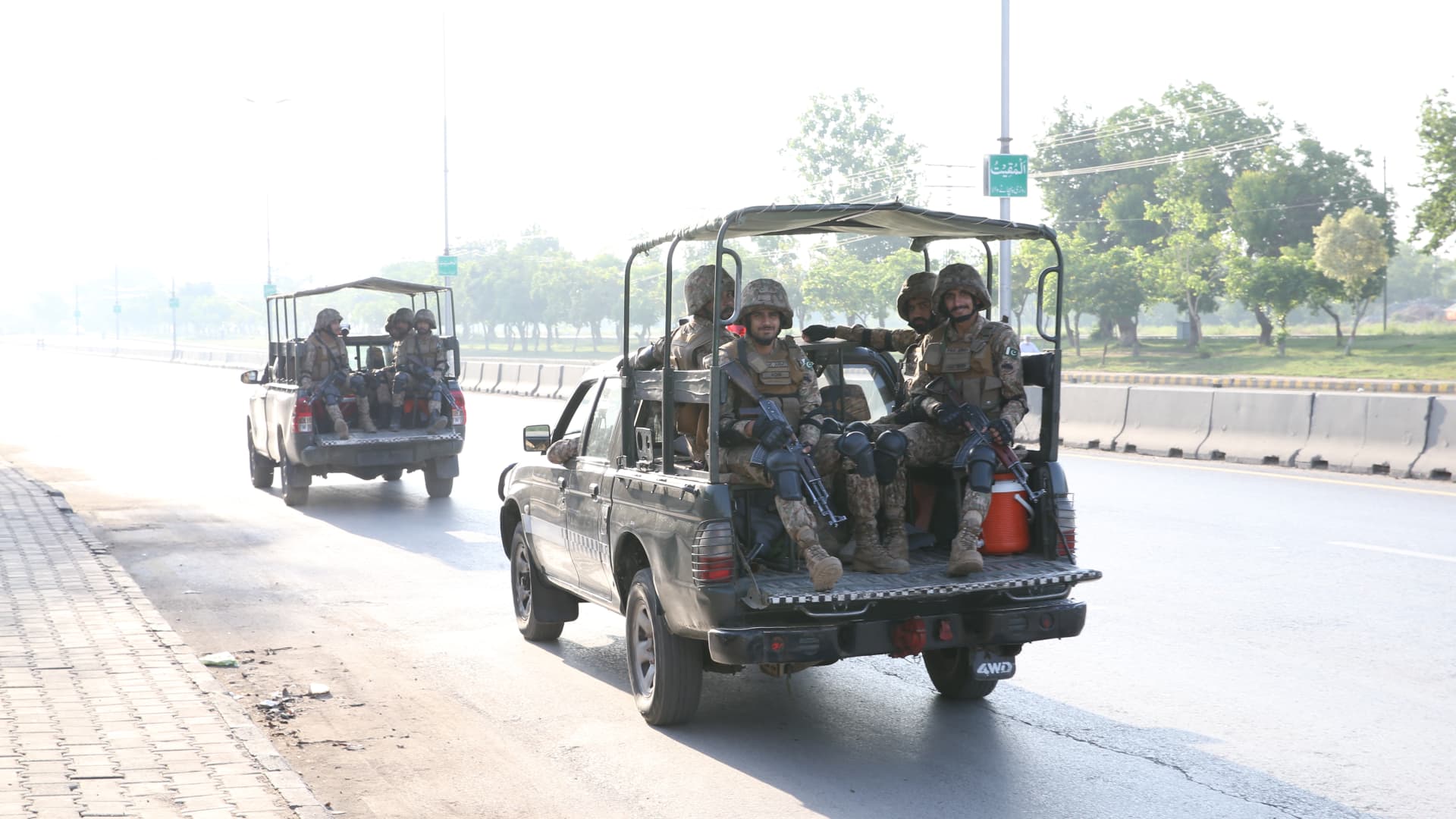

Pakistani security forces were deployed outside Nur Khan Air Base after an Indian missile strike occurred in Rawalpindi on May 10, 2025. Following the incident, Pakistan’s Defence Minister Khawaja Asif confirmed in an interview with ARY TV that there has been no meeting of the National Command Authority (NCA)—the country’s primary body responsible for overseeing its nuclear arsenal—nor is any meeting planned. His comments came in the wake of a military operation against India, which intensified tensions in the region.
Asif’s statement reflects the heightened state of alarm within Pakistan’s military and political circles. Earlier reports indicated that Prime Minister Shehbaz Sharif had called for an NCA meeting to assess the situation. However, uncertainty looms as Pakistan’s information minister did not respond to requests for further clarification.
In a separate televised address, Pakistan’s Foreign Minister also hinted at a potential for de-escalation. He remarked, “If India stops here, then we will consider stopping here.” The remarks seem to suggest that Pakistan is open to diplomatic avenues but is prepared to respond to threats.
The situation has caught the attention of international powers, particularly the United States. U.S. Secretary of State Marco Rubio has actively engaged in discussions with both Pakistan’s Army Chief General Asim Munir and India’s Foreign Minister Subrahmanyam Jaishankar. Rubio underscored the urgent need for both nations to de-escalate tensions and re-establish direct communication channels to prevent further miscalculations.
The recent escalation in hostilities stems from a long history of conflict between India and Pakistan, particularly regarding territorial disputes and military skirmishes. This latest incident adds another layer of complexity to an already volatile relationship, prompting fears of a broader confrontation.
As the situation develops, analysts and international observers are closely monitoring the responses from both governments. The international community remains hopeful that dialogue will take precedence over military action, given the potentially catastrophic consequences of any escalation.
In conclusion, while both Pakistani officials and military leadership express readiness to engage in dialogue, the current stance presents a precarious balance. With calls for calm and the potential for further military actions, the international landscape will be watching closely as events unfold in this increasingly tense environment.
Original Source: https://www.cnbc.com/2025/05/10/pakistan-minister-denies-nuclear-body-meeting-after-offensive-launched-on-india.html
Category :
Tags:
Publish Date: 2025-05-10 12:29:00