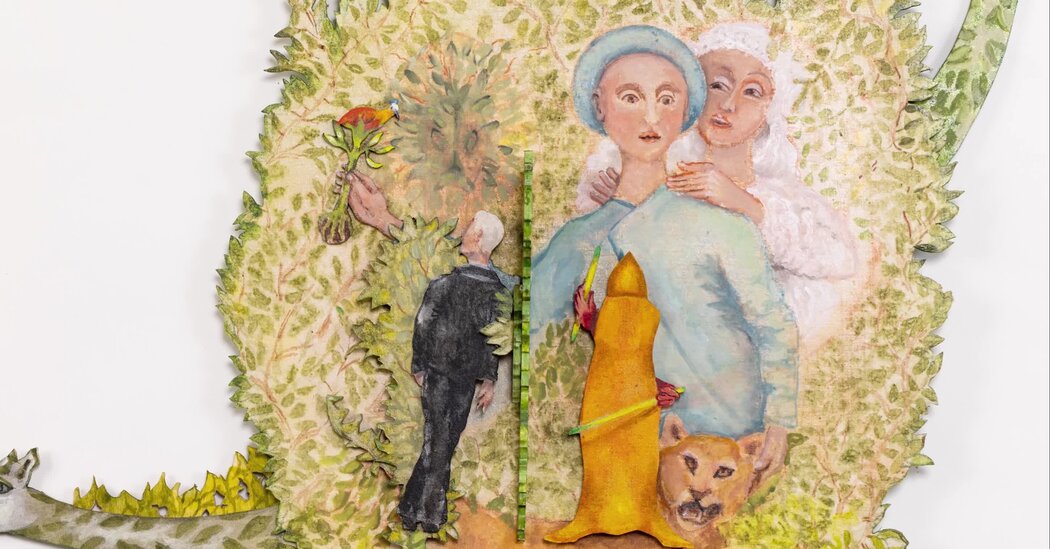

In the vibrant heart of Paris during the late 1950s, Jean-Claude Silbermann knew exactly where to find the Surrealists. Every evening, a group led by the influential writer and poet André Breton would gather at Le Musset cafe. Silbermann, only a budding artist at the time, boldly approached Breton. “You are André Breton. I am Jean-Claude Silbermann. I’m a Surrealist,” he declared. To Silbermann, Surrealism was more than art—it was a mindset, an embodiment of revolt.
Born in 1935 in Boulogne-Billancourt, Silbermann defied familial expectations by leaving home to pursue poetry instead of joining his father’s successful hat business. His life took him from the suburbs of Paris to Oslo and Copenhagen, navigating various odd jobs, including palm reading, to sustain himself. These experiences barely anticipated his later return to Paris, where he briefly succumbed to bourgeois comforts before a chance meeting with Breton reignited his artistic passions.
Now 90, Silbermann’s journey through Surrealism continues to captivate. His artworks will soon grace the Independent Art Fair in Manhattan, marking their debut in the United States. These pieces embrace the Surrealist ethos with dreamlike imagery, celebrated recently at the Pompidou’s “Surrealism” exhibition. Here Silbermann notes, he was “the only Surrealist alive” among the historical retrospectives.
In 2024, the artist was reintroduced via a unique connection to Vincent Sator, whose grandmother was once married to Breton. Sator’s gallery, Galerie Sator, is showcasing Silbermann’s vibrant works, created mainly between 2021 and 2024. Among them, the standout “Vous Partez Déja?” portrays a vibrant yellow bird clutching pink and purple skulls, symbolizing the complex interplay between Silbermann’s artistic vision and his personal experiences.
Though Silbermann’s art isn’t directly political, his life reflects 20th-century upheavals. His family’s harrowing escape during World War II, and his anti-war stance during the Algerian War, demonstrate his resilience and belief in freedom—a theme central to Surrealism.
Silbermann insists that Surrealism remains vital, poised for new interpretations by future generations. “It is not over,” he asserts, highlighting Surrealism’s nature as an attitude towards life rather than a historical artifact. His artwork, filled with fantastical, psychological, and politically suggestive scenes, encourages viewers to engage deeply with the unknown—echoing the notions of intuition and spontaneity championed by Freud.
Despite struggles, such as his three-year illness during the Algerian War, art provided salvation. He transitioned from poetry to painting, finding it more accessible yet equally profound. His works, like “L’Attente et Le Moment de La Nuit,” traverse themes of transformation and transcendence, while pieces like “Le Consommateur” critique consumerism through surreal symbolism.
Silbermann’s narrative, interwoven with anecdotes of Surrealist giants and wartime escapades, captures a life dedicated to art and revolt. As he humorously reflects on his legacy, recognizing himself both as “the last Surrealist alive” and part of an ongoing movement, the impact of his work resonates, promising freshness amid a century-old rebellion.
Original Source: https://www.nytimes.com/2025/05/05/arts/design/the-last-surrealist.html
Category : Art,Breton, Andre,France,United States,Surrealism,Independent Art Fair,Silbermann, Jean-Claude (1935- )
Tags:
Publish Date: 2025-05-05 23:05:00