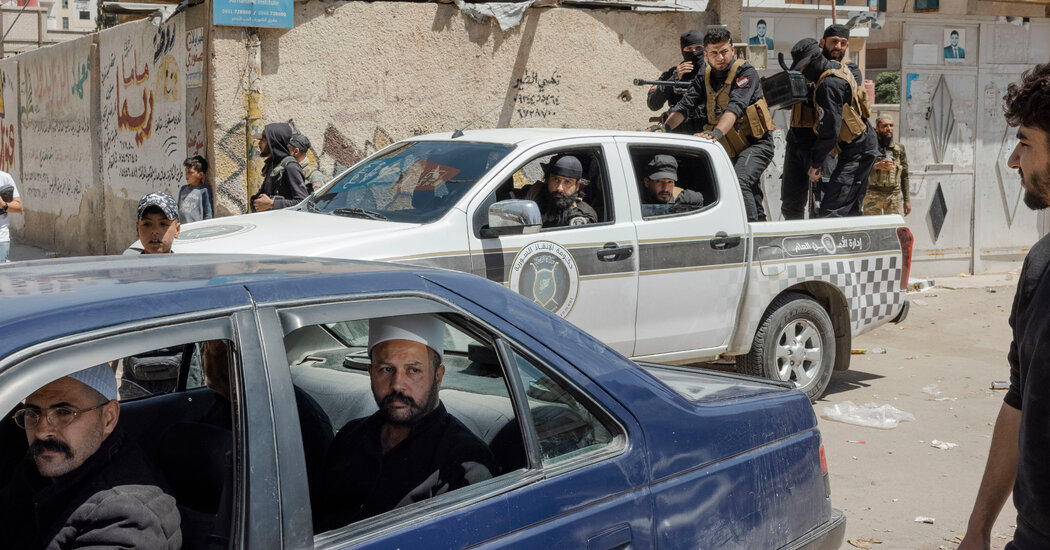

Sirens blared and a convoy of armed men followed closely as a black SUV maneuvered through the streets of Ashrafieh Sahnaya in Syria on Friday morning. This dramatic arrival signaled the government forces’ reclamation of the town from armed groups, following a two-day sectarian conflict that left dozens dead and showcased the fragile security under Syria’s new leaders. Now, government officials had come to assure a skeptical populace of peace.
In the local religious meeting hall, government representatives sat with Druse leaders. “We’re all in one ship,” stated Jameel Mudawwar, the area’s top official. His call for unity was not new, but this time it came with action.
Facing pressure from the national military, the Druse militias, known for controlling a strategic area in southern Syria, agreed to government concessions in exchange for laying down their arms. These concessions included promises to investigate abuses during the clashes and integrate some fighters into government forces. “We don’t want to carry weapons. We don’t want to be against the state,” declared Sheikh Abu Rabih Haj Ali, a chief Druse religious leader.
This development comes after Sunni rebels overthrew Bashar al-Assad’s regime in December. Despite the shift, many in Syria’s minority communities, including the Druse, remain distrustful of their new leaders. Recent violence was partially incited by a false audio tape allegedly of a Druse cleric insulting the Prophet Muhammad, leading to attacks from Sunni extremists. Over 101 people, including civilians, were killed in the ensuing chaos as local Druse militias clashed with both government forces and armed Sunni extremists.
Amid this turmoil, Israel intervened, claiming to protect the Druse, by launching airstrikes on Syrian government targets. The Druse, a religious minority practicing a secretive offshoot of Islam, number over a million across the Middle East.
At Friday’s meeting, concerns persisted. One attendee demanded assurance of security, accusing pro-government forces of civilian harm. Mudawwar responded, “We are promising you a better life.”
Some attendees were placated. Saleh Makiki, grieving the loss of five family members in the conflict, expressed willingness to move forward after key Druse demands were met, including the release of 32 detained locals.
Outside, opinions were split. Bahira Haj Ali observed the meeting’s aftermath from her window, appreciative of the local Druse militias’ resistance but wary of disarming. “This is our security,” she said.
Discrepancies about the conflict’s origins persisted, with Sunnis and Druse blaming each other for initial aggression. The town’s square bore the marks of battle, littered with broken glass and bullet casings.
Following Friday prayers, young men gathered, raising the flag of Hayat Tahrir al-Sham, a Sunni faction central to the current power dynamic. Their chants of unity clashed with those emphasizing Sunni identity and allegiance to the Prophet Muhammad.
As Ashrafieh Sahnaya grapples with its future, the path to peace remains rife with challenges, underscoring the complex web of allegiances and fears shaping Syria’s present landscape.
Original Source: https://www.nytimes.com/2025/05/03/world/middleeast/syria-druse-sectarian-violence.html
Category : Syria,Druse (Sect),Hayat Tahrir al-Sham,War and Armed Conflicts,Fringe Groups and Movements,Deaths (Fatalities),Religion-State Relations,Sunni Muslims,Peace Process,Ashrafieh Sahnaya (Syria)
Tags:
Publish Date: 2025-05-03 18:03:00