
In the Syrian city of Jaramana on Wednesday, tensions were palpable as armed men stood guard in response to an escalating crisis. These men, some dressed in jeans, others in the traditional baggy pants of the Druse sect, bore rifles across their chests. They blocked roads and moved with urgency, conveying a tension that left little room for distraction.
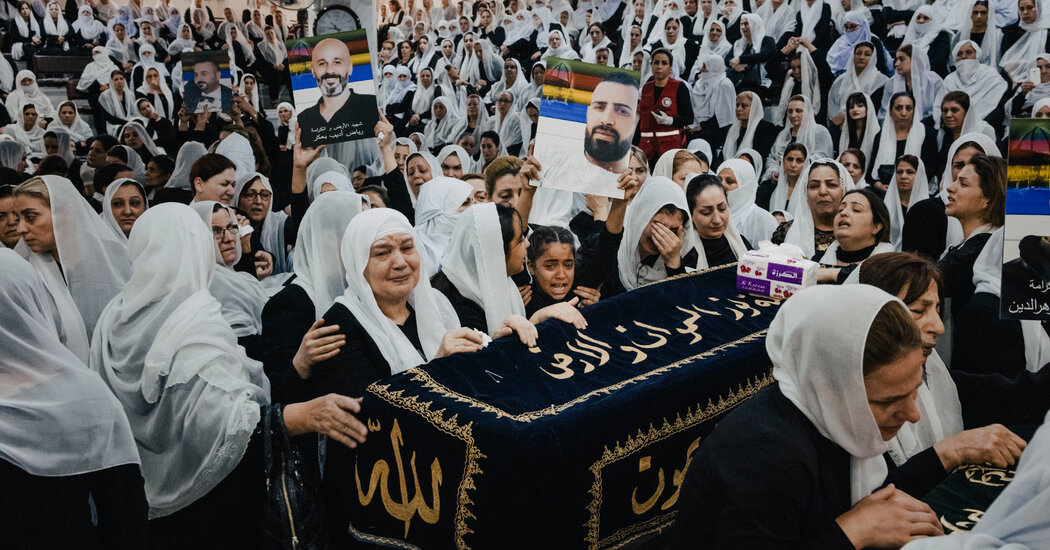
At the heart of this unrest was a Druse religious gathering site, where seven velvet-draped coffins lay surrounded by grieving women. These coffins held the bodies of men killed by gunfire and shelling on Tuesday, allegedly by Islamist extremists. As funeral processions unfolded, reports of clashes and rising death tolls in nearby Druse towns trickled in.
While some trucks from Syrian security forces circulated, the defense of Jaramana rested primarily on its residents, who had armed themselves to protect their community. “We’re just protecting ourselves,” said Ghassan Azzam, a local resident, expressing a shared sentiment of self-reliance in the face of inadequate government intervention.
These clashes come amid ongoing violence against Syria’s religious minorities following the collapse of Bashar al-Assad’s regime in December. The new Sunni-dominated government promised inclusivity but has struggled to maintain its credibility due to repeated attacks on minority regions. Incidents such as the massacres of Alawite civilians in the coastal heartland have fueled skepticism about the government’s commitment.
Rabee Mounzer, a Druse leader, criticized the government for its lack of control. “Either the government is turning a blind eye, or it doesn’t have the capacity to control anyone,” he lamented. His fears echoed throughout the community, haunted by memories of past violence.
The week’s violence was triggered by a circulated audio clip allegedly insulting the Prophet Muhammad, believed to be from a Druse cleric. Although cleared by Syria’s Interior Ministry, the message stirred outrage among Muslims, who threatened the Druse community. Armed men on motorbikes launched an attack early Tuesday, targeting a government checkpoint and killing two residents. By dawn, shouting attackers clad in Islamic patches incited further violence.
Seven Jaramana residents and eight attackers died in the skirmishes. Among the attackers, an identity card linked to Hayat Tahrir al-Sham, a group once affiliated with Al Qaeda, was found. While some fighters have integrated into the new government’s forces, others remain unsupervised, maintaining their extremist affiliations.
Despite Syria’s civil war, sectarian violence had been absent in Jaramana, a diverse town where Druse, Christians, and Muslims have long coexisted. But the recent conflict signals a shift. “We’ve all coexisted for decades,” said Laureen al-Halabi, a Druse mourner.
Despite the chaos, Jaramana’s residents appeared resolute in transcending sectarian divisions to protect their town. “It’s not about being a Druse or not,” stated Issam al-Mortada, a Christian resident, emphasizing unity against common threats.
As the city grappled with fear, officials labeled the attackers as religiously motivated outsiders. While government representatives offered reassurances, community leaders like Majed Salloum demanded action over promises.
The impact of the violence is evident, with shops shuttered, schools closed, and a curfew enforced. As night descended, residents sheltered with loved ones, wary of the fragile peace in their beloved town.
Original Source: https://www.nytimes.com/2025/05/01/world/middleeast/syria-sectarian-attack-druse.html
Category : Druse (Sect),Hayat Tahrir al-Sham,Damascus (Syria),Syria,Minorities,War and Armed Conflicts,Civilian Casualties,Alawite Muslims,Religion-State Relations,Al Qaeda,Islamic State in Iraq and Syria (ISIS),vis-photo
Tags:
Publish Date: 2025-05-01 15:34:00