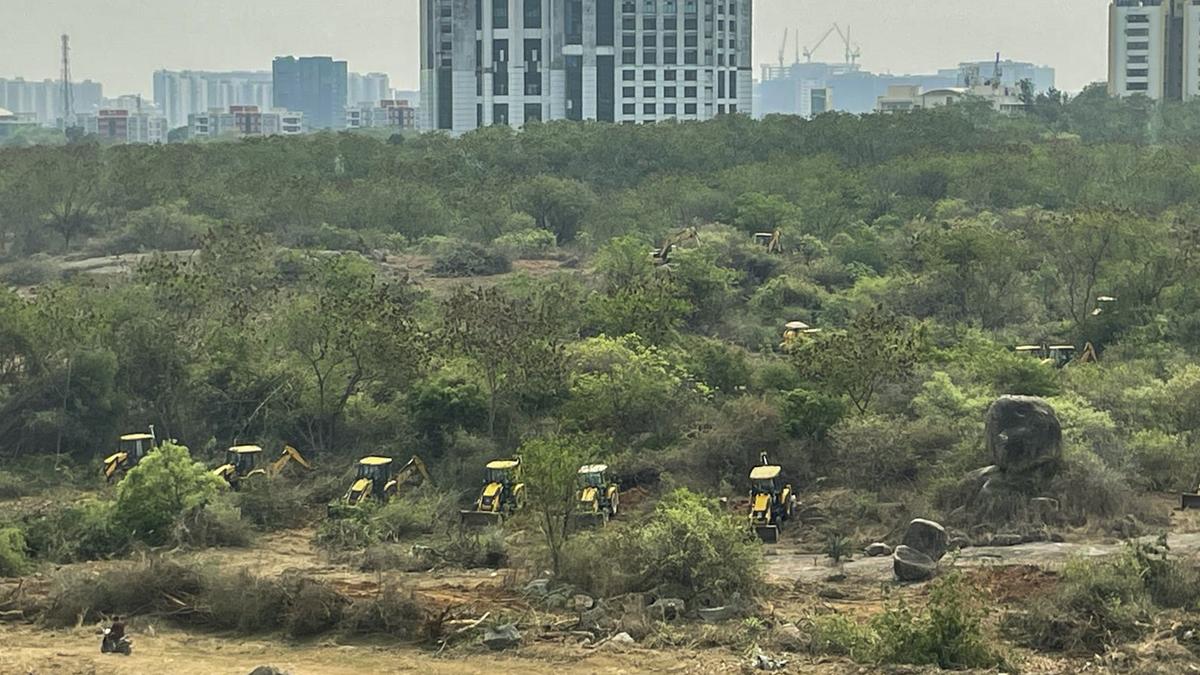

The controversy surrounding the 400-acre land parcel in Kancha Gachibowli, Hyderabad, reveals a complex web of interests intersecting on this ecologically-rich terrain. The Telangana government’s plan to auction the land has sparked significant debate among various stakeholders, including the University of Hyderabad, students, environmental activists, and political parties. Each group sees the land through a distinct lens — be it as a resource, a sanctuary, an asset, or a symbol.
At the heart of the matter lies an unquestioned legal truth: the land belongs to the state. The dispute, however, centers on its significance and future. The government views the auction as a pragmatic step towards revenue generation and economic growth, vital for Hyderabad’s continuing development. Yet, opponents argue this decision exemplifies short-sighted urban planning, severing community ties and ignoring the long-term ecological consequences.
The land itself is a biodiverse gem, an unexpected oasis amidst urban sprawl. It’s not just a plot of earth but a thriving ecosystem housing ancient rock formations, seasonal water bodies, and a wide range of flora and fauna, some of which are vulnerable. In a city grappling with escalating temperatures, the ecological services provided by such spaces are indispensable, offering cool relief and essential habitat conservation.
Despite recurring declarations of sustainable development goals, urban land management often prioritizes immediate gains over enduring stewardship. Environmental assessments, if conducted, are often superficial. Communities, integral to these decisions, are frequently marginalized, their voices unheard in the corridors of power. The notion of preservation as progress remains largely unrecognized within conventional urban planning.
While the state holds strong legal ground regarding ownership, the policies guiding land use demonstrate a gap between statutory rights and broader ecological responsibilities. Current legal frameworks fail to enforce sustainable practices, creating a vacuum where decisions lack accountability and fail to protect the environment.
This situation underscores a broader inconsistency within Indian urban policies. Both the National Urban Policy Framework and local master plans champion sustainability and inclusive growth on paper, but these principles dissolve when faced with commercial pressures. The Kancha Gachibowli case serves as a poignant example of this discrepancy.
Protests against the proposed auction have seen students and activists silenced, some facing forcible removal — a harsh contradiction to democratic ideals and environmental responsibility. This disheartening scenario only magnifies the fragility of our developmental strategies, where short-term economic interests overshadow long-term ecological vision.
In a city already saturated with underutilized commercial real estate, the plan to monetize Kancha Gachibowli’s land appears myopic. This approach treats the land as a mere commodity, ignoring its value as a communal resource vital to addressing the ongoing environmental crisis. What’s evident is not a lapse in legal prowess but a failure of imagination, a refusal to see potential beyond immediate fiscal returns.
The need of the hour is not just legal action but ecological leadership and a collective commitment to a sustainable, inclusive future for Hyderabad. The land in Kancha Gachibowli is more than property; it’s an embodiment of our urban blind spot. The question that remains is whether we possess the resolve and imagination to overcome this oversight.
Comments and tags: Environment, Urban Development, Hyderabad, Kancha Gachibowli, Land Dispute, Telangana Government, Sustainability.
Original Source: https://www.thehindu.com/opinion/op-ed/what-kancha-gachibowli-makes-visible/article69449367.ece
Category : Comment
Tags:
Publish Date: 2025-04-15 01:18:00