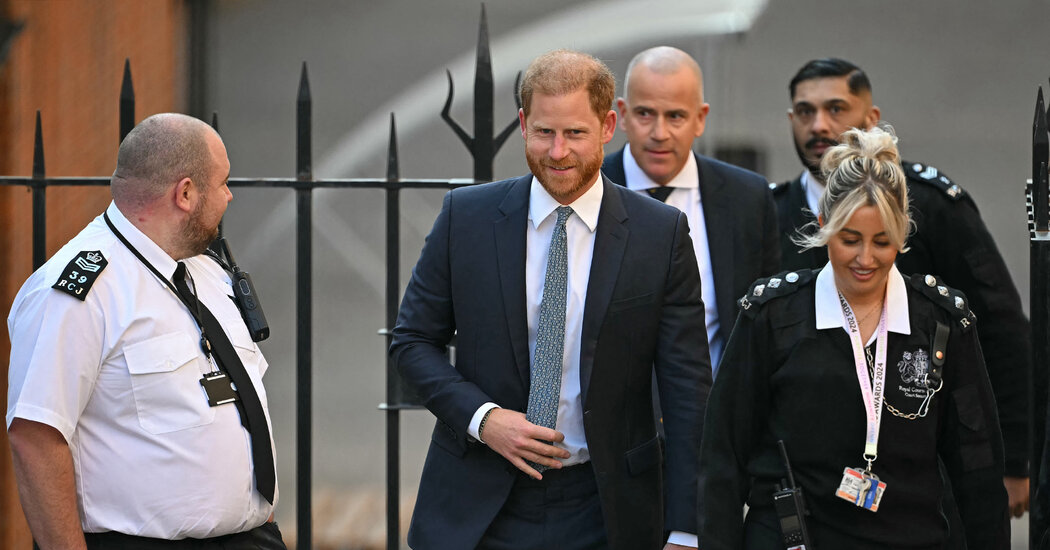

Prince Harry’s legal battle against the withdrawal of publicly financed security during his visits to the UK moves forward as the Court of Appeal in England starts hearing the case. The discussions span over two days, focusing on a pivotal decision made after Harry and Meghan Markle stepped down from their royal roles and relocated to North America in 2020. Post-exit, a key committee concluded that Harry and Meghan were no longer eligible for the police protection typically afforded to members of the royal family.
Central to the case is the February 28, 2020, ruling by the Executive Committee for the Protection of Royalty and Public Figures (Ravec). This committee, comprising government officials, police, and royal household members, is charged with arranging security for royals and other at-risk figures in the UK. Prince Harry contests that the decision breaches official policy, although he lost the initial phase in February last year. Nonetheless, a judge later permitted him to appeal on restricted grounds, finding his appeal to have a “real prospect of success” despite initial hesitations.
Arguments presented by Harry’s legal team highlight several grievances, notably that Harry was neither informed of Ravec’s existence nor given an opportunity to contribute to its decisions. Confronted with ongoing talks concerning his safety, Harry wrote to a government official expressing disbelief and distress. In a letter dated February 10, 2020, he evoked the memory of his mother, Princess Diana, underscoring the potential risks his family faces, exacerbated by what he described as “additional layers of racism and extremism.” Harry argued the necessity of Metropolitan Police protection to counter these threats. Meanwhile, the British government has denied Harry’s claims of being unjustly punished.
Prince Harry initiated this legal challenge in September 2021, arguing that Ravec violated its own protocols by retracting publicly funded protection, failed to weigh critical factors, and acted with a lack of fairness and transparency. In a court session in July 2022, it was revealed that Harry had offered to personally fund the necessary security measures. However, Ravec deemed private funding inappropriate on principle. According to the Home Office, it was deemed unfair for affluent individuals to “purchase” government protection when such security was not deemed necessary on a public funding basis. Furthermore, there were concerns about the potential scarcity of specially trained close protection officers, as British police are not typically armed.
Harry suffered a setback when a court rejected his legal challenge about the funding in early 2023. By February 2024, a High Court judge dismissed his broader case. However, he was allowed to appeal on legal grounds regarding Ravec’s adherence to policy. Amidst legal proceedings, Harry has continued visiting the UK, notably paying for private security during visits, such as the funerals of Queen Elizabeth II and King Charles III’s coronation.
Once the appellate hearing concludes, the judges may deliver an immediate ruling or opt to “reserve judgment,” deliberating further before announcing a decision. An unfavorable outcome allows the losing side to apply for a subsequent appeal to the UK Supreme Court, contingent on the potential for success. Echoing the British government’s stance, the Home Office refrained from commenting directly on the case but affirmed that the UK’s protective security system remains “rigorous and proportionate.”
Original Source: https://www.nytimes.com/2025/04/08/world/europe/prince-harry-security-hearing-court.html
Category : Royal Families,Police,Harry, Duke of Sussex,Great Britain,Europe,Markle, Meghan
Tags:
Publish Date: 2025-04-08 14:17:00