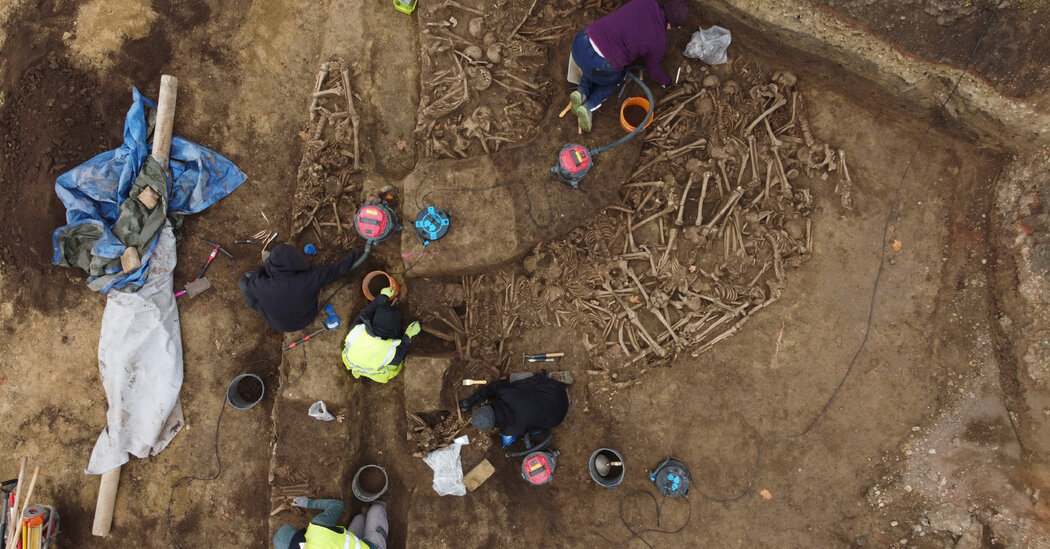

In a remarkable archaeological discovery beneath a Vienna soccer field near the Danube River, experts have unearthed a mass grave linked to the turbulent era when the Roman Empire clashed with Germanic tribes nearly 2,000 years ago. The find, announced by a team at the Vienna Museum, was made by a construction company in Vienna’s Simmering district during October renovations. The grave likely results from a “catastrophic” military event, possibly involving Roman troops suffering a severe defeat and retreating hastily from the site.
Radiocarbon analysis dates the bones to approximately A.D. 80 to 234, a time under the rule of emperors such as Domitian and Trajan, who had significant military confrontations with local Germanic tribes. Artifacts like an iron dagger, lance points, scale armor, and a helmet cheek piece help confirm this timeline. Additionally, shoe nails from caligae, iconic Roman military footwear, were found near one of the skeletons, bolstering the evidence of Roman military presence.
Archaeologists note the rarity of such uncremated skeletal remains from this period, as Romans predominantly practiced cremation until the third century A.D. Michaela Binder, the project’s lead anthropologist, emphasizes the unique opportunity this presents to study the lives of ordinary Roman soldiers from the first century A.D. “Aside from the military aspect, it is an absolute unique chance to study the life histories of people in the first century A.D.,” Binder stated.
Martin Mosser, an archaeologist with Vienna’s Department of Urban Archaeology, interprets the unceremonious burial and fatal wounds observed on the remains as indicative of a hasty retreat following a brutal conflict. “The undignified nature of the burial site along with the deadly wounds found on each individual suggests a catastrophic military confrontation, possibly followed by a hasty retreat,” Mosser explained.
This site, the first physical evidence of Roman-Germanic battles in modern-day Vienna, could mark the beginnings of the metropolis’s history. The team speculates that a Roman defeat might have catalyzed the growth of Vindobona, a nearby military base, into a significant legionary fortress. Mosser added, “It suggests a concrete reason for the buildup of Vindobona into a full-scale legionary fortress, which would take us to the founding moment of Vienna.”
The grave, containing remains of at least 129 individuals, could hold more than 150 as bones were intermingled. All identified remains so far belong to men aged 20 to 30, exhibiting severe injuries, mainly to skulls, torsos, and pelvises. These wounds appear to stem from weapons like spears, swords, and iron bolts, indicating the men fell in battle rather than being executed.
David Potter, a Roman history professor at the University of Michigan, draws parallels between this discovery and the notorious Roman defeat in the Battle of the Teutoburg Forest. He remarked, “I think we’ve got another moment reflecting a Roman defeat and a burial of troops after the fact.”
Further research, including DNA analysis, is underway to uncover more about the origins and conditions of the individuals buried there. Mosser reflects on the grave’s tragedy, likening it to modern conflicts. “With so many young individuals buried so irreverently, one inevitably thinks about the horrific wars of the more recent past as well as the present,” he lamented, concluding, “The unfortunate conclusion: Humans have not become any wiser.”
Original Source: https://www.nytimes.com/2025/04/04/world/europe/roman-empire-grave-vienna.html
Category : Roman Civilization,Historic Buildings and Sites,Skeletons,Danube River,Vienna (Austria)
Tags:
Publish Date: 2025-04-05 18:14:00