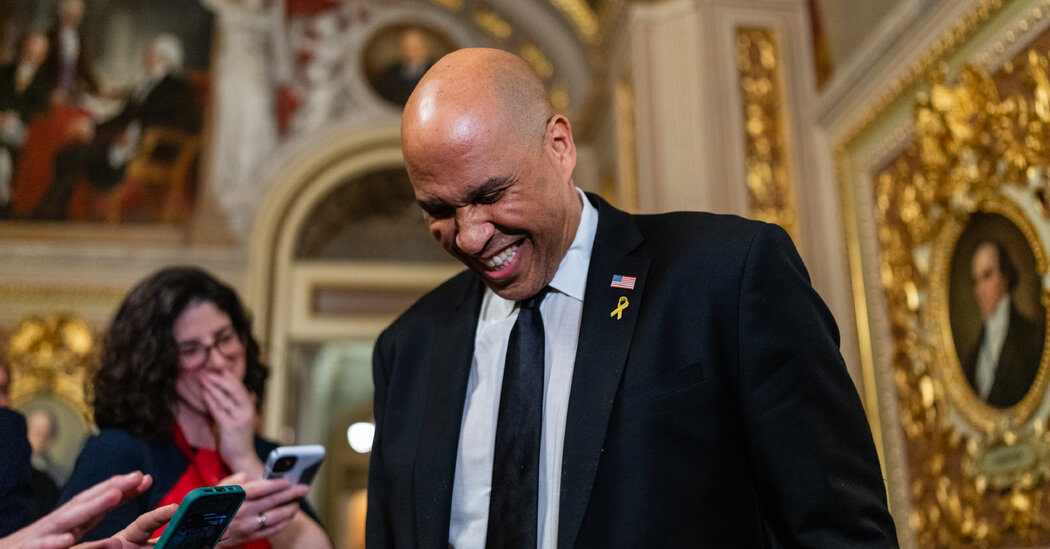

In an unprecedented endurance feat, Senator Cory Booker delivered the longest speech in Senate history, speaking non-stop for 25 hours to criticize the Trump administration. Starting Monday evening and concluding the following night, Booker forsook basic needs such as eating, sitting, or even a bathroom break to maintain his stand. “My body is definitely going through it right now,” Booker confessed in a Wednesday evening interview. “But my spirit is so high.”
Booker, 55, undertook a meticulous regime preceding his marathon speech, abstaining from water since Sunday night to eliminate restroom interruptions and fasting in the days leading up. He mentioned that his Oura ring, a digital health tracker, logged his heart rate spiking to over 100 beats per minute seven hours into the speech, suggesting his body’s intense exertion. After his prolonged oration, a fatigued Booker consumed a banana, rehydrated in the Senate cloakroom, and later slept for six and a half hours.
Medical professionals stress that Booker’s marathon speech defied health recommendations. Dr. Santina Wheat of Northwestern Medicine Delnor Hospital highlighted the risks of extended restroom avoidance, including kidney stones and urinary tract infections. Despite speculation, Booker’s communications director clarified he wore neither a catheter nor a diaper. Consequently, dehydration caused Booker to cramp, a common occurrence when muscles lack a break and sufficient fluids, noted Dr. Joseph Herrera of Mount Sinai Health System.
Dehydration can exacerbate fatigue, dry mouth, and challenge standing for extended periods, while nutritional deficits may cause dizziness and impaired concentration. Dr. Herrera advises consumption of a meal two to three hours prior to demanding physical tasks to sustain energy levels. Unsupported standing is physically demanding; Dr. Herrera mentions it exerts pressure on crucial joints, potentially leading to soreness and muscle strain, issues Booker mitigated with Motrin.
As he stood at the Senate floor, breaks were limited to interjections from peers, although the primary dialogue was his own reflection on President Trump’s early tenure. Sustaining a long speech requires significant cognitive energy, especially with minimal rest, noted Dr. Indira Gurubhagavatula of Penn Medicine. Sleep deprivation impairs short-term memory and concentration, rendering coherent articulation challenging. By the end of his ordeal, Booker candidly described himself as feeling “loopy.”
Despite the toll, Booker remained visibly energetic, steadily leaning on the lectern but articulating passionately until his speech’s conclusion. Dr. Jennifer Heisz, from McMaster University, suggests that when a task holds significant meaning, motivation can override exhaustion—a sentiment Booker demonstrated.
Booker’s resolute commitment was evident until his final words on Tuesday night. With a slight quaver in his voice and leaning against the lectern, he concluded with, “I yield the floor.” This historic speech amalgamates politics, perseverance, and personal sacrifice, embodying passion-driven resilience in contemporary U.S. politics.
Original Source: https://www.nytimes.com/2025/04/02/well/cory-booker-senate-speech-prep.html
Category : Booker, Cory A,Senate,Memory,United States Politics and Government,Politics and Government,Sleep
Tags:
Publish Date: 2025-04-03 07:49:00