Trump’s Devastating Order on Federal Unions: A Critical Blow to Groups Battling Destructive DOGE Cuts

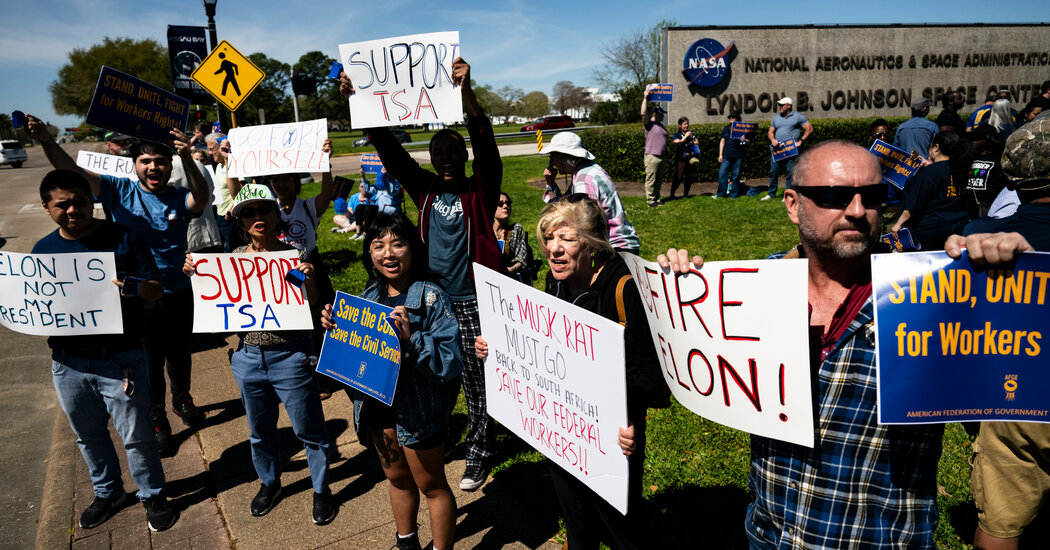
Federal worker unions have been at the forefront of opposing President Trump’s recent initiatives, striving to protect the interests of civil servants amidst sweeping administrative changes. Over the past two months, unions have launched lawsuits, organized protests, and increased membership by thousands. However, this week, President Trump enacted a definitive measure that could undermine their efforts significantly. Through an executive order, the president described unions as antagonistic to his agenda, citing national security as a justification to exclude around one million civil servants from union representation across more than a dozen federal agencies. This order effectively strips unions of their ability to represent these workers either at the bargaining table or in court.
Accompanying this order, the administration filed a lawsuit in a federal court in Texas. The suit aims to secure judicial permission for the administration to annul existing collective bargaining agreements, arguing that these agreements have constrained presidential authority in matters of national security. Labor leaders immediately vowed to challenge these actions in court, as the new measures can considerably weaken federal unions and reduce protections for many government workers.
Brian Kelly, who leads a local union of the American Federation of Government Employees (AFGE) at the Environmental Protection Agency, voiced deep concern about the implications. Kelly warned, “They are hobbling the union, ripping up collective bargaining agreements, and then they will come for the workers. So, it’s a worst-case scenario.” This executive move adds to President Trump’s ongoing campaign to diminish the power of entities he perceives as obstacles, including groups representing government employees often labeled as the “deep state.”
President Trump’s order extends to numerous agencies, identifying sections as central to national security and thereby exempt from collective bargaining. While agencies like the FBI and the CIA already operate under these exemptions, the order now includes parts of the Veterans Affairs, Treasury, Energy Departments, the EPA, and sizable parts of the Department of Health and Human Services, as well as “most components” of the Justice Department.
White House spokesman Harrison Fields articulated the administration’s rationale: “The goal is to stop employees in certain security-related agencies from unionizing in ways that disrupt the president’s agenda.” Following this, the visibility of federal employee unions, primarily AFGE, has escalated as they challenge the administration’s workforce reductions and policies, partially driven by Elon Musk’s Department of Government Efficiency.
Union officials have witnessed a significant increase in membership, propelled by their resistance efforts. Yet, this executive order challenges their ability to sustain these gains. Samuel Bagenstos, a law professor at the University of Michigan, predicts severe legal challenges ahead, deeming the order an “overreach of the president’s authority.” Without collective bargaining agreements, unions may lose the legal standing necessary to advocate for employees in court.
AFGE President Everett Kelley denounced the order as “plainly retaliatory,” affirming that the labor movement will persist in its advocacy. Similarly, Randy Erwin of the National Federation of Federal Employees criticized the order as a historic infringement on collective bargaining rights, challenging its legality. As unions regroup in response, leaders acknowledge the necessity of rallying federal workers and the general public to counter what they view as an existential threat to their influence and efficacy. This evolving situation continues to captivate the political and governmental landscape, demanding scrutiny and strategic action.
Original Source: https://www.nytimes.com/2025/03/29/us/politics/federal-worker-unions-doge.html
Category : United States Politics and Government,Organized Labor,Government Employees,Collective Bargaining,Suits and Litigation (Civil),Executive Orders and Memorandums,American Federation of Government Employees,Government Efficiency Department (US)
Tags:
Publish Date: 2025-03-29 20:00:00