
In a significant political upheaval in Turkey, the nation’s largest opposition party is orchestrating extensive rallies and calling for boycotts against businesses supporting the government, amidst a historic wave of protests. This movement gained momentum following the contentious arrest of Ekrem Imamoglu, the influential mayor of Istanbul and a prominent political adversary to President Recep Tayyip Erdogan. Imamoglu’s detention on March 19, on corruption charges that he fervently denies, has ignited widespread dissent across the country.
University students have emerged at the forefront, forming councils to strategize protests and share survival tips for dealing with riot police and tear gas. “This is not only about Imamoglu,” says Irem Tacyildiz, a 24-year-old student from the Middle East Technical University, reflecting a broader sentiment among protestors dissatisfied with Erdogan’s government. Despite attempts by the government to stifle the dissent, including mass arrests and media restrictions, these measures appear to be galvanizing, rather than disheartening, government critics.
Erdogan’s administration has been accused of tilting Turkey towards autocracy, with foreign observers noting his tightening grip on media, judiciary, and security forces. Seren Selvin Korkmaz of the Istanbul-based think tank IstanPol emphasizes the need for the opposition to devise creative methods to voice their positions amid shrinking democratic spaces.
On the political battlefield, the Republican People’s Party (C.H.P.), Turkey’s main opposition and home to many of the country’s secular urban elite, has reaffirmed its support for Imamoglu as its presidential candidate. Ozgur Ozel, the party’s leader, is vocally championing the movement by coordinating efforts from a makeshift base at Istanbul City Hall, where protests continue unabated. Ozel has been vocal in urging boycotts of pro-government companies and lambasting media outlets that refuse to broadcast the demonstrations.
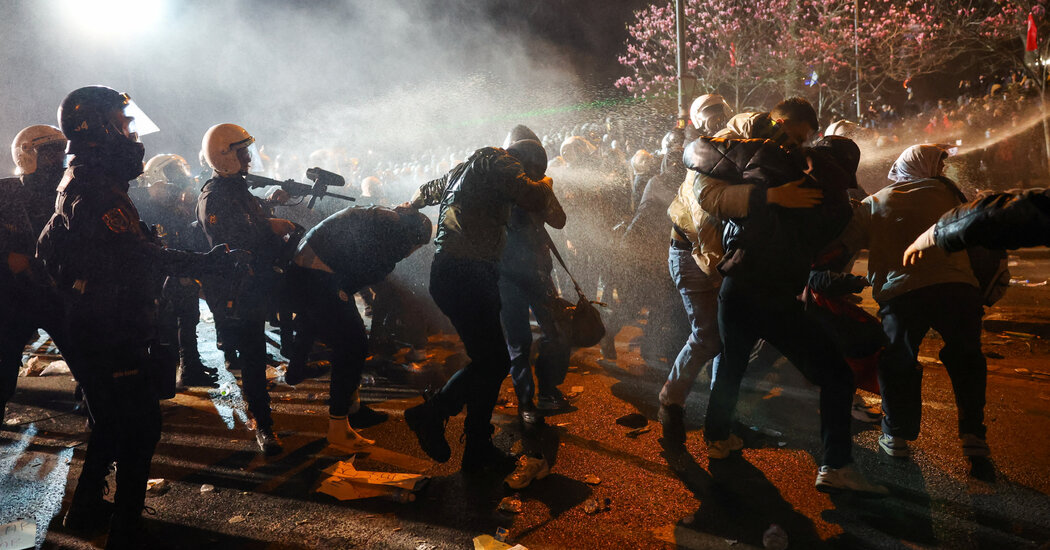
The turmoil has sparked widespread nightly protests across Turkey’s major urban centers. In response, the government has implemented drastic measures, banning public demonstrations, and dispatching riot police to disperse crowds using water cannons and tear gas. Over 1,800 protestors have been detained, according to government sources.
Pro-government media outlets have largely remained silent on the protests while focusing heavily on the charges against Imamoglu. Opposition channels have been penalized, with SZC TV, among others, facing sanctions for allegedly inciting public unrest.
President Erdogan has labeled the protests as acts of vandalism, accusing the opposition of orchestrating the chaos to divert attention from corruption allegations. Meanwhile, Justice Minister Yilmaz Tunc maintains that the judiciary operates independently, dismissing claims that Imamoglu’s arrest was politically motivated.
As the tension escalates, there is growing speculation about possible early elections, though the official date is set for 2028. Analysts like Osman Sert highlight the unifying effect of Imamoglu’s arrest on the opposition, which now faces enormous challenges against a formidable government apparatus.
As the political landscape bristles with unrest, the drive for change amongst Turkey’s opposition remains staunch. For many, these are precarious times for Turkish democracy, yet the spirit of resistance endures, with the opposition resolute in its stride against Erdogan’s extensive influence.
Original Source: https://www.nytimes.com/2025/03/29/world/middleeast/turkey-opposition.html
Category : Turkey,Demonstrations, Protests and Riots,Erdogan, Recep Tayyip,Istanbul (Turkey),Imamoglu, Ekrem
Tags:
Publish Date: 2025-03-29 14:33:00