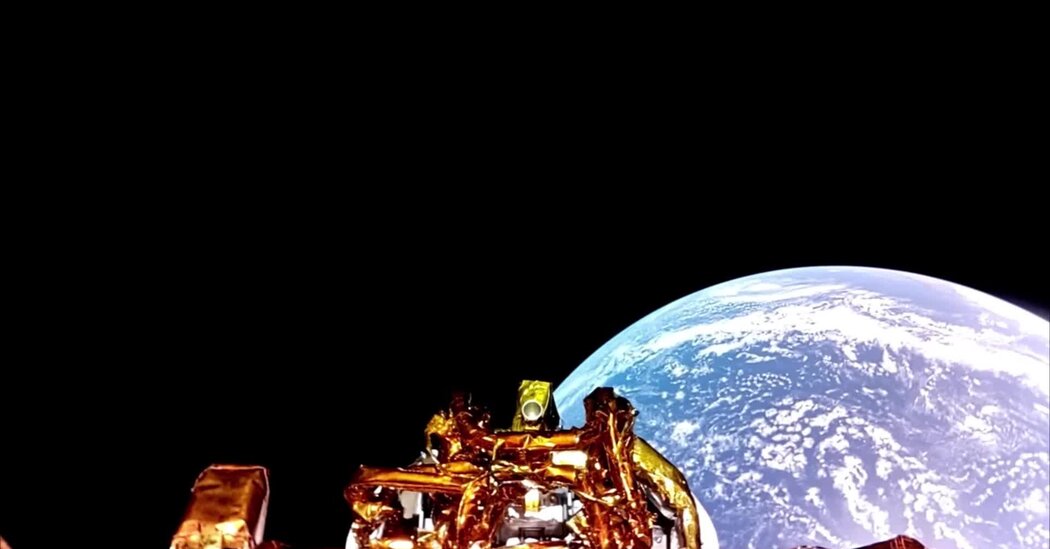

NASA’s gamble on commercial collaborations to facilitate lunar scientific experiments has finally paid off after prior setbacks. A recent mission by Firefly Aerospace, based in Cedar Park, Texas, marked the first successful completion of such an endeavor. Their robotic lander, Blue Ghost, triumphantly collected data on the Moon’s surface, outshining previous missions that faltered.
On March 16, the scene at Firefly’s mission control near Austin was both jubilant and reflective as the spacecraft that traveled over a quarter of a million miles accomplished its mission and awaited its imminent shutdown. “I think people are just excited and also relieved to see how well the mission went,” Ray Allensworth, the spacecraft program director at Firefly, described the mood. Blue Ghost had delivered crucial scientific observations from Mare Crisium, a lunar lava plain, before losing solar power as the sun set on its location.
For NASA, the success of Blue Ghost brought a trove of data, a welcome change from prior commercial moon missions that yielded little. One experiment, led by Robert Grimm from the Southwest Research Institute in Boulder, Colorado, was particularly fruitful. As Blue Ghost landed, cameras captured the craft’s thruster exhaust interacting with lunar dust, revealing the dynamics of the landing process—vital knowledge as NASA plans for larger spacecraft landings in the future. “Better than being a crater,” Grimm remarked, highlighting the relief and achievement.
Another aspect of the mission involved understanding lunar regolith—a critical factor for future lunar habitats as NASA contemplates establishing a permanent outpost. The Electrodynamic Dust Shield experiment aimed to tackle the dust issue, and the data gathered promise insights into how abrasive lunar particles behave and how best to manage them.
Expanding our understanding of the Moon, Blue Ghost deployed instruments like the Lunar Magnetotelluric Sounder. This cutting-edge technology could reveal essential clues about the Moon’s geological composition. Although a pneumatic drill managed only a fraction of its intended depth due to rocky terrain, it still collected invaluable thermal and conductive data. “We’re trying to answer really basic questions about lunar geology,” Dr. Grimm emphasized, pointing to the larger implications for understanding both the Moon and other rocky celestial bodies.
Adding to the mission’s diverse scientific payload, Kris Zacny from Honeybee Robotics highlighted the success of the sample collection technology, PlanetVac, which will inform future missions, including Japan’s Martian Moons Exploration. In parallel, an Earth-focused experiment led by Dr. Brian Walsh from Boston University used the Moon as a vantage point to study Earth’s magnetosphere, shedding light on how solar wind interacts with our planet’s magnetic field.
The mission’s success has left an indelible mark on those involved, with Maria Banks recounting how nightly glances at the Moon reminded her of Firefly’s lasting contribution. As the experience closed, many involved felt inspired by the achievement and its significance for future lunar exploration.
This successful mission reflects a significant stride in public-private spaceflight collaborations, suggesting a promising future for lunar research and manned exploration efforts. Blue Ghost’s mission underscores NASA’s and commercial entities’ commitment to advancing space and astronomy research, showcasing the potential for innovative partnerships in the realm of space exploration.
Original Source: https://www.nytimes.com/2025/03/21/science/blue-ghost-moon-science.html
Category : Moon,Firefly Aerospace Inc,National Aeronautics and Space Administration,Research,Private Spaceflight,Space and Astronomy
Tags:
Publish Date: 2025-03-22 01:16:00