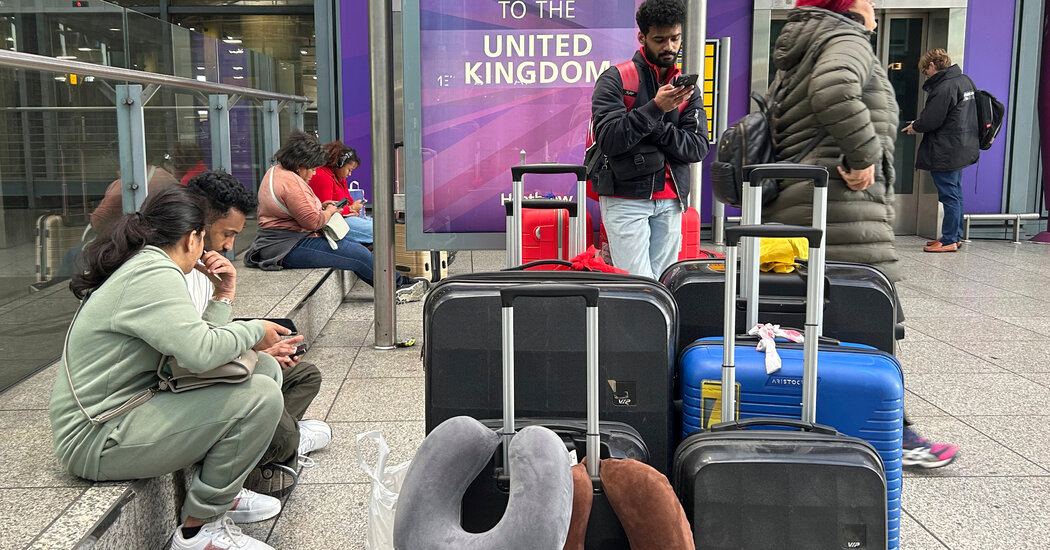

The airline industry is bracing for turbulence as carriers scramble to reroute flights following a power outage at London’s Heathrow Airport. This outage, caused by a fire at a nearby electrical substation, has stranded tens of thousands of passengers at this critical global hub. Although authorities, including the police in London, have stated there is no evidence of intentional damage, an investigation is still underway.
The aviation sector is notoriously complex due to its deeply interconnected system. Thus, responding to disruptions of this magnitude requires meticulous coordination. Adjusting even a few flights can trigger cascading effects, as highlighted by Dr. Michael McCormick of Embry‑Riddle Aeronautical University. “They have to look at where passengers with bags, aircraft, and aircrews need to be tomorrow, the next day, and the next day,” he explained, stressing the importance of long-term recovery planning.
Airlines’ network operations centers, which act as the nerve centers of these businesses, are on high alert. Staffed 24/7, these centers manage everything from weather monitoring and aircraft scheduling to maintaining communication with air traffic control. Routine disruptions might be handled easily, but major incidents such as the one at Heathrow necessitate broad adjustments involving numerous constraints.
For instance, when Southwest Airlines faced a weather-induced crisis during the winter holidays of 2022, it had to cancel thousands of flights. This allowed the airline to rearrange crews and aircraft, but it illustrates the complexity of crisis management in aviation. Ryanair, on the other hand, demonstrated a swift response to the current havoc by adding extra flights between Dublin and London’s Stansted Airport to assist the stranded Heathrow passengers.
However, rerouting is a daunting task. Aircraft vary in passenger capacity and range, and logistics such as fuel requirements and weight balance add layers of complexity. Crews face strict regulations that limit their working hours, introducing yet another challenge—timing out if flights are delayed.
Sean Doyle, CEO of British Airways, stated in a video address that even if operations resume quickly, logistical hurdles remain, particularly concerning deploying new crew members. British Airways, operating a significant portion of flights to and from Heathrow, anticipates a “huge impact” on its clientele, according to Cirium, an aviation data company.
Airlines collaborate with airport operators and air traffic control agencies during such crises, but resources can be limited. Airports can only handle a finite number of flights and specific plane types. In the United States, air traffic control faces chronic staffing shortages, further complicating the situation.
The aviation industry frequently practices crisis responses to various catastrophic scenarios, but every disruption presents unique challenges requiring improvisation. Tom Parry of Kiwi.com, renowned for his insights on business resilience, affirms this notion, highlighting the need for adaptability in crisis response strategies.
Heathrow’s power outage has sparked criticism of its infrastructure reliability. Willie Walsh, Director General of the International Air Transport Association, questioned the lack of backup power solutions, underscoring the critical importance of infrastructure resilience at a global hub.
As airlines grapple with immediate concerns and passenger rerouting, the intricate ballet of aviation logistics continues, highlighting the sophisticated choreography required to keep the skies safely running.
Original Source: https://www.nytimes.com/2025/03/21/business/heathrow-airport-closed-aviation-effects.html
Category : Airlines and Airplanes,Air Traffic Control,Airports,Pilots,Shortages,Heathrow Airport (London, England)
Tags:
Publish Date: 2025-03-21 23:19:00