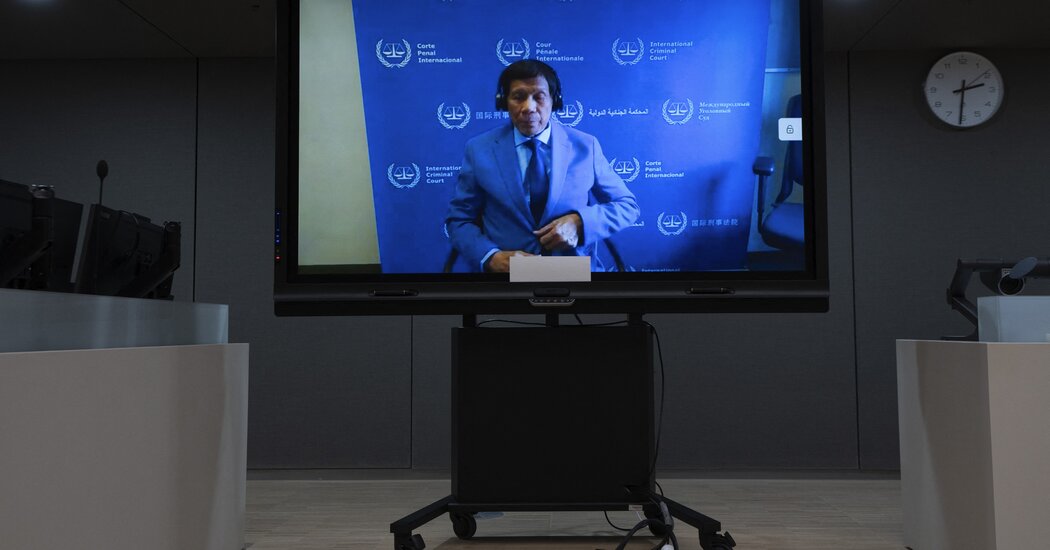

In a landmark event that once seemed improbable for a former head of state, Rodrigo Duterte, ex-president of the Philippines, appeared before the International Criminal Court (ICC) via video link. This hearing on Friday marked a pivotal moment for Filipinos seeking justice for thousands of civilians killed under his controversial “war on drugs.” Arrested earlier this week on charges of crimes against humanity, Duterte was informed of his rights and the charges against him during the 30-minute procedural hearing. Judge Iulia Motoc scheduled a follow-up on September 23 to assess whether the prosecution’s evidence warrants a trial.
As the former mayor of Davao City and president, Duterte’s aggressive anti-drug campaign led to the deaths of tens of thousands, including minors, often not involved in drug activities, according to rights groups. This has cast a long shadow over his leadership, highlighting the significant stakes involved in the proceedings. Duterte’s lawyer, Salvador Medialdea, described his arrest as “pure and simple kidnapping” and “political score-settling,” asserting Duterte’s health issues, including hearing and sight impairments, as reasons for temporary release.
Duterte, who addressed the court in English while seated in a blue suit, was arrested at Manila’s main airport upon returning from Hong Kong. This followed an ICC-issued warrant executed with Interpol’s assistance since the Philippines had withdrawn from the court during his presidency. Transferred to The Hague, Duterte faces allegations of orchestrating large-scale killings, torture, and rape between November 2011 and March 2019, a period when the Philippines was a court member.
This hearing is set against a backdrop of political turmoil in the Philippines. After Duterte’s presidential term ended in 2022, Ferdinand R. Marcos Jr., son of a former dictator, assumed office with Sara Duterte, Rodrigo’s daughter, as vice president. Their alliance, however, has since deteriorated, with Marcos initially opposed to cooperating with the ICC but later permitting investigation access to the country. This development signals an attempt by Marcos to potentially diminish the Dutertes’ political influence without severe repercussions, particularly as Sara Duterte leads polls for the 2028 presidential race.
In the Philippines, responses to the proceedings were mixed. While Duterte’s supporters held gatherings in Davao City, relatives of drug war victims watched the hearing with anticipation, seeking closure for their loved ones. Marilyn Malimban, whose partner was killed in 2016, expressed hope, stating, “Duterte is feigning weakness,” believing the ex-leader’s grip on power does not extend to The Hague.
Despite these charges, the ICC faces challenges in securing a conviction. Historically, the court has struggled with this, as seen with the acquittal of former Ivory Coast President Laurent Gbagbo in 2019. The prosecution must demonstrate that Duterte’s anti-drug campaign constituted a deliberate attack on civilians, fulfilling the criteria for crimes against humanity.
Sara Duterte has labeled her father’s arrest as political oppression, whereas President Marcos positions his compliance with international law, following the Interpol warrant. Outside the court, she conveyed hopes for visiting rights for the former president. Camille Elemia and Aie Balagtas See contributed reporting from the Philippines, highlighting a nation divided as it confronts past grievances while navigating its political future.
Original Source: https://www.nytimes.com/2025/03/14/world/asia/duterte-philippines-icc-crimes-against-humanity.html
Category : Politics and Government,Deaths (Fatalities),War Crimes, Genocide and Crimes Against Humanity,Drug Abuse and Traffic,Duterte, Sara,Duterte, Rodrigo,Hague (Netherlands),International Criminal Court,Philippines
Tags:
Publish Date: 2025-03-15 03:07:00