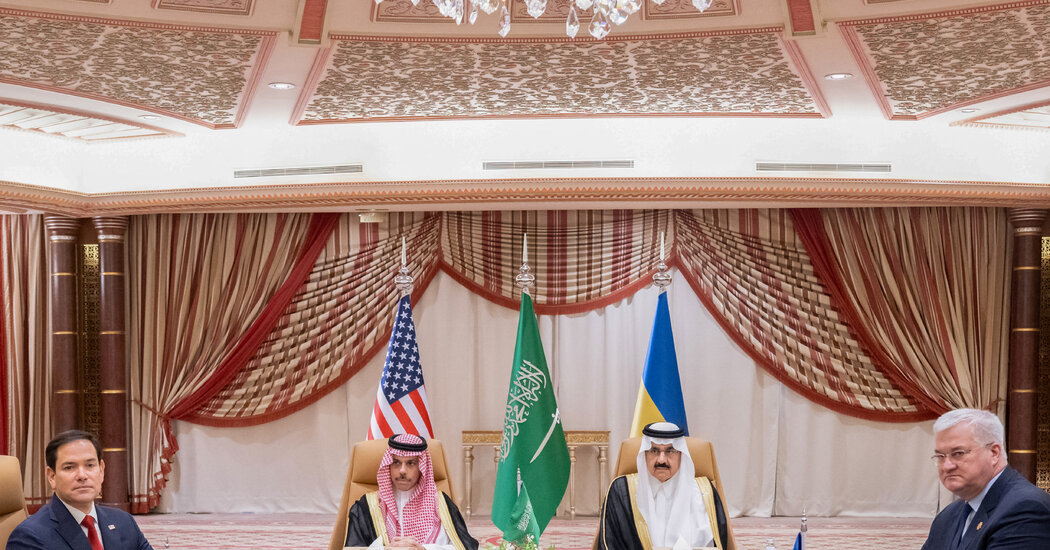

In a significant geopolitical move, the United States has agreed to resume military aid to Ukraine, lifting a temporary suspension on intelligence sharing and military assistance. This decision follows extensive talks held in Saudi Arabia and coincides with Ukraine’s conditional support for a proposed 30-day ceasefire with Russia, contingent on Russia’s agreement. A joint statement from the U.S. and Ukraine emphasized that any ceasefire terms would require Russia’s approval. The two nations also concurred on the urgent development of Ukraine’s critical mineral resources. Russia was notably absent from the Saudi talks and has not yet publicly responded to these developments.
President Donald Trump indicated the possibility of engaging in direct discussions with Russian President Vladimir Putin in the coming days, expressing hopes for a lasting ceasefire. Secretary of State Marco Rubio expressed confidence in the negotiations, stating, “The ball is now in their court,” placing pressure on Russia to de-escalate the conflict. Meanwhile, President Emmanuel Macron of France convened a meeting with military leaders from over 30 nations to deliberate on forming a multinational peacekeeping force to oversee any ceasefire in Ukraine.
Concurrently, tensions are escalating as Russia commenced an offensive in Sudzha, located in the Kursk region, which was seized by Ukraine last year. This military maneuver marks a significant escalation and potentially the first incursion into Russian territory since World War II, raising the stakes significantly.
In a separate but related diplomatic development, there was a brief flare-up in U.S.-Canada relations. President Trump initially threatened to double tariffs on steel and aluminum imports from Canada following Ontario’s imposition of a 25% surcharge on electricity exports to U.S. states like Michigan, Minnesota, and New York. However, after Ontario rescinded its surcharge, Trump retracted the tariff threat. Despite this, planned tariffs went into effect as scheduled. In an unexpected declaration, Trump reiterated his interest in annexing Canada, arguing it would eliminate all tariff issues, though this notion was largely symbolic.
In another major international news, former Philippine President Rodrigo Duterte was arrested in Manila following a warrant from the International Criminal Court (ICC) accusing him of crimes against humanity linked to his anti-drug campaigns, which reportedly resulted in 30,000 deaths. Duterte is now being extradited to The Hague to face these charges, marking a significant test for the ICC’s jurisdiction, as it is empowered by the Rome Statute, a treaty ratified by 125 countries.
Meanwhile, Africa’s geopolitical landscape is in focus as Kigali, Rwanda’s capital, strives to maintain its image as a prime tourist destination despite ongoing conflict in the Democratic Republic of Congo, where Rwanda backs the M23 rebel group. This involvement has resulted in thousands of deaths and has strained Rwanda’s status as a security ally in Africa.
On a lighter note, cultural exchanges continue as the West End musical “Operation Mincemeat,” a comedy based on a World War II espionage operation, prepares for its Broadway debut. Despite concerns about cultural translation, early feedback suggests optimism about its reception among American audiences.
The global landscape remains dynamic, with tectonic shifts in political, economic, and cultural spheres continuing to attract and demand international attention.
Original Source: https://www.nytimes.com/2025/03/12/briefing/ukraine-russia-canada-duterte.html
Category :
Tags:
Publish Date: 2025-03-12 10:11:00