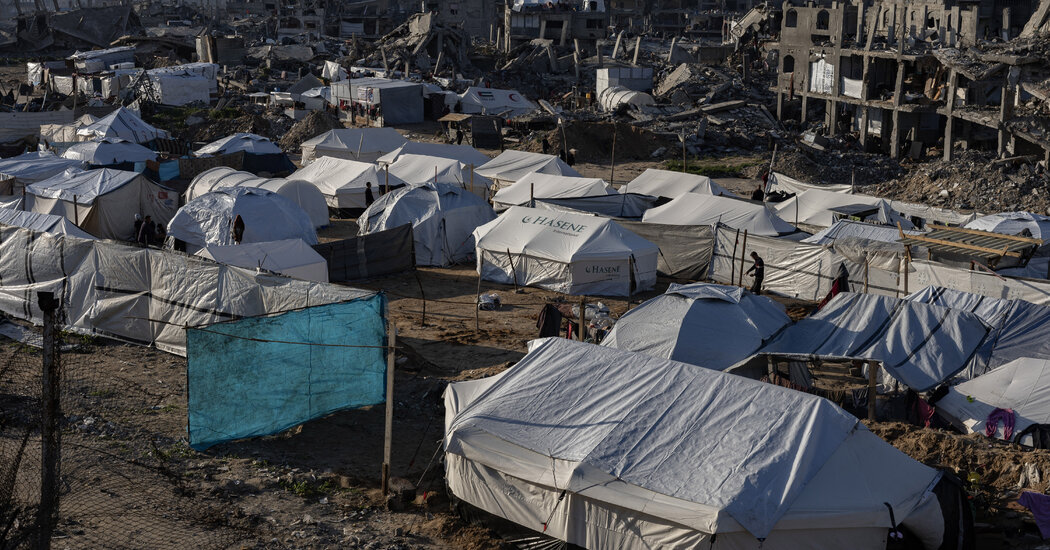

In the wake of the protracted conflict in Gaza, a multitude of proposals have emerged regarding the region’s governance following a war that began in October 2023 with a significant Hamas-led attack on Israel. These proposals intensified after a temporary ceasefire was brokered in January, increasing the urgency for a long-term resolution. However, consensus remains elusive as each proposal faces significant opposition from key stakeholders, complicating the path to peace.
Former President Donald Trump proposed a controversial plan for the United States to govern Gaza and forcibly relocate its residents. While appealing to many Israelis, the plan was deemed unacceptable by Hamas and the United States’ Arab allies, who argued it would constitute a war crime under international law. The Arab states, including Egypt and Saudi Arabia, offered an alternative: a Palestinian technocratic administration within a broader Palestinian state. However, this proposal lacked clarity on removing Hamas’s influence and was contingent on forming a Palestinian state, a stipulation opposed by many Israelis.
The complexity of achieving a resolution is underscored by fundamentally opposing positions. Israel demands a Hamas-free Gaza, while Hamas insists on retaining its military wing, a sticking point that erupted from the October conflict. Thomas R. Nides, a former U.S. ambassador to Israel, noted, “The devil is in the details, and none of the plans make sense.” He emphasized the difficulty of reconciling Israel’s and Hamas’s opposing stances.
Despite various negotiations, spearheaded by mediators from Egypt, Qatar, and the United States, Israelis and Palestinians remain no closer to a mutually agreeable solution for Gaza. The ceasefire that began in January was intended to last only six weeks, a period that expired in early March. Yet, an informal truce prevails as negotiations persist, overshadowed by disputes: Hamas seeks Israeli acceptance of a postwar framework before hostage release, while Israel insists on resolving the hostage issue first.
The tension was highlighted recently when Israel cut off power to a vital desalination plant in Gaza and halted humanitarian supplies, moves seemingly aimed at pressuring Hamas. Simultaneously, Israeli troops’ failure to withdraw from key border areas flouted an initial truce condition, heightening regional tensions.
Efforts to maintain a dialogue continue with meetings in Egypt and Qatar. Adam Boehler, an American envoy, reported “some progress” in negotiations with Hamas, breaking from traditional U.S. policy. However, hopes for a breakthrough remain tempered, with Boehler acknowledging that a resolution is still weeks, if not months, away.
Meanwhile, divisions persist within Hamas, shown by senior official Mousa Abu Marzouq’s openness to discussions on disarmament. Nonetheless, Hamas distanced itself from his comments. The prospect of Israel returning to conflict grows as the impasse drags on, exacerbated by the lack of progress in hostage negotiations and ongoing disputes.
As the situation stands, Israel confronts an undesirable choice: tolerate Hamas’s ongoing presence or engage in another conflict, warned Ofer Shelah of the Institute for National Security Studies. The potential Israeli occupation of Gaza would impose significant burdens, impacting Israel politically and economically, while deepening the humanitarian crisis for Palestinians.
In an environment fraught with complexity, the future of Gaza remains uncertain, with each proposal beset by profound challenges that demand international cooperation and compromise to overcome.
Original Source: https://www.nytimes.com/2025/03/10/world/middleeast/gaza-plan-israel-hamas-ceasefire.html
Category : Israel-Gaza War (2023- ),International Relations,Palestinians,Politics and Government,Hamas,Israel,Gaza Strip,Trump, Donald J,Netanyahu, Benjamin
Tags:
Publish Date: 2025-03-10 22:49:00