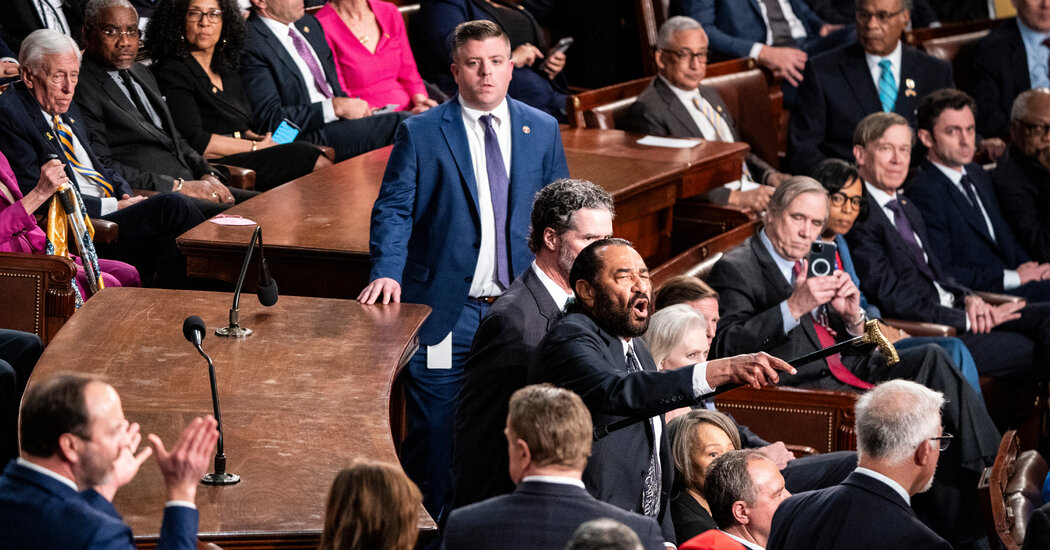

Democratic lawmakers have voiced disapproval of their party’s disjointed reaction to President Donald Trump’s recent address to Congress, with particular criticism directed at Representative Al Green of Texas. Green drew attention during the speech by standing and repeatedly shouting “No mandate,” leading to his eventual removal from the chamber. The party leadership had advised a restrained and dignified protest, but Green’s actions highlighted internal disagreements about opposing Trump’s agenda, especially with looming government funding decisions.
The lack of unified Democratic response was criticized across multiple Sunday news shows, with Representatives and Senators highlighting the distraction Green’s protest created from their broader policy messaging against Trump’s initiatives. The Democratic leadership yearned for a focus on economic and healthcare issues that could resonate with the electorate, rather than controversy stirred by Green’s individualistic dissent.
Representative Tom Suozzi of New York, on CBS, described Green’s protest as a strategic blunder inconsistent with the decorum expected in the U.S. House of Representatives. Suozzi was among ten Democrats who voted with Republicans to formally censure Green, one of the most severe House reprimands. Similarly, Senator Adam Schiff from California emphasized on ABC the missed opportunity in critiquing the potential negative impact of proposed Republican budget cuts on Medicaid.
Senator Elissa Slotkin of Michigan, who delivered the Democratic response to Trump’s speech, expressed on NBC’s “Meet the Press” that while frustration against Trump’s policies is understandable, her approach focuses on constructive propositions instead of mere opposition. She advocates for promoting policies Democrats support rather than merely opposing Trump’s.
The views of these lawmakers paralleled pushbacks from the Democratic leadership, who had aimed for their critique on economic issues like increased living costs for food, housing, and gas to dominate rather than get overshadowed by dramatic protests. House Minority Leader Hakeem Jeffries acknowledged the restraint shown by the majority of Democrats during Trump’s address but also reiterated his disagreement with Green’s approach. Senate Minority Leader Chuck Schumer echoed this sentiment, advocating for a focus on substantive economic messaging.
Even progressive wings within the Democratic Party expressed concerns. On CNN, Senator Andy Kim of New Jersey called for higher standards of decorum, equating Green’s protest with the disruptions often seen from far-right Republicans like Marjorie Taylor Greene during President Biden’s congressional addresses. Representative Ro Khanna of California, in an interview on “Fox News Sunday,” criticized the scattered response as a diversion from Democrats’ economic messaging.
Defending his actions, Green argued for the necessity of “righteous indignation and righteous incivility” in the face of Trump’s tactics, presenting a historical perspective linking his actions to civil rights movements. He stated on the House floor that his presence in Congress is due to past sacrifices and disruptions in history that fought for change.
This controversy underscores a critical juncture for Democrats as they navigate resistance to Trump’s policies while striving to unify their platform and messaging strategy in a politically divisive climate.
Original Source: https://www.nytimes.com/2025/03/09/us/politics/trump-speech-congress-democrats.html
Category : United States Politics and Government,Demonstrations, Protests and Riots,Politics and Government,United States Economy,Democratic Party,House of Representatives,Green, Alexander N (1947- ),Jeffries, Hakeem,Khanna, Ro,Kim, Andy (1982- ),Schiff, Adam B,Schumer, Charles E,Slotkin, Elissa,Suozzi, Thomas R,Trump, Donald J
Tags:
Publish Date: 2025-03-11 01:02:00