Revolutionary Webb Discovery Unveils Hidden Carbon Factories in Majestic Cosmic Dust Rings!

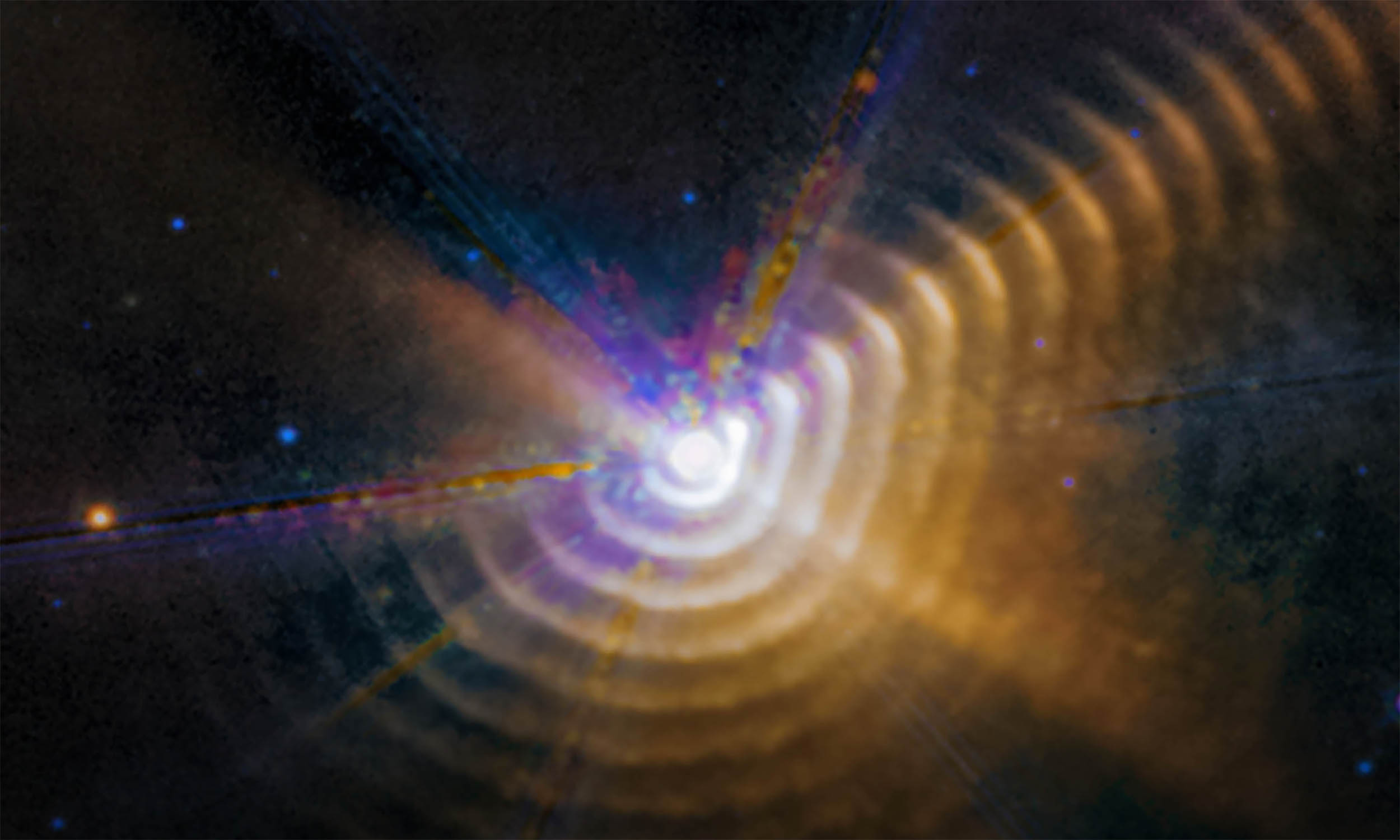
Astronomers have long sought to understand how life-essential elements like carbon spread throughout the universe. Recent observations from NASA’s James Webb Space Telescope have revealed a significant process occurring in a binary star system within our own Milky Way, approximately 5,000 light-years away. In the Wolf-Rayet 140 system, two massive stars orbit each other in elongated paths and come close every eight years. During these encounters, strong stellar winds collide, creating carbon-rich dust.
This dust forms expanding shells that scatter into space, visible in the mid-infrared range captured by the Webb Telescope. Remarkably, these shells expand at a rapid rate of over 1,600 miles per second, highlighting a dynamic process of material distribution. The telescope has identified 17 such dust shells formed over 130 years, and many more are expected as this process continues.
The fate of the central Wolf-Rayet star will influence the future distribution of this carbon dust. It may end in a supernova, scattering the dust further into space, or collapse into a black hole, preserving the dust shells. These scenarios underline the stars’ impact on their surroundings, contributing to the formation of new stars and planets.
The discovery of this carbon dust mechanism provides valuable insight into the origin of cosmic materials. It highlights how binary star systems not only generate essential elements but also actively disperse them across the galaxy, potentially aiding the creation of new planetary systems. This ongoing research aids our understanding of stellar evolution and life’s elemental roots throughout the cosmos.
Original Source: https://www.earth.com/news/webb-telescope-directly-observes-carbon-factories-milky-way-galaxy-wolf-rayet-140/
Category :
Tags:
Publish Date: 2025-01-22 05:12:00