Breaking Discovery: IIA Scientists Unveil Astonishing Emissions from Novae in Andromeda Galaxy

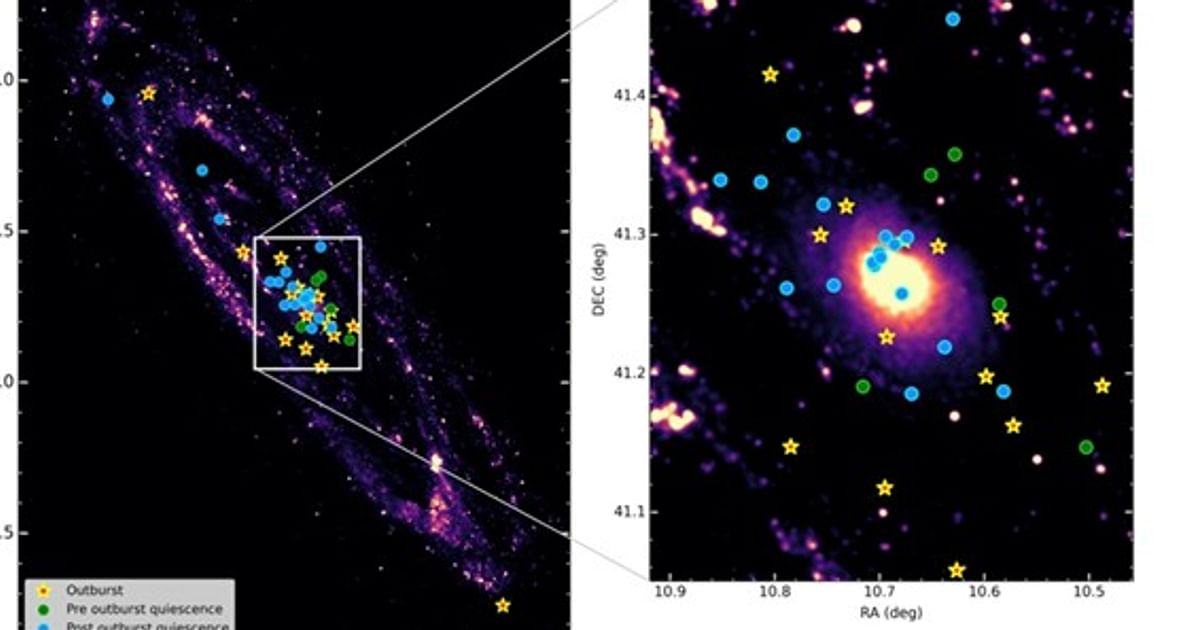
In a groundbreaking achievement, astronomers from the Indian Institute of Astrophysics have successfully detected ultraviolet emissions from novae in the Andromeda Galaxy, marking the first instance of such an observation. This significant discovery was made possible with the assistance of ISRO’s AstroSat, India’s first dedicated multi-wavelength space observatory. The ultraviolet emissions are indicative of nuclear explosions occurring in the Andromeda Galaxy, offering new insights into cosmic events outside our Milky Way.
The detection of these emissions opens a new window into understanding the processes involved in novae, which are powerful astronomical phenomena involving explosive nuclear reactions on the surface of white dwarf stars. Such events are key to comprehending stellar evolution and the lifecycle of stars. The Indian scientists’ discovery contributes to the global astrophysical community’s ongoing efforts to unravel the mysteries of the universe.
AstroSat’s successful capture of these emissions underscores the growing capabilities of India’s space research and technology. This achievement not only highlights the prowess of India’s astronomical research community but also places Indian scientists at the forefront of cosmic exploration.
The observations made with AstroSat in the ultraviolet spectrum are particularly noteworthy as they provide a unique perspective that is not as easily achievable with optical telescopes. As researchers continue to analyze the data, further revelations about the dynamics of novae and the broader implications for galaxy evolution are anticipated. The findings have sparked excitement within the scientific community, offering promising avenues for future research in the field of astrophysics.
Original Source: https://www.deccanherald.com/science/iia-scientists-detect-emissions-from-novae-in-andromeda-galaxy-3310650
Category :
Tags:
Publish Date: 2024-12-10 02:05:00