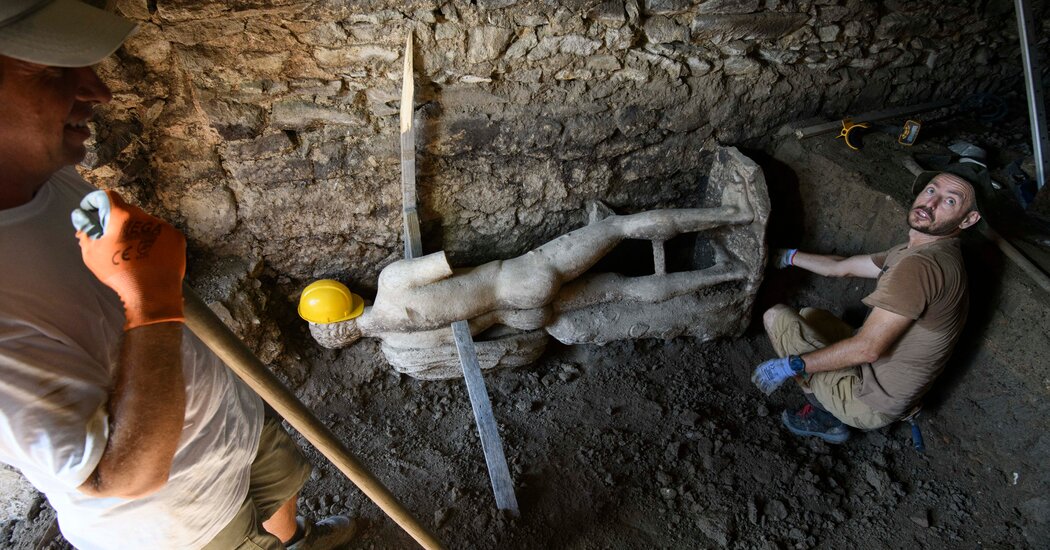

Last week, archaeologists in Bulgaria made a stunning discovery in an ancient Roman sewer: a well-preserved marble statue, taller than a man. Lyudmil Vagalinski, the scientific director of the excavation near the village of Rupite, recounted the thrilling find. The team unearthed the statue gradually, revealing its intricate carvings, from toenails to torso, and finally, its intact head.
Believed to depict the god Hermes, the statue sheds light on attempts by pagans to preserve their deities during the rise of Christianity in the late fourth century. Possibly hidden in 380 A.D., when Emperor Theodosius I made Christianity the Roman Empire’s official religion, it might also be a relic of secrecy following a devastating earthquake in 388 A.D. that left the sewers unused but sturdy.
The statue, though missing parts of its right arm and left hand, is remarkably intact, a rare and high-quality find, according to experts. Its location offers significant insights into Heraclea Sintica, a lesser-known Roman city, challenging assumptions about the artifacts’ origins, often presumed to come from wealthier areas.
Dr. Vagalinski and his team are meticulously extracting the statue, with plans for dating and analysis before its display in a local museum. This extraordinary find not only deepens our understanding of ancient Bulgarian heritage but also illuminates the lengths to which pagans went to protect their religious symbols amidst the rise of Christianity.
Original Story https://www.nytimes.com/2024/07/09/world/europe/bulgaria-statue-roman-sewer-archaeologists.html
Category : Bulgaria,Archaeology and Anthropology,Religion and Belief,Roman Civilization,Christians and Christianity,Pagans and Paganism
Tags: