
Fancy gets the call. Fit closes the deal.
There is a line from a recent founder interview that I intend to quote back to every startup team I mentor this year: “Fancy is getting them into the call but not getting them to convert.”
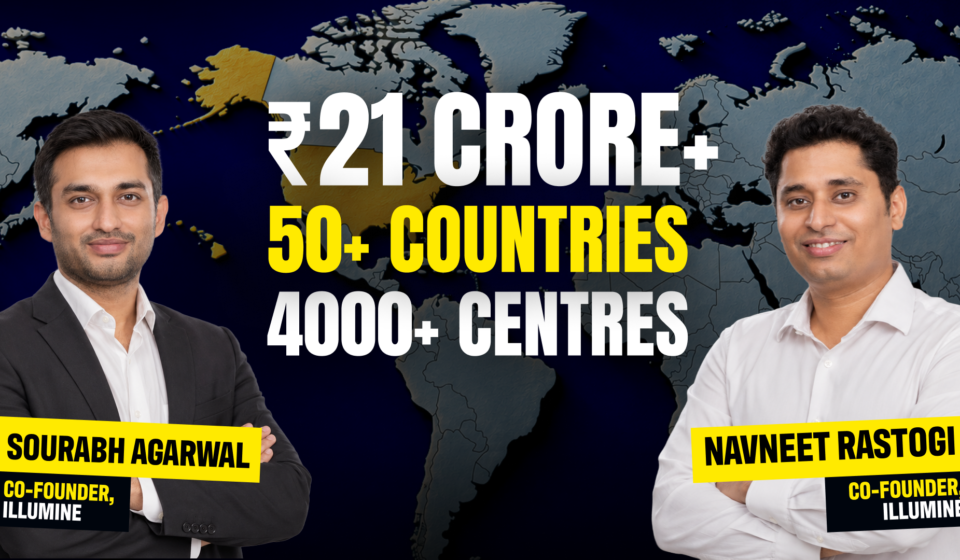
It came from Navneet Rastogi of Illumine, an Indian SaaS platform for preschools and childcare centres that grew from roughly 200 customers to operations in 50+ countries, with the US now a major revenue driver. The company’s journey – a COVID-era near-collapse, a pivot to Middle East markets, and a hard-won US entry – is a masterclass in something I have argued for years: in B2B software, distribution and customer understanding beat feature parity every single time.
The signal buried in the noise
What fascinates me is not the Meta ad numbers – monthly leads jumping from ~20 to 400–500 after the team switched from conversion campaigns to awareness campaigns. That is a useful tactical lesson. The deeper one is why awareness was needed in the first place. Illumine was an unfamiliar Indian company asking US childcare operators to walk away from Procare, a two-decade incumbent. No amount of ad optimisation fixes a credibility gap. You build the funnel only after you build the trust layer.
The moat is customer intelligence, not code
Rastogi’s central claim – that as AI commoditises software development, the durable advantage becomes accumulated understanding of complex workflows – is one I have been making in enterprise architecture circles for some time. Anyone can ship a CRUD app today. Almost nobody can articulate the billing, payroll, occupancy, and regulatory minutiae of a licensed childcare centre in Texas versus Florida. That is domain knowledge earned in the field, not in the IDE.
Their early Meta “failure” was actually a positioning failure. They attracted small home-daycare operators when they wanted established centres – because the features they marketed signalled the wrong buyer. Fixing that required desk research: mapping centres state by state, understanding fee structures and purchasing power. My advice to product teams is blunt: your ICP is not a persona document, it is an operating reality.
AI with the guardrails intact
The most architecturally interesting thread is how Illumine applied AI. Teachers sorting hundreds of photographs to write individual parent updates – three hours a day – collapsed to ten minutes with AI drafting and human approval. Note what they declined: emotion-detection cameras. They drew a line where observation of children belongs to educators, not algorithms. That is precisely the discipline I look for when advising on AI integration. Automate the drudgery; protect the judgment.
The India-built, world-serving playbook
Here is the connect to home. Illumine generates roughly 90% of its US revenue from teams sitting in India – not as a back office, but delivering the actual sales and success conversations, adapted for American consultative buying behaviour. This is the underreported story of Indian SaaS. We are no longer just code shops for the West. We are understanding customers there, hiring domain experts (former centre directors included), and delivering from here. For founders in Guwahati or Kochi: your geography is no longer the constraint. Your customer literacy is.
Takeaways worth pinning
- Awareness is not a soft metric; it is a prerequisite pipeline function for unknown brands.
- Domain depth is the last sustainable moat. Feature parity is table stakes.
- AI should remove toil, not judgment. Write your “what we won’t automate” list before your roadmap.
- India-based teams can own global revenue end-to-end if you invest in cultural fluency, not just delivery bandwidth.
Closing thought
Software is becoming cheap. Understanding people is not. The companies that win the next decade will be the ones that confuse nobody about who they serve – and then serve them obsessively.
About the Author: Sanjeev Sarma is the Founder Director and Chief Software Architect at Webx Technologies. With a core focus on Generative AI integration, Cloud-Native Scalability, and Enterprise Software Architecture, he has spent over two decades driving digital transformation across Northeast India and beyond. Beyond his corporate leadership, Sanjeev is deeply invested in shaping the future of the IT industry. He serves as an Industry Expert on the Board of Studies for Assam Don Bosco University’s School of Technology, advises state technology committees, and actively mentors emerging tech startups at STPI. He brings a unique, dual perspective of high-level enterprise execution and future-ready academic curriculum development.