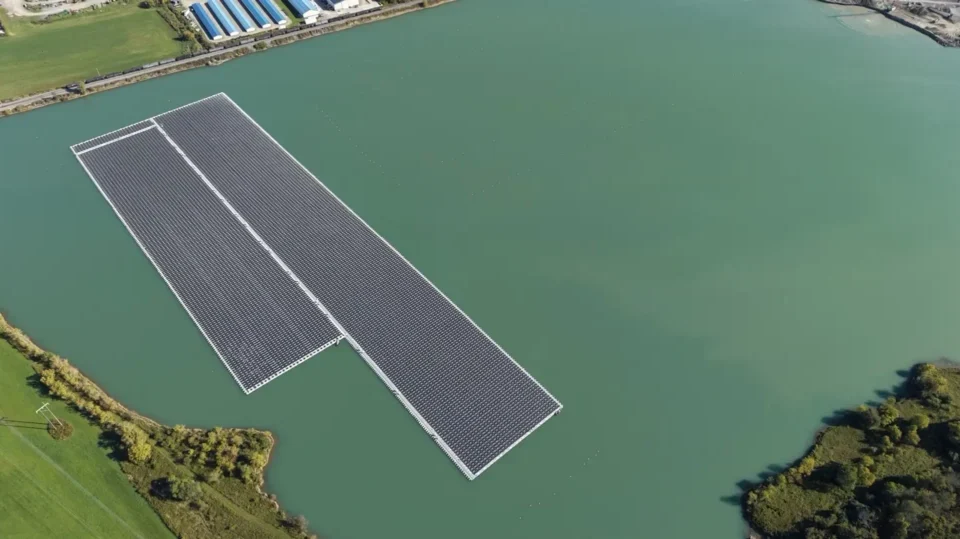
Repurposing Industrial Water: The Strategic Case for Floating Community Solar

Why the Future of Infrastructure-Digital or Physical-Belongs to Dual-Use Architecture
We have a habit in both technology and infrastructure of romanticizing the “greenfield.” Whether it is spinning up a brand-new cloud-native application from scratch or clearing virgin land for a massive solar farm, starting with a blank slate feels clean and frictionless. Yet, the most resilient breakthroughs rarely happen on blank slates; they happen when we engineer new value onto constrained, active environments.
A compelling example of this principle is taking shape in Cortlandville, New York, with the Crown City Solar project. Built on a 120-acre flooded mine pit within an active sand and gravel operation, this 22.5 MW floating community solar complex will soon power roughly 1,500 local subscribers while preserving surrounding farmland. Notably, the project is engineered to endure extreme winter snow loads and even floats its medium-voltage transformers and switchgear on custom barges to improve electrical efficiency and bypass floodplain risks.
The Power of Brownfield Orchestration
As an Enterprise Architect, I see a striking parallel between this physical engineering feat and modern software system design. In enterprise IT, there is always pressure to discard legacy environments in favor of total rewrites. However, true architectural maturity lies in brownfield modernization-building scalable, high-availability services on top of active operational cores without disrupting the primary business.
Just as an active industrial quarry is taking on a second job as a clean power plant, modern enterprises must learn to layer AI, real-time analytics, and API-driven microservices onto existing legacy backbones. The goal is not to tear down what already works, but to unlock dormant capacity within it.
Designing for the Edge and the Extreme
Equally fascinating is the decision to float the transformers and switchgear directly alongside the solar panels. In software terms, that is edge computing. Instead of hauling raw, low-efficiency power across vulnerable floodplains to a distant substation, the architecture processes and steps up the energy right where it is generated.
Furthermore, engineering for a 69-pound-per-square-foot snow load mirrors the discipline of chaos engineering-designing systems not for ideal lab conditions, but for the harshest possible production realities. Of course, orchestrating a community solar grid from a dynamic, floating platform also underscores the silent backbone of modern clean tech: cloud-native telemetry, IoT sensors, and predictive maintenance software working in lockstep to keep distributed assets stable.
A Blueprint for Land-Constrained Geographies
This dual-use mindset holds profound relevance for regions like Northeast India. Across our hills and valleys, we face a delicate balancing act: we need rapid energy and digital expansion, yet we must fiercely protect our agricultural land and forest cover from sprawling infrastructure-all while navigating intense monsoon floodplains.
Rather than viewing flooded quarries, reservoirs, or industrial water bodies as dead zones, treating them as dual-use energy assets offers a sustainable path forward. It echoes the exact philosophy behind India’s Digital Public Infrastructure (DPI): instead of building expensive, land-heavy physical branches in every village, we layered scalable digital rails onto existing mobile networks.
Strategic Takeaways for Builders and Leaders
- Optimize for Brownfield Leverage: Before demanding a blank slate, ask how new capabilities can be layered onto existing operational assets without halting production.
- Push Processing to the Edge: Whether it is electrical conversion on water or AI inference on local devices, reducing the distance between generation and transformation minimizes loss and latency.
- Architect for Worst-Case Conditions: Resilience is not an afterthought; it must be baked into the foundational tolerances of your system.
- Protect Scarce Resources: The smartest architectures solve a problem without creating a new deficit-whether that deficit is farmland, capital, or technical debt.
Ultimately, the next decade of innovation won’t be defined by how much new territory we claim, but by how intelligently we reimagine the spaces and systems we already have.
About the Author: Sanjeev Sarma is the Founder Director and Chief Software Architect at Webx Technologies. With a core focus on Generative AI integration, Cloud-Native Scalability, and Enterprise Software Architecture, he has spent over two decades driving digital transformation across Northeast India and beyond. Beyond his corporate leadership, Sanjeev is deeply invested in shaping the future of the IT industry. He serves as an Industry Expert on the Board of Studies for Assam Don Bosco University’s School of Technology, advises state technology committees, and actively mentors emerging tech startups at STPI. He brings a unique, dual perspective of high-level enterprise execution and future-ready academic curriculum development.