The Commercial Filter: What Ports Reveal About Hydrogen’s Limits

Technical Possibility Isn’t a Business Case: What California’s Ports Teach Us About Infrastructure Bets
There is a trap I have watched countless technology programmes fall into over two decades. We confuse “it works in the demo” with “the market will use it.” A pilot succeeds, a press release follows, and then the platform waits years for users who never arrive.
A recent development in maritime energy illustrates this trap more clearly than most software case studies.
The Signal from San Pedro Bay
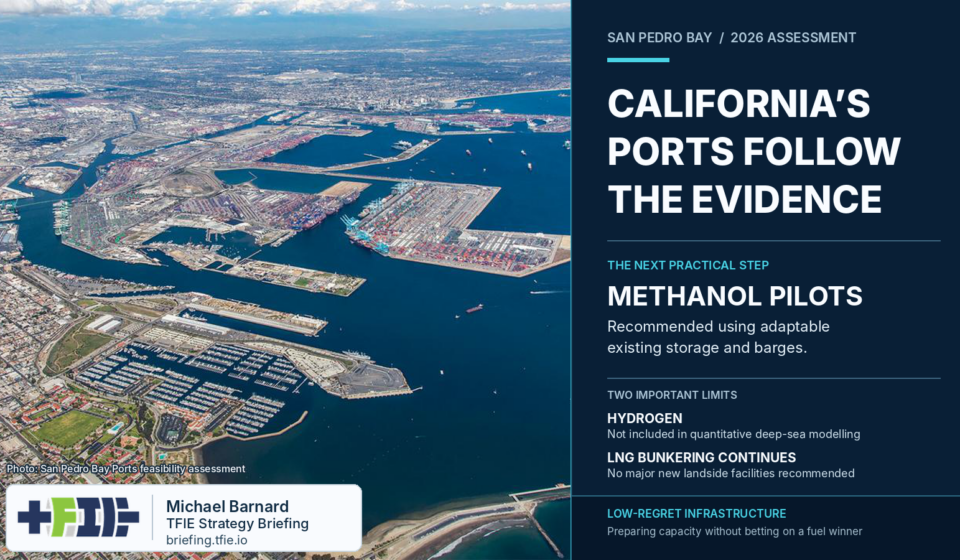
The Ports of Los Angeles and Long Beach released a Clean Marine Fuel Feasibility Assessment. It recommends methanol bunkering demonstrations, continued use of existing LNG ship-to-ship arrangements, and no major new fuel terminals until demand becomes credible. Hydrogen, despite two decades of enthusiastic California state support, did not make the cut for detailed deep-sea planning.
The study surveyed 38 shipping lines and received 19 responses. Nine showed interest in methanol. Only one showed interest in hydrogen.
Demand Is an Architectural Input, Not an Afterthought
What strikes me is not the fuel choice itself. It is the decision filter. Two commercially accountable institutions asked a simple question: what will our customers actually use, and what infrastructure must we provide to serve them?
In enterprise architecture, we call this designing for real load rather than imagined load. I have seen state-level e-governance platforms built for millions of hypothetical users while the actual citizen workflow remained paper-bound. The infrastructure was technically excellent and commercially orphaned.
Methanol won largely on compatibility. It is a liquid at ordinary conditions and fits into a mature global chemical-handling ecosystem. Existing storage and bunkering equipment can be adapted. Hydrogen, by contrast, demands an entirely new cryogenic or high-pressure network spanning production, transport, storage, and onboard systems.
That is the classic greenfield-versus-brownfield trade-off. The option that integrates with existing “legacy” systems usually beats the theoretically superior option that requires rebuilding the whole stack. Long Beach’s $1 million incentive for an initial commercial-scale methanol bunkering operation is the equivalent of a well-scoped proof of value. It tests feasibility without committing to a monolithic, irreversible build.
Don’t Mistake Delivery Metrics for Outcomes
The source analysis raises a caveat that every CTO should note. Methanol is not inherently green. It can be made from natural gas, coal, biomass, or renewable electricity, and those pathways have radically different emissions profiles. The ports could build a flawless bunkering service and still achieve little decarbonisation if the fuel is fossil-based.
This mirrors a failure mode I see constantly in digital transformation. We measure “systems deployed” instead of “outcomes delivered.” Bunkering readiness is an output. Verified lifecycle emissions reduction is the outcome. Architects must design the measurement layer alongside the delivery layer, not bolt it on later.
I also admire something in the original analysis: the author openly revised his own earlier shipping-fuel forecast. He now gives more weight to batteries for short-sea routes and biomethanol for deep-sea routes. Willingness to update one’s model is a rare and underrated leadership trait.
A Lesson Closer to Home
India is investing heavily in green hydrogen through its National Green Hydrogen Mission, and our ports are positioning themselves as future hubs. The ambition is right. The California lesson is to sequence it carefully, guided by offtake demand rather than enthusiasm.
For Assam, the parallel is even more direct. The analysis suggests electricity is best suited to inland and short-sea shipping. The Brahmaputra waterway, with its ferries and short-haul cargo routes, is precisely where electrification and frugal, modular charging infrastructure could leapfrog complex fuel networks altogether.
Strategic Takeaways
- Let validated demand gate capital. Surveys of intent are signals. Binding commitments are a business case.
- Favour ecosystem compatibility. The solution that plugs into existing infrastructure scales faster than the elegant rebuild.
- Pilot before you pour concrete. Incentivised demonstrations de-risk decisions without locking in architectural debt.
- Instrument outcomes, not just deployments. Readiness is meaningless without verified impact.
- Update your models publicly. Intellectual honesty compounds over time.
Closing Thought
The future rarely belongs to the most celebrated technology. It belongs to the one that fits the world as it actually is, and then quietly changes it.
About the Author: Sanjeev Sarma is the Founder Director and Chief Software Architect at Webx Technologies. With a core focus on Generative AI integration, Cloud-Native Scalability, and Enterprise Software Architecture, he has spent over two decades driving digital transformation across Northeast India and beyond. Beyond his corporate leadership, Sanjeev is deeply invested in shaping the future of the IT industry. He serves as an Industry Expert on the Board of Studies for Assam Don Bosco University’s School of Technology, advises state technology committees, and actively mentors emerging tech startups at STPI. He brings a unique, dual perspective of high-level enterprise execution and future-ready academic curriculum development.